Federal hurricane recovery grants flowing into Florida over the past 90 days total just $30.2 million, a figure that looks like a 98% collapse from the same window a year ago. The collapse is a statistical artifact, but the crisis underneath it is real.
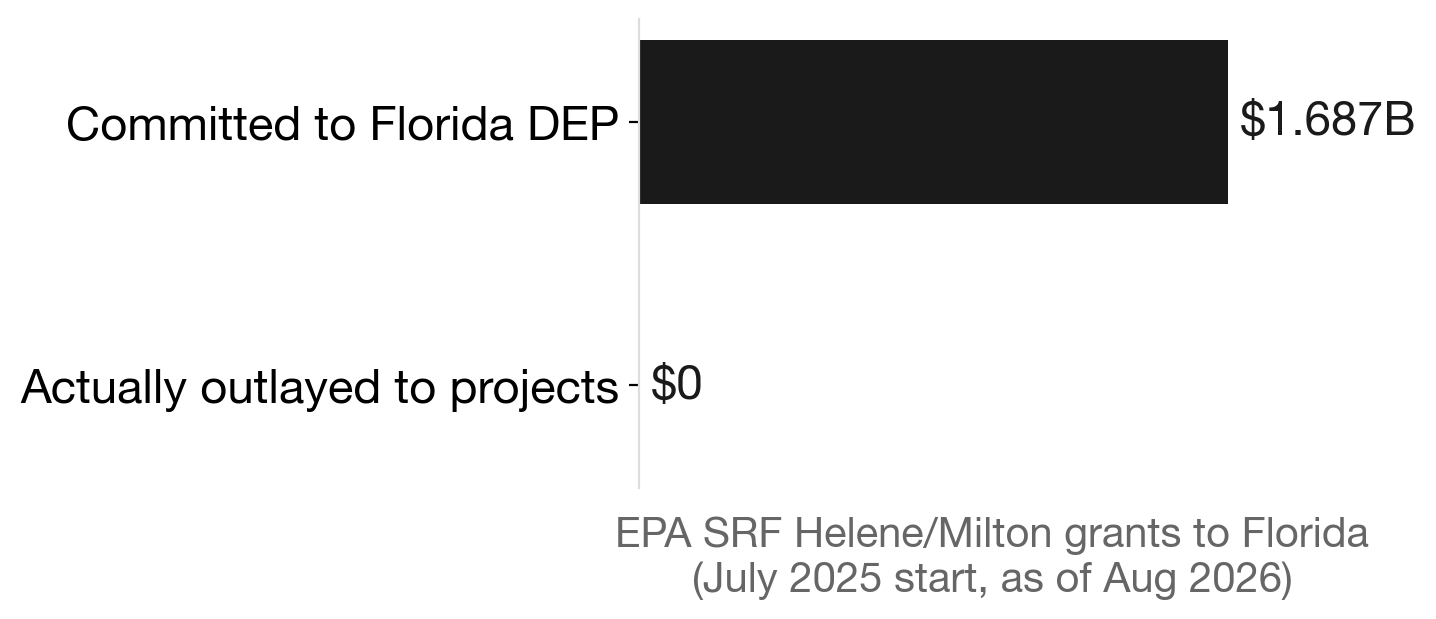
The year-ago comparator is dominated by a single event: the American Relief Act of 2025, signed December 21, 2024, directed $1.687 billion in EPA State Revolving Fund capitalization grants to Florida's Department of Environmental Protection for water-infrastructure resiliency after Hurricanes Helene and Milton. That is the largest single-state SRF disaster allocation in the program's history, surpassing North Carolina's $761 million for the same storms. All three grants, covering drinking water, clean water, and decentralized wastewater systems, carry a July 2025 start date. Total outlayed to any project as of August 2026: $0.
Florida DEP only signed its first loan agreement under the program on July 1, 2026, according to an EPA press release issued that day. The SRF model works differently from a direct grant: the federal capitalization money flows to a state revolving loan fund, and actual project dollars move only when a local utility or water authority executes a loan agreement with DEP and begins drawing on it. That multi-step process means the disbursement clock barely started last month, with a December 2031 deadline to spend the funds.
Source: NationGraph.
The practical effect is that $1.687 billion in committed disaster recovery money sits in Tallahassee waiting for local water systems to navigate an application and loan-execution pipeline. The money is real and will eventually reach projects. But communities whose water infrastructure was damaged or stressed by Helene and Milton are, more than a year after those storms, still waiting.
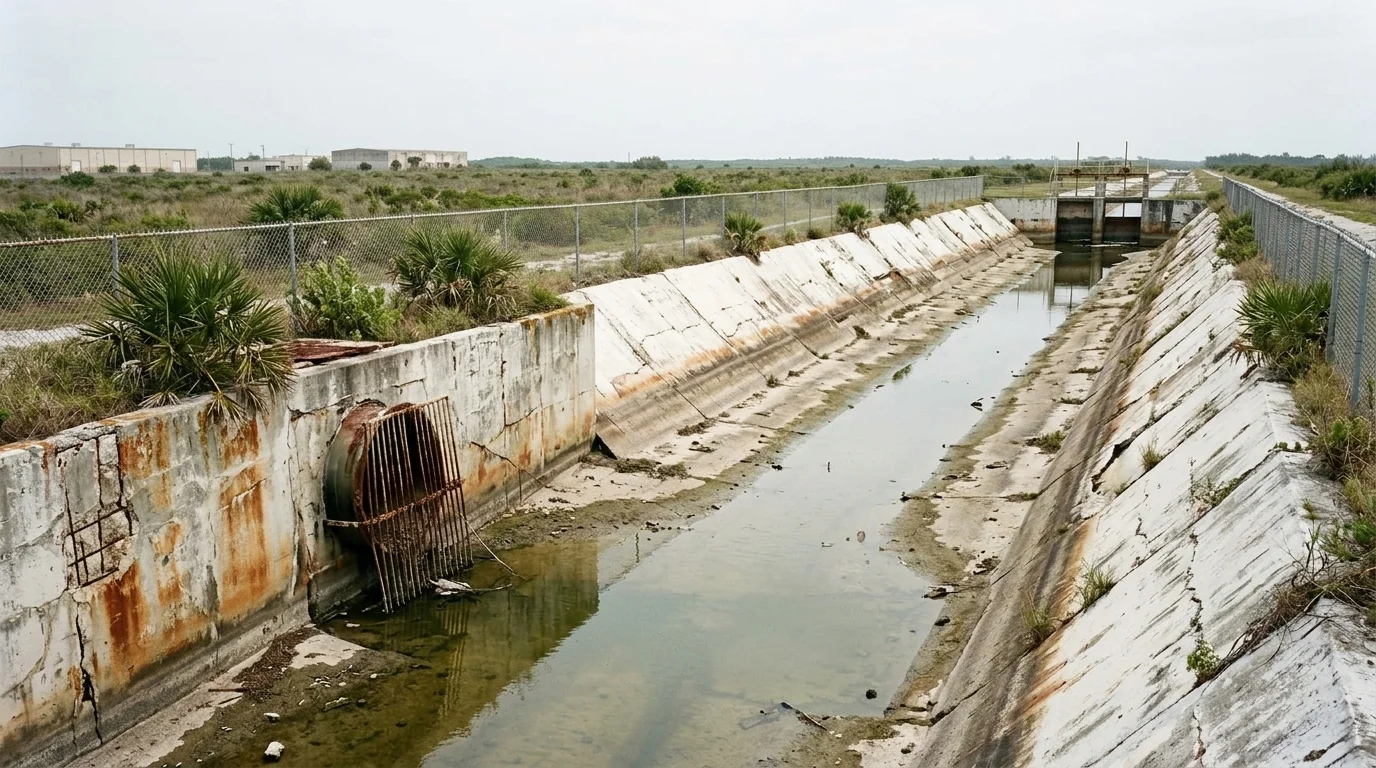
While that pipeline inches forward, a separate federal program, the one designed to prevent the next storm from causing the same damage, has been shut down permanently. FEMA Director Cameron Hamilton terminated the Building Resilient Infrastructure and Communities program in April 2025, canceling $293 million of Florida's approved pre-disaster resilience grants. Florida had drawn only $19 million of those funds, roughly 6 percent, before the cancellation. The projects that died with BRIC include road-elevation work in Jacksonville and St. Augustine, a hardened first-responder safe room in Key West, and approximately $150 million in canal-hardening work managed by the South Florida Water Management District, the agency with the most exposure in the canceled portfolio.
A federal court declared the BRIC termination unlawful in December 2025, but the program remains frozen. Florida has not joined the multi-state legal challenge to the cancellation. Governor DeSantis has publicly aligned with the Trump administration's broader FEMA restructuring, a political posture that leaves the state without leverage to contest either the BRIC freeze or the slow pace of SRF drawdowns at the federal level.
The only meaningful new money arriving in the current 90-day window is a $29.4 million USDA Emergency Watershed Protection grant to Pinellas County for Hurricane Milton creek stabilization, a legitimate and significant award that accounts for nearly all of the $30.2 million in recent federal activity. Pinellas County's creek stabilization work is one of the few active disbursements in a recovery portfolio that looks robust on paper and sluggish in practice.
Across Florida's full active hurricane grant portfolio, roughly $2.06 billion is obligated across EPA, DOT, USDA, HHS, and NSF. Of that, approximately $173 million has actually been paid out. The most-disbursed segment is DOT transit recovery, with $165 million of $210 million obligated already outlayed, a reflection of how much faster direct-grant transit programs move compared to the SRF loan model.
For Floridians, the picture that emerges is a state that absorbed two major hurricanes in the same season, secured a historic federal commitment to fix its water infrastructure, and is now watching both the disbursement timeline and the pre-disaster hardening pipeline stall simultaneously. The govtech.com account of the BRIC cancellation documented the specific local projects that lost funding, and in each case, those projects had already gone through FEMA's competitive review and received conditional approval before the program was terminated.
The next signals to watch are the pace of SRF loan agreements executed by Florida DEP through the fall, the federal court proceedings on BRIC's legal status, and whether the 2026-2027 state budget, which already ended Florida's own Hurricane Restoration Reimbursement Grant Program for Ian and Nicole beach erosion on June 30, creates any replacement mechanism for pre-disaster hardening. Hurricane season runs through November.