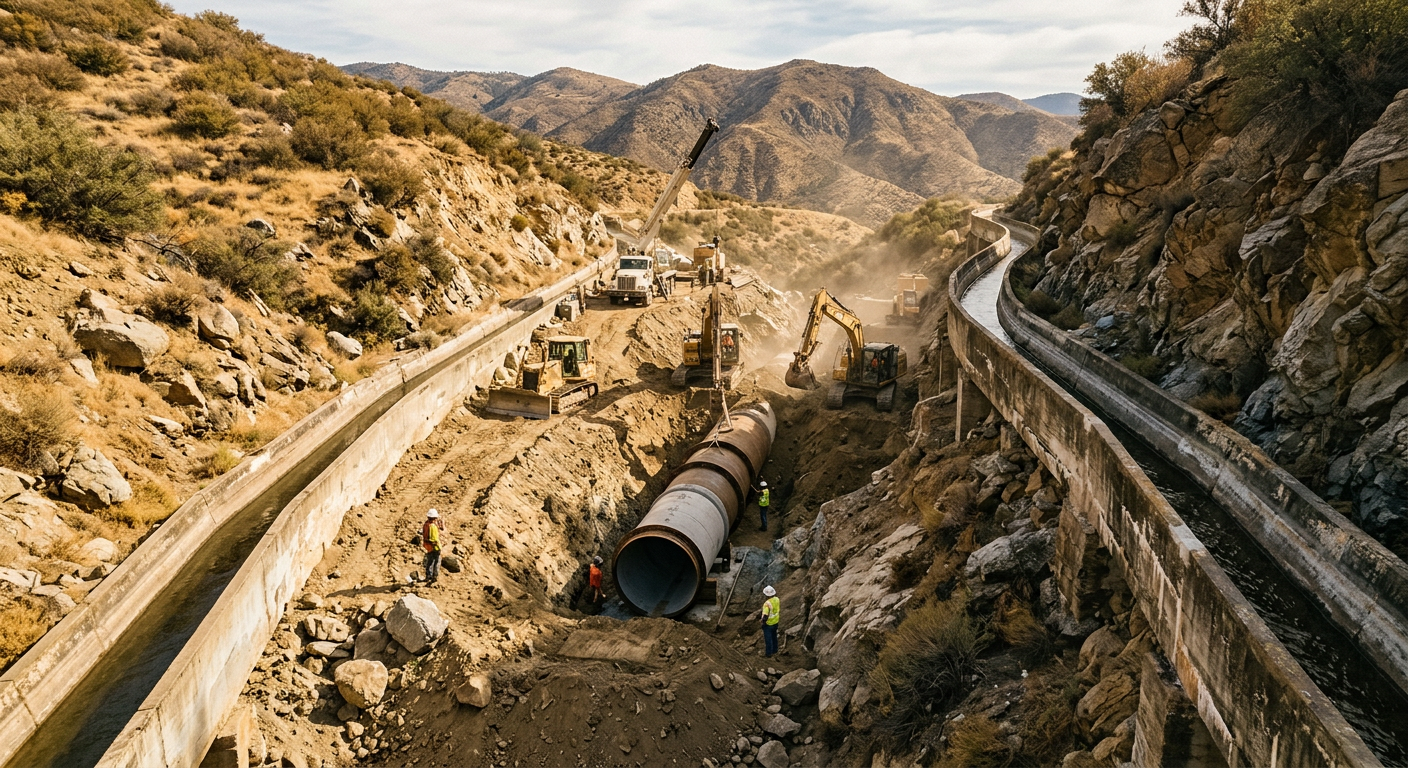
New York issued 17 broadband-related RFPs in the last 30 days, against a trailing 12-month average of roughly 5 per month. That 3.3x spike is not the result of a single large project breaking into pieces. It is the sound of an entire funding cascade, years in the making, finally hitting an immovable construction deadline.
The deadline is December 31, 2026. Under the U.S. Treasury's Capital Projects Fund rules, any infrastructure backed by ConnectALL's Municipal Infrastructure Program must be substantially complete by that date. Counties that miss it risk forfeiting their awards. With roughly seven months left, procurement boards from the Finger Lakes to the Capital Region are doing the only rational thing: bidding everything at once.
The deeper cause is a multi-year funding approval process that finally cleared its last federal gate at the end of 2025. NTIA approved New York's BEAD Final Proposal on December 4, 2025, and NIST signed off on January 16, 2026, collectively unlocking $664.6 million in federal BEAD funds. Then, on April 27, Governor Hochul, Senators Schumer and Gillibrand, and Representative Tonko announced $542 million in provisional BEAD deployment awards to nine ISPs targeting 58,617 unserved homes and businesses. Years of applications, environmental reviews, and federal back-and-forth compressed into a single construction mandate: build now.

Source: NationGraph.
Empire State Development is the most visible actor in the current surge. The agency issued three RFPs in the last 30 days, including live construction bids for the Excelsior Broadband Network fiber corridor running from Syracuse to Buffalo along the New York Thruway, with a key RFQ due June 12. The EBN is the single largest state-owned infrastructure project in the current wave, a public fiber backbone designed to anchor connectivity for the communities that private ISPs have historically passed over.
Rural counties are generating the rest of the volume, and their bids tell a clear story. Livingston County alone accounts for six RFPs in the window, with Wayne and Saratoga Springs each contributing three. The procurement titles span construction materials, legal services, project management, and partnership agreements. That mix is the profile of a local government standing up broadband construction capacity from scratch, not a jurisdiction making incremental upgrades to existing infrastructure.
New York's 17 RFPs in 30 days more than double Pennsylvania's count of eight for the same period, and dwarf Massachusetts at seven, New Jersey at four, and Connecticut at one. Part of that gap reflects New York's structural complexity: dense urban cores, sprawling upstate rural counties, and sovereign tribal lands all require different infrastructure models, and the state's ConnectALL initiative has been designed to address all of them simultaneously. But the gap with neighboring states also reflects that New York's Treasury deadline exposure is higher. The ConnectALL MIP has already awarded between $268 million and $308 million across 24 counties, enabling an estimated 2,300 to 2,400 miles of new fiber and more than 68 wireless hubs. Every one of those projects has December 31 hanging over it.
The urgency is compounded by a separate policy layer. New York's January 2025 affordable broadband law requires large ISPs to offer $15 to $20 monthly tiers to qualifying households. That provision creates demand-side pressure that only matters if the infrastructure is actually built, giving both state officials and ISPs a second reason to treat the construction deadline as real.
For residents of the counties currently issuing bids, the practical meaning is straightforward: contractors are being selected now for projects that will be underway this summer and fall. Livingston, Wayne, and Saratoga Springs are not planning broadband; they are buying materials and hiring project managers. Whether those projects finish on time will depend on contractor capacity, supply chain conditions, and how cleanly the counties can move from award to ground-breaking. The December 31 deadline does not flex.
The BEAD-funded ISP projects operate on a longer runway, with construction expected to continue through 2030. That two-tier structure means the current procurement surge is specifically the Treasury-deadline tier doing its work. The BEAD tier will produce a slower, steadier procurement signal over the next several years.
The next signal to watch is the June 12 EBN RFQ deadline. If Empire State Development awards that contract on schedule, the Syracuse-to-Buffalo corridor moves into active construction before the end of summer. If it slips, the timeline pressure for the state's flagship public fiber project tightens considerably.