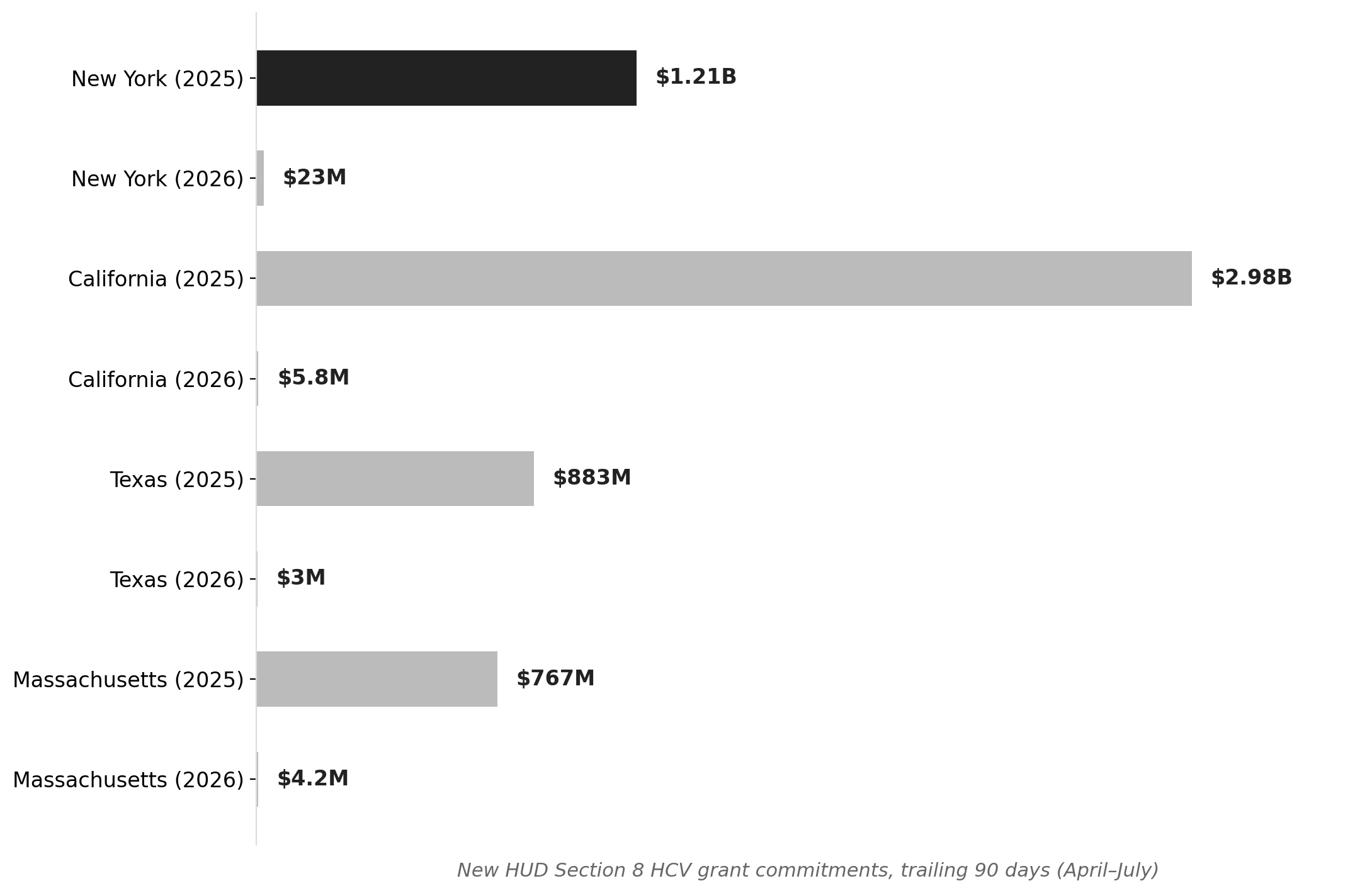
New federal commitments to fund Section 8 Housing Choice Vouchers in New York have collapsed to $23 million in the trailing 90 days, down from $1.21 billion in the same April-to-July window one year ago. That is a 98% drop. NYCHA's 96,000 voucher holders are still receiving rent assistance this month, but the federal machinery that creates new multi-year grant commitments, the mechanism by which the program is renewed and expanded, has nearly stopped issuing new awards.
The collapse is not a New York anomaly. California fell from $2.98 billion to $5.8 million in the same comparison. Texas dropped from $883 million to $3 million. Massachusetts went from $767 million to $4.2 million. Whatever is breaking is breaking everywhere at once.
Three simultaneous federal shocks explain why. HUD has been operating under continuing resolutions since the start of FY2026, with no enacted appropriations bill, leaving new grant starts in legal and administrative limbo. At the same time, DOGE-driven workforce reductions cut HUD's headcount by roughly 23%, impairing the agency's capacity to process new awards, according to the National Low Income Housing Coalition. And in March 2025, HUD terminated the Emergency Housing Voucher program, which was funded by the American Rescue Plan and had supplied a meaningful share of recent new issuances. NYCHA responded by pausing all new voucher issuances from the general HCV waitlist beginning August 2025, a pause that remains in effect.
Source: NationGraph.
Layered on top of these operational disruptions is a strategic one. The Trump administration's FY2026 budget proposed eliminating the Housing Choice Voucher program entirely, replacing it with a state block grant alongside a $26.7 billion cut to federal rental aid. Congress has not enacted that proposal, but it has produced what housing policy analysts describe as planning paralysis at local public housing authorities, which cannot commit to multi-year renewals when the program's legal structure is openly in question.
The prior-year comparison illustrates just how much pipeline activity has stalled. In spring 2025, three New York entities alone anchored more than $950 million in new commitments: the Housing Trust Fund Corporation took $368 million, the NYC Department of Transportation received $299 million, and NYCHA secured $287 million. Those multi-year awards are still running. NYCHA holds roughly $205 million in currently active HCV grants; the Port Authority holds a $451 million active award. Existing commitments are paying rent today. What has stopped is the issuance of the next round of commitments, the ones that would fund 2027 and beyond.
For NYCHA, which expects Section 8 funds to comprise 43 to 48 percent of its total revenue, the distinction between "currently funded" and "renewal pipeline intact" is not abstract. The authority receives approximately $200 million per month from HUD to administer the nation's largest Section 8 program. The Emergency Housing Voucher funding that has been running down since March 2025 is expected to run out entirely by late 2026, affecting an estimated 5,500 NYC households. According to a New York State Comptroller analysis, NYCHA's financial exposure to federal policy shifts is among the most acute of any housing authority in the country.
The demand side of this equation makes the pipeline freeze particularly consequential in New York. When NYCHA briefly reopened its HCV waitlist in summer 2024, more than 600,000 households applied; roughly 200,000 were added by lottery. The rental market those households face has no affordable slack. Any sustained contraction in the rate of new voucher issuances translates directly into displacement pressure in a city where below-market units do not exist at sufficient scale to absorb it.
The Center on Budget and Policy Priorities has estimated that even the more generous Senate FY2026 HUD funding proposal, if enacted at flat levels, could result in 250,000 fewer Section 8 recipients nationally compared to current enrollment. New York, as the program's largest single jurisdiction, would absorb a disproportionate share of any such reduction.
What to watch: Congress is expected to resume appropriations negotiations in late summer 2026, and any enacted FY2026 HUD spending bill would restart the legal authority for new grant awards. A continuing resolution that carries into FY2027 without an enacted budget would extend the current freeze. NYCHA has not announced a timeline for resuming general waitlist voucher issuances, and HUD has not signaled when its grant-processing capacity will return to pre-DOGE levels. The 96,000 families currently housed are not immediately at risk. The question is whether the pipeline that would house the next 96,000 will exist by the time it is needed.