
Thirty-one Georgia institutions issued a stormwater management RFP for the first time in over a year during the past 30 days, a spike that lands with too much precision to be seasonal noise. From November 2025 through April 2026, the monthly count of new stormwater procurements held between 10 and 24 institutions. In May, it jumped to 33. The force behind it is a single date: June 15, the annual reporting deadline baked into Georgia EPD's Phase I Large MS4 NPDES permits, which were reissued on June 5, 2024 and cover 44 of the state's largest stormwater systems.
Two years into that permit cycle, the first full compliance accounting is now due. Permit holders who let their contracted stormwater programs go quiet during the intervening period are scrambling to get engineers, maintenance crews, and inspection services under contract before EPD asks to see the paperwork.
The breadth of the procurement wave is striking. The 31 first-timers include 18 cities and municipalities, 7 counties, two water and sewer authorities, two school districts, and two state agencies, spread across coastal, suburban, and rural Georgia. Gwinnett, Cobb, Chatham, Camden, Glynn, Paulding, and Washington counties are all in the mix alongside cities as varied as Tybee Island, Newnan, Cartersville, Sandy Springs, and Baxley.
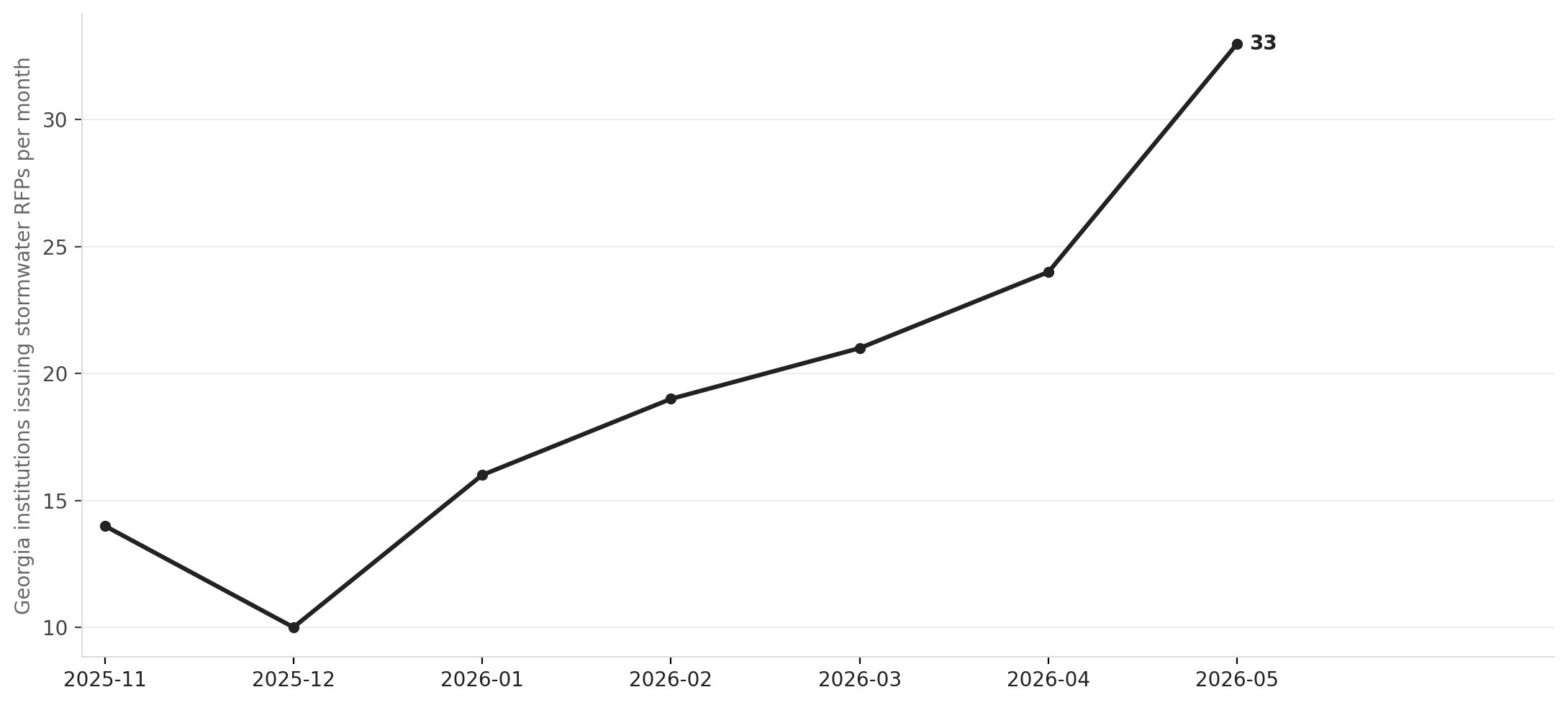
Source: NationGraph.
Tucker, a DeKalb County city of roughly 35,000 residents, illustrates the dynamic at its most compressed. Tucker posted five separate stormwater RFPs inside a single month: on-call maintenance, system repairs, conduit work, and daily operations. That is not one department filling a gap; that is a municipality rebuilding a stormwater program from the ground up on a deadline. DeKalb County itself, one of the original Phase I Large MS4 permit holders, filed a comprehensive Stormwater Management Plan update with Georgia EPD in December 2024, signaling that even established programs are recalibrating to the reissued permit terms.
The permit deadline alone would explain urgency. But Georgia's ongoing $26.3 billion construction boom is adding a second pressure. The state recorded 423 major facility expansions and new locations in the past year, each one generating new impervious surface and triggering its own NPDES construction permit obligations under the 2023-reissued general permits (GAR100001 through GAR100003). New EPD guidance has also tightened the impervious-area calculation for solar farms to a 70 percent threshold, pulling industrial sites into compliance conversations they were not expecting. Every new rooftop, parking lot, and solar array adds runoff load to municipal systems that were already sized for smaller cities.
Atlanta's own green infrastructure mandate, which requires new developments to manage the first inch of rainfall on site, layers a municipal standard on top of the state and federal requirements. Other Georgia municipalities are watching Atlanta's enforcement posture and adjusting their own programs accordingly.
Federal dollars are arriving to help absorb the cost. The EPA committed $3.45 million to Roswell effective June 1, 2026, and $3 million to Savannah effective April 2026, in congressionally mandated stormwater grants. The Georgia Environmental Finance Authority is carrying an additional $3.7 million in active EPA Sewer Overflow and Stormwater Reuse grants running through 2028 and 2029. That funding provides the financial justification local budget offices need to authorize new contractor spend quickly, which may help explain why the procurement response has been so synchronized.
For residents, the practical consequence is more visible stormwater infrastructure activity across the state through summer and fall: pipe inspections, catch-basin cleanouts, illicit discharge investigations, and green infrastructure installations in newer subdivisions. Communities with active contracts will be better positioned for the next permit renewal cycle; those that do not complete procurements before EPD's reporting window closes will face the next annual report without documented program support.
The next signal to watch is how many of the 31 new entrants successfully award contracts before the June 15 deadline and whether EPD signals any enforcement posture toward permit holders who cannot demonstrate active programs in their annual reports. If the agency tightens that posture, the June spike may look modest compared to what procurement volumes do in the same window next year.