Wisconsin issued 16 lead pipe replacement RFPs in the 30 days ending May 25, 2026, against a trailing 12-month average of roughly 2.4 per month. That 6.6x spike has a single timestamp: May 20, the day the EPA announced a $94.3M Drinking Water State Revolving Fund award for Wisconsin. Eleven of the 16 contracts came from Milwaukee's Public Works Department within 96 hours of that announcement.
The procurement surge is not routine budget cycling. It is the signature of a city, and a state, racing to lock in work before two clocks run out simultaneously.
The first clock is legislative. The Bipartisan Infrastructure Law's annual capitalization grants to state revolving funds are in their final cycle. FFY 2026 is the last guaranteed allocation year, and the September end-of-fiscal-year application deadline is the practical cutoff for communities that want a piece of the current tranche. Wisconsin's DNR has $578M obligated across 30 active federal drinking water grants dating to 2021, but only $211M of that has been outlayed, meaning the majority of committed money has not yet been converted into finished pipe replacements. The window to spend it is real but bounded.
Source: NationGraph.
The second clock is political. The Trump White House's FY2027 budget proposes a 90% cut to state revolving loan funds, the primary federal delivery mechanism for lead pipe replacement dollars nationwide. As Wisconsin Independent reported, the Biden-era funding stream is set to expire this year, and no comparable successor program exists. The $94.3M announced May 20 arrived, in other words, alongside a credible threat that it may be among the last checks of its kind.
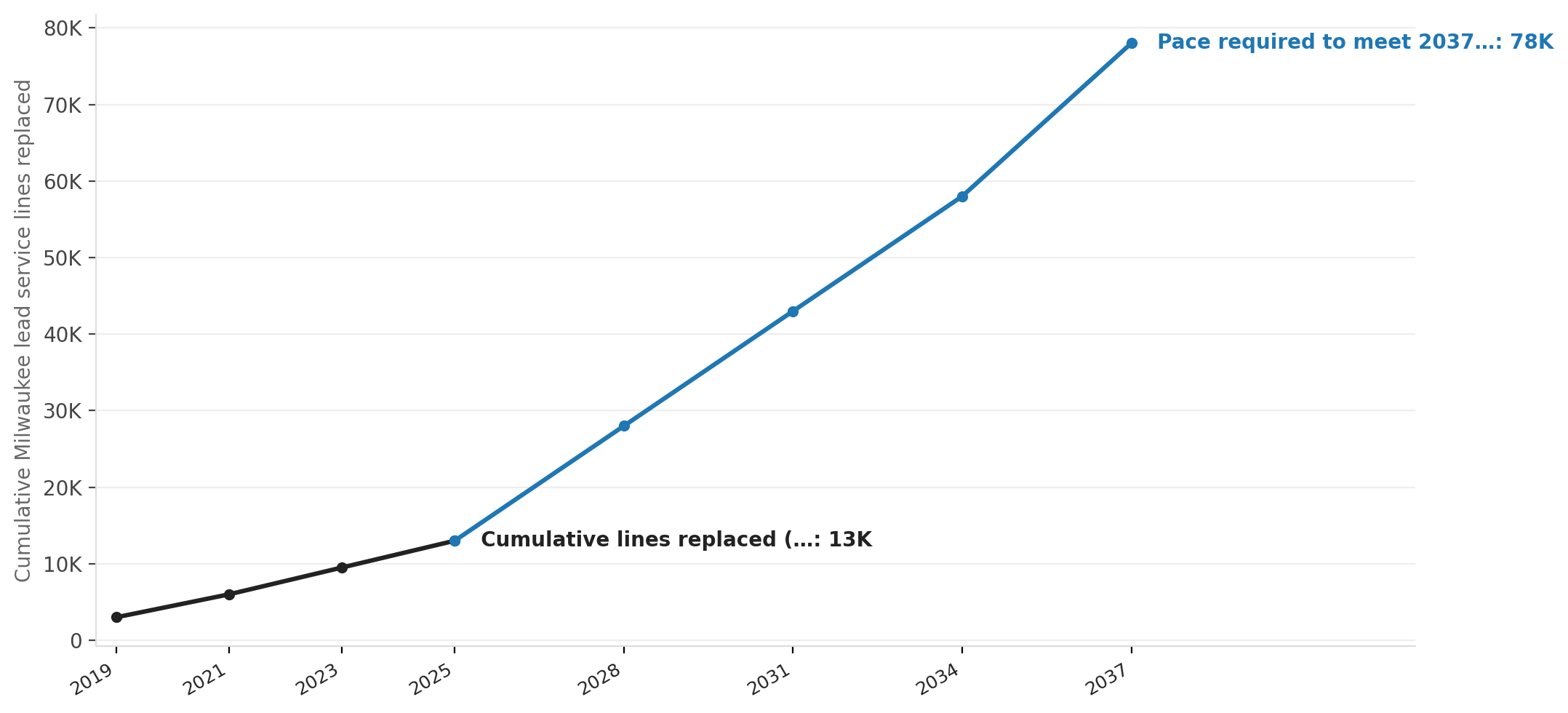
Milwaukee's response to that collision was immediate and specific. The city's batch RFPs cover contracts for 200, 500, 750, and 1,000 service line replacements under its Prioritization Program, a structure designed to keep multiple contractor pools active and avoid the bottleneck of a single mega-contract. Mayor Cavalier Johnson has said Milwaukee holds roughly half the state's estimated 343,000-plus remaining lead service lines. Water Works Superintendent Patrick Pauly has been direct about the math: without continued federal support, the city cannot meet the EPA's 2037 full-replacement mandate and would need to reinstate cost-sharing burdens on property owners. At Milwaukee's current pace of roughly 5,000 replacements per year, finishing 65,000 remaining lines by 2037 carries a price tag of approximately $650M.
The five remaining RFPs in the 30-day window came from Cudahy, Beaver Dam, and Superior, mid-size cities that received portions of the $159M Governor Evers and the DNR directed to 29 municipalities in December 2025. Their participation suggests the urgency is not limited to the state's largest city, even if Milwaukee's volume dominates the procurement picture.
The public health stakes behind the contracting activity are not abstract. Nearly 1-in-20 children under six tested in Wisconsin in 2024 showed lead poisoning. In some Milwaukee neighborhoods, the rate runs close to 20 percent. Wisconsin tightened its own regulatory floor in January 2025, lowering the lead poisoning threshold from 5 to 3.5 micrograms per deciliter, a move that increases the number of children who formally qualify as poisoned even as federal funding faces its sharpest political challenge in years.
The EPA has told a federal appeals court it intends to defend the 2037 replacement deadline. That commitment matters because it preserves the legal obligation that gives every dollar urgency. A mandate without funding creates liability; funding without a mandate creates optional progress. Right now Wisconsin has both, but only one of them looks durable past 2026.
For residents in Milwaukee, Cudahy, Beaver Dam, and Superior, the near-term signal to watch is contractor response to the open RFPs. A robust bidding market means work starts quickly; a thin one, caused by labor shortages or material supply constraints, could leave obligated federal dollars sitting idle past the application window. The DNR has noted that reallocated dollars from low-demand states could extend activity into 2027 and 2028, which provides a limited buffer. But the procurement burst of the last 30 days reflects what municipal engineers already know: the safest moment to move on federal infrastructure money is the moment it is announced, not the moment it might be cut.