Federal electric vehicle grants flowing into Florida have hit $53.4 million in the last 90 days, a 61% jump over the same window a year ago, and almost none of it is going toward the highway charging stations that dominate the political debate over EVs. It is going to the cargo docks.
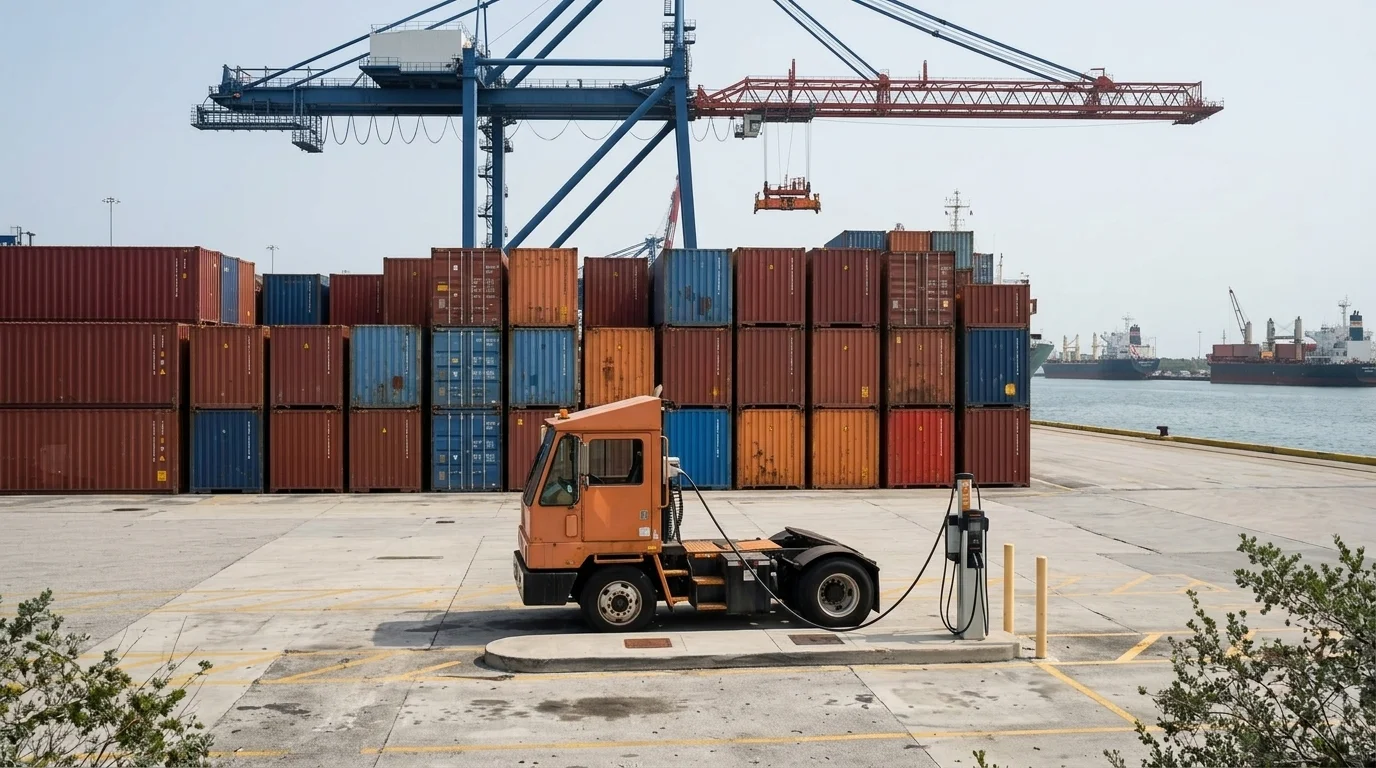
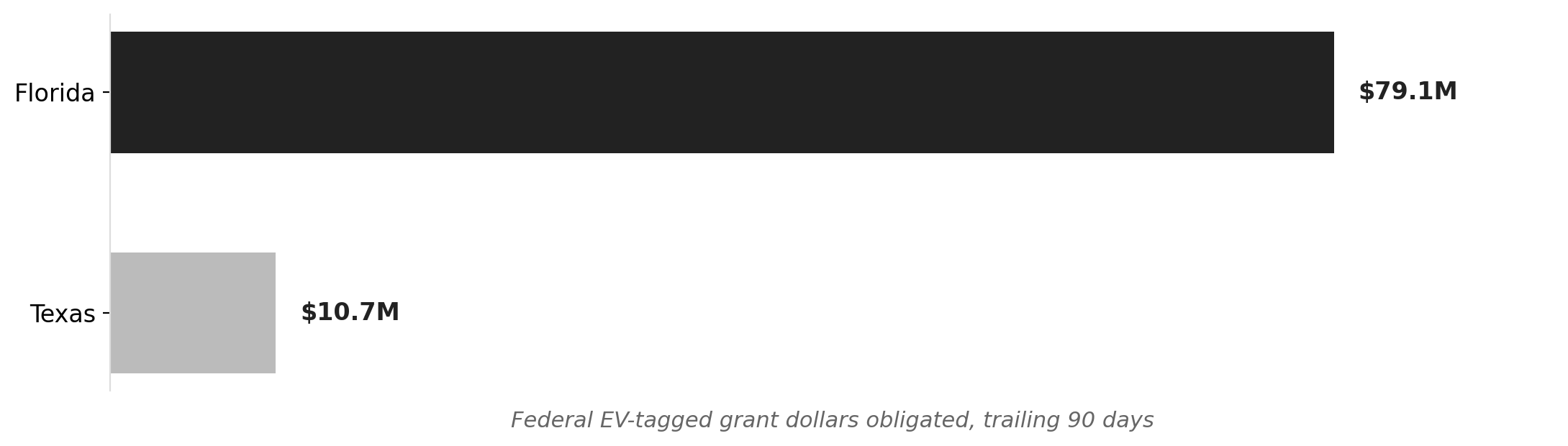
Two awards explain most of the surge. The U.S. DOT's Port Infrastructure Development Program obligated $53.4 million to Broward County for Port Everglades on May 13, 2026, covering charging infrastructure, hybrid and electric port equipment, and workforce development through November 2031. One month earlier, Miami-Dade County received a $25.7 million INFRA grant for PortMiami to deploy 50 electric terminal tractors, 76 hybrid trucks, 42 dual charging stations, and 820 all-electric refrigerated container outlets. Together, as the Southeast Florida Climate Compact noted, these two neighboring seaports have absorbed roughly $79 million in recent federal port electrification awards, making Florida the top-receiving state for EV grants in the trailing 90-day window by a factor of five over Texas, which collected $10.7 million across three grants.
The reason this money is moving now, while highway-charging funds sit in bureaucratic limbo, is not accidental. The NEVI formula program, Florida's $198 million allocation for EV charging along designated highway corridors, was suspended by FHWA in February 2025 under a Trump executive-order review of EV spending. A federal court ordered reinstatement in June 2025, and FHWA issued new interim guidance in August 2025, but the freeze-thaw cycle left Florida's NEVI pipeline effectively stalled for most of the year. The Port Infrastructure Development Program and the INFRA grant program are discretionary awards administered by U.S. DOT's Maritime Administration and BUILD offices. They were not subject to the same executive-order review, and they had application timelines already in motion from FY2024 appropriations under the Bipartisan Infrastructure Law. As FHWA's own NEVI program page reflects, those formula funds remain under interim guidance while the discretionary programs have moved ahead.
Source: NationGraph.
Beneath the port awards sits a maturing second tier of fleet electrification. The EPA's Clean Heavy-Duty Vehicles Grant Program finalized $7.6 million to Duval County Public Schools for 25 zero-emission buses and $7.3 million to the Miami-Dade County School Board for another 25 electric school buses, both obligated in early 2025. The Pinellas Suncoast Transit Authority holds a $27.8 million Low-No Emissions bus grant active through 2034, and the City of Tallahassee is running a $20.4 million Low-No award through 2033. Florida's full active EV-tagged federal grant portfolio now exceeds $185 million across transit, port, school, and research programs.
What makes this geography of spending notable is the political backdrop. Governor DeSantis vetoed SB 284, a bipartisan bill that would have required state agencies to conduct total-cost-of-ownership analysis before purchasing EVs, a signal of official ambivalence toward state-directed EV promotion. Florida has no EV purchase mandate, no ZEV standard, and a charging infrastructure density that reflects it: the Southeast as a whole has just 0.40 public charging stations per 1,000 people, among the lowest rates in the country. Yet billions in federal freight and fleet dollars are arriving without requiring any state policy commitment in return. The ports and school districts applied through federal channels, cleared federal criteria, and received federal checks. Tallahassee's posture toward EVs was largely beside the point.
Port Everglades and PortMiami are among the busiest seaports in the Western Hemisphere, handling roughly 11% of all U.S.-Latin American trade. Both had multi-year decarbonization roadmaps already on file, Port Everglades completed a shore power master plan for its cruise terminals, and PortMiami had electrification targets embedded in its capital plan. Those pre-existing plans made them competitive applicants for PIDP and INFRA dollars that required demonstrated project readiness. The federal money, in other words, did not create the strategy. It funded one that was already written.
For residents, the near-term consequence is asymmetric. Freight operations at two of the state's largest economic engines will get cleaner equipment and lower diesel emissions in the communities surrounding the ports. School children in Duval and Miami-Dade will ride electric buses. But the highway charging network that would change daily life for a driver in Orlando or Jacksonville remains dependent on the NEVI program, which is still navigating interim guidance and contested rulemaking.
The next signal to watch is whether FHWA's August 2025 interim guidance holds long enough for Florida to obligate any of its $198 million NEVI allocation before the end of the federal fiscal year. If it does not, the pattern of the last 90 days is likely to continue: federal EV investment in Florida growing, but routed almost entirely through the freight and fleet back-channels that don't require anyone in the state capitol to say yes.