Five Missouri transit agencies issued new procurement requests in the last 30 days after more than a year of silence, not because they are growing, but because Governor Mike Kehoe's budget cuts have made doing nothing more dangerous than restructuring.
The trigger is arithmetic. Kehoe's FY2026 budget cut Missouri's Transit Operating Investment from $11.7 million to $6.7 million, a 42% reduction. His FY2027 proposal would cut it further to $1.7 million, split among 30 providers. That would matter less if these dollars were purely operational. They are not. State transit funds serve as the primary local match for federal FTA formula grants, which flow on an 80/20 split. Lose a dollar of state money and you forfeit four dollars of federal money you were already entitled to claim. As Kimberly Cella, CEO of Citizens for Modern Transit and executive director of the Missouri Public Transit Association, has described it, it is a double whammy: losing the state investment while simultaneously losing the leverage to draw down far larger federal pools.
The scale of that leverage is visible in Missouri's active federal portfolio. Kansas City alone holds over $174 million in FTA Capital Investment Grants running through 2028. MoDOT received a freshly awarded $25.8 million rural transit formula grant from FTA in March 2026, running through 2031. Federal money is flowing. The problem is that the agencies best positioned to need it are the ones losing the match capacity to claim it.
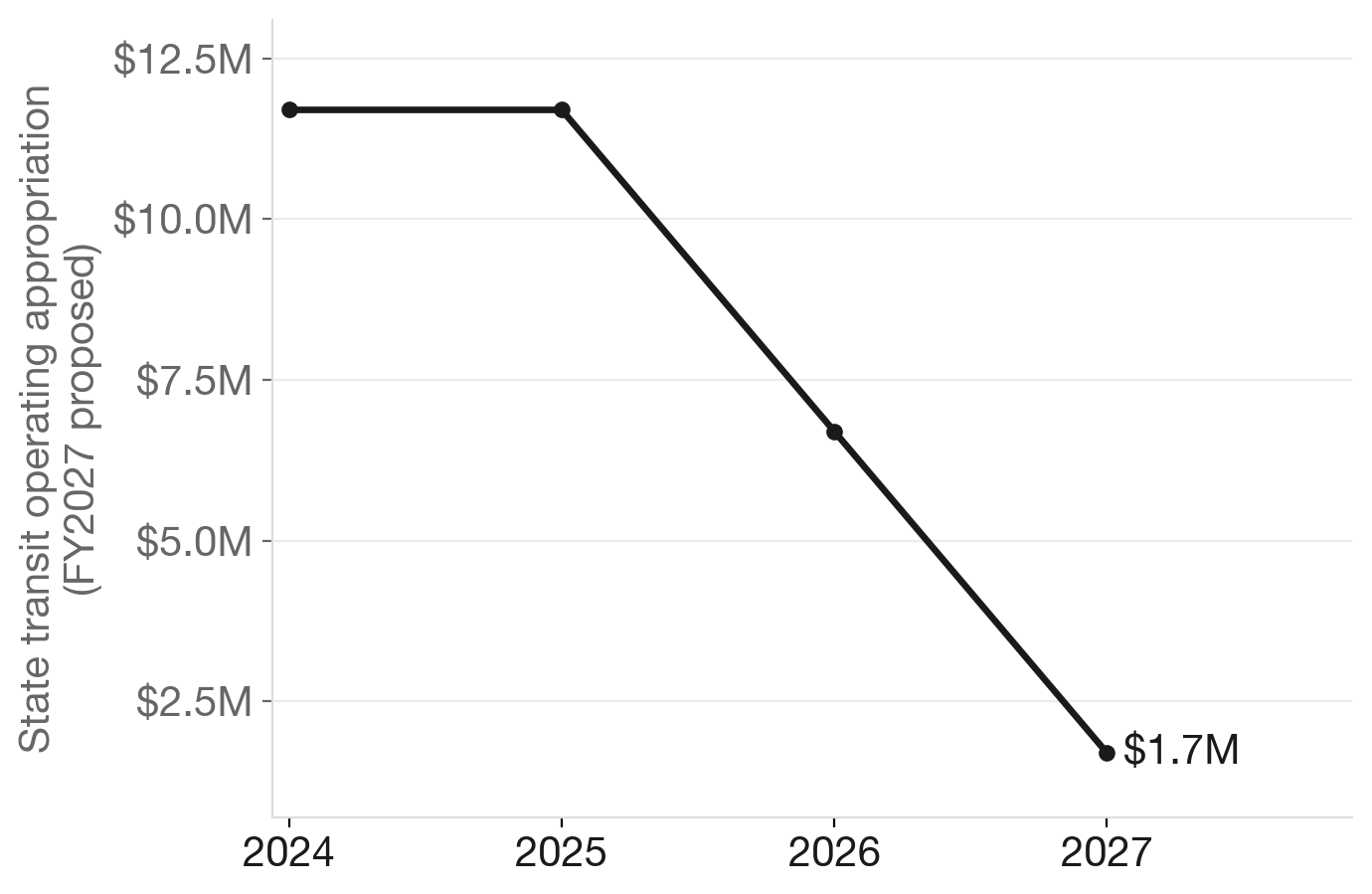
Source: NationGraph.
OATS Transit, which serves riders across 87 Missouri counties, lost $900,000 in state funding in 2025. Because of the match structure, that translated to a total funding loss of $1.8 million, nearly double what the state cut alone would suggest. Rural providers with no alternative revenue base have the least room to absorb that kind of multiplier effect.
The procurement activity in the last 30 days reflects agencies trying to get ahead of a collapse rather than invest toward an expansion. The most operationally urgent case is Jefferson City's JEFFTRAN. The agency commissioned a $124,884 systemwide Comprehensive Transit and Mobility Study, awarded to Olsson Inc. and approved by city council in June 2026, while simultaneously running a reduced alternating-route schedule it adopted in May because the agency has 15 drivers against a needed 20. JEFFTRAN Director Gerry Stegeman has identified pay competition as the core driver of the shortage. The study, which the city canceled and re-bid before awarding, is essentially a diagnostic: before JEFFTRAN can make any structural argument for more resources, it needs an independent accounting of what the system actually costs to run correctly.
St. Joseph presents a different version of the same pressure. The city approved a $1.7 million Phase I construction contract in March 2026 for a new transit transfer station at East Hills Library, a capital commitment that signals long-term intent. At the same time, St. Joseph's transit operation has been issuing fresh insurance RFPs for employee health and life coverage, procurement that had gone more than a year without a competitive bid. Building infrastructure while renegotiating employee benefits simultaneously is not a contradiction; it is what agencies do when they are trying to stabilize cost structures before a funding floor drops further.
Bi-State Development, which runs Metro transit in St. Louis, issued a parts procurement specific to its Battery Electric Bus fleet, the first BEB-specific parts order in the database window, reflecting the maintenance demands of 24 electric buses already in service. The procurement is more operational than strategic, but it signals that electrification commitments made during a period of healthier state budgets now carry maintenance obligations that persist regardless of what the state legislature does next session.
The pattern across these agencies is consistent: procurement activity that a year ago would have been routine is now happening under deadline pressure, with agencies trying to lock in contracts and restructure cost bases before the FY2027 state budget makes the match math untenable. Missouri already spends substantially less on transit than neighboring states by per-capita measures, according to Citizens for Modern Transit research. The proposed FY2027 cut to $1.7 million would put it in a category of its own.
The next signal to watch is the Missouri legislature's handling of the FY2027 appropriations process. If the $1.7 million figure holds, several agencies will face a choice between drastically reduced service and finding alternative local match sources, municipal general funds, county levies, or fare increases, that most mid-size Missouri cities are not structured to provide quickly. The federal money will still be there. Whether Missouri's transit agencies can still reach it is the open question.