Federal charter school funding flowing into Ohio has jumped from $172,670 to $14.2 million in 90 days, an increase of more than 8,000 percent, and the pipeline is only beginning to open. Nine Ohio community schools in Columbus, Cleveland, Dayton, Toledo, and Westerville received $14.3 million in facilities subawards on September 15, 2026, the first major disbursement from two separate federal grants totaling $47.4 million that started October 1, 2026. Both run through September 30, 2027, meaning more checks are on the way.
The money comes from two distinct federal programs, and Ohio is one of only a handful of states to win both at once. The first is the Charter Schools Program State Entity grant: $20.2 million administered by the Ohio Department of Education and Workforce to open new community schools and replicate or expand high-quality ones. The second is the Charter School Facilities Incentive Grant, branded "Facilities for the Future," worth $27.2 million and aimed specifically at physical infrastructure: capital improvements, new construction, renovations, land purchase, and career and technical education programming. Ohio DEW holds both awards as the state intermediary and issues competitive subawards to individual schools. The two programs share a federal funder and a state administrator but serve fundamentally different purposes, seats versus buildings, and should not be read as a single initiative.
The grants are the downstream result of a record $500 million federal Charter Schools Program investment announced by Education Secretary Linda McMahon in May 2025, a $60 million increase timed to National Charter Schools Week. McMahon framed the investment explicitly around 2024 NAEP scores showing 12th-grade math and reading at historic lows, positioning charter expansion as a supply-side answer to public school performance declines. She traveled to Columbus personally on September 25, 2025, to announce Ohio's awards alongside Gov. Mike DeWine and Sen. Bernie Moreno, a staging that underscored how central the state is to the administration's school-choice strategy.
Source: NationGraph.
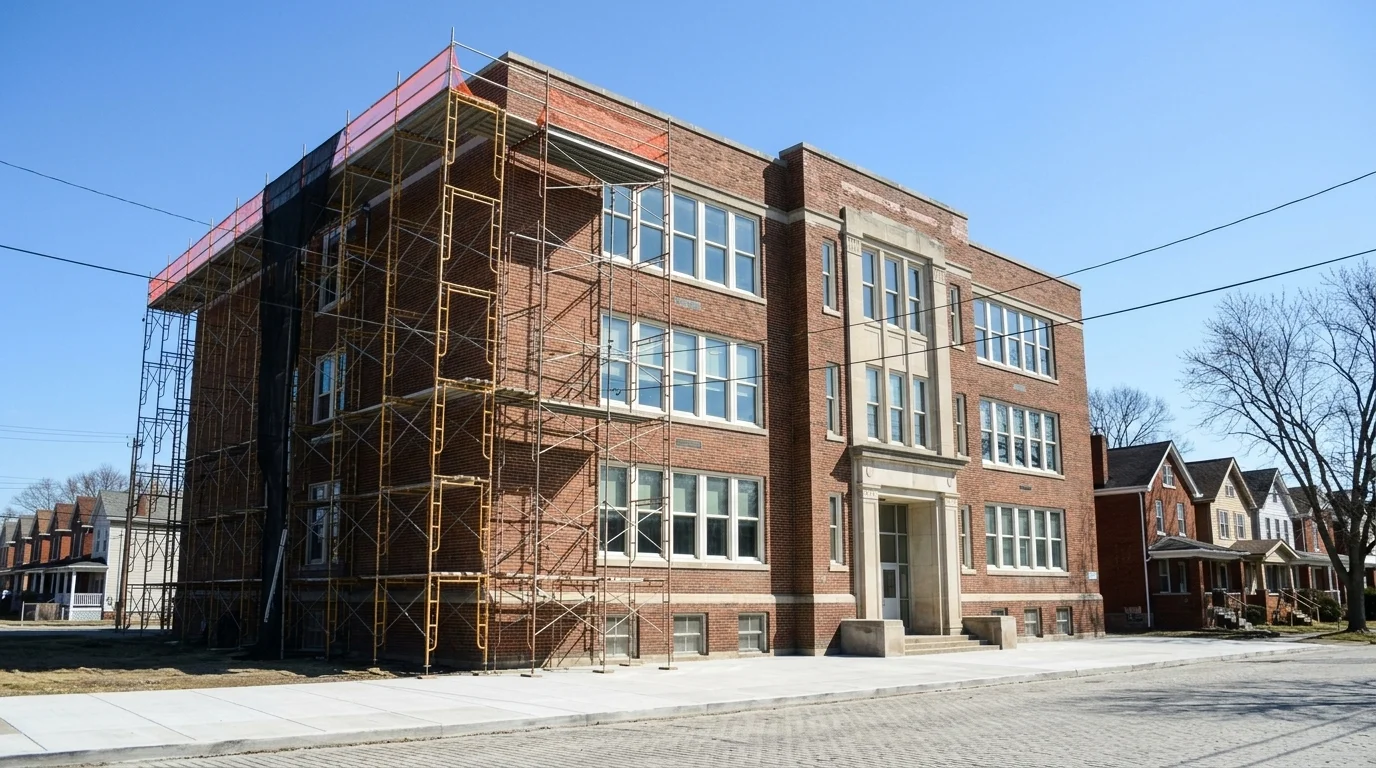
What makes Ohio's position particularly notable is a structural feature of state law that the federal facilities money amplifies directly. Under Ohio Revised Code Section 3313.411, charter operators hold a statutory right of first refusal to purchase vacant public school buildings before they go to other buyers. In cities like Cleveland and Dayton, where traditional public school enrollment has contracted and buildings sit empty, that legal advantage combines with a $27.2 million federal facilities grant to create real purchasing power. The September 15 subaward announcement covered facility upgrades across five cities, and the grant explicitly prioritizes underserved communities and CTE programming expansion, meaning the schools likely to benefit are in exactly the places where vacant district buildings are most available.
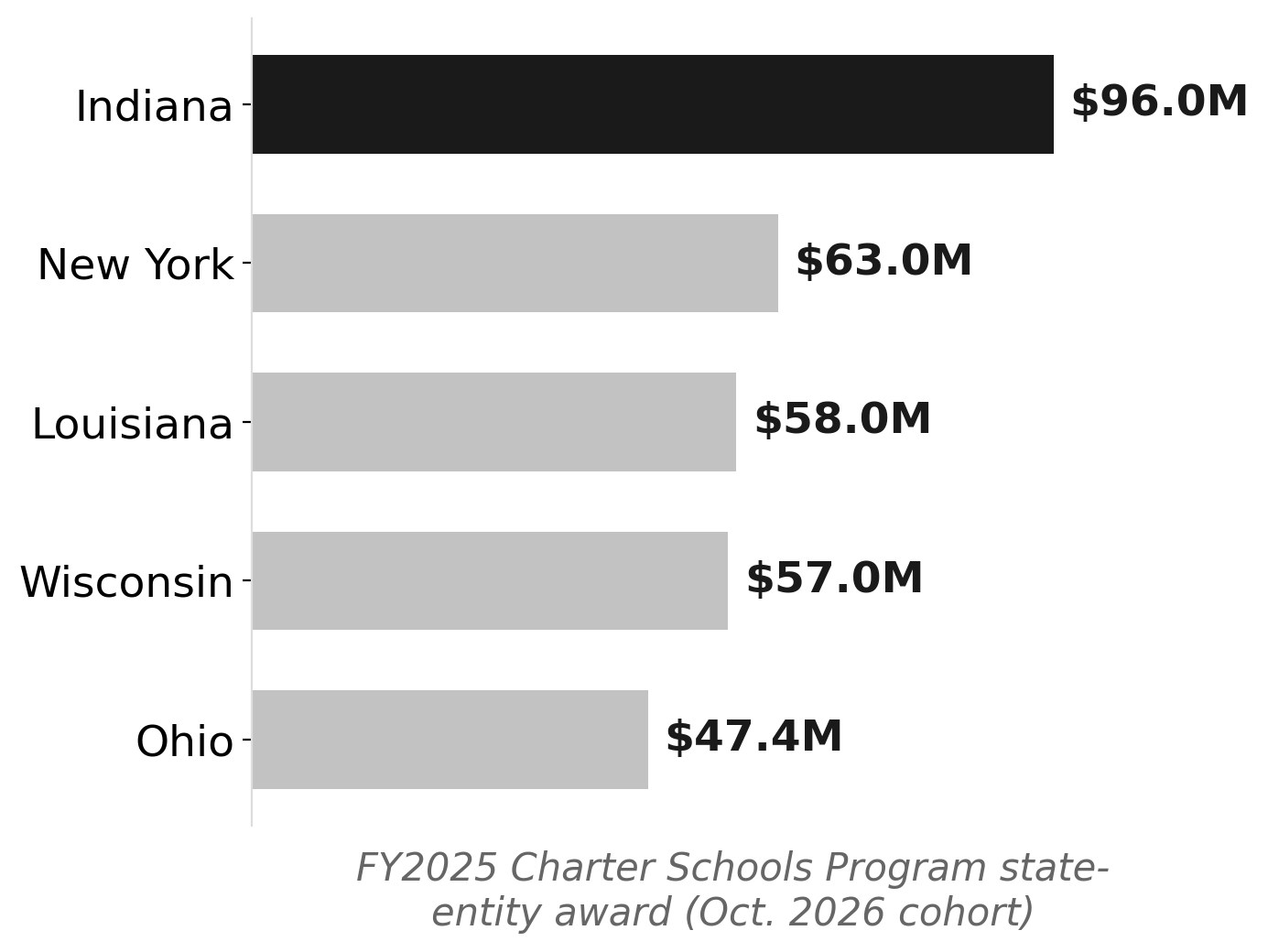
Nationally, Ohio's $47.4 million places it roughly fifth in the current CSP cohort. Indiana led the field at more than $96 million, followed by New York, Louisiana, and Wisconsin. But Ohio's dual-grant status distinguishes it: winning both the programmatic expansion award and the facilities award simultaneously gives the state tools to grow enrollment and build or renovate the physical space to house it, a combination most states in the cohort do not hold.
There is a relevant caution embedded in the state's own charter history. In 2015, Ohio received a $71 million federal CSP award that ran into accountability problems serious enough that $22 million went unspent, the result of too few eligible new schools to absorb the money. The current grants carry explicit performance requirements, and Ohio DEW's role as intermediary means the department is on the hook for subaward oversight. Ohio is also ineligible for the FY2026 CSP State Entity competition that launched in April 2026, meaning the state cannot add a third layer of federal expansion dollars on top of its current awards. The five-year grant window is the lane Ohio is in.
For families and educators in Columbus, Cleveland, Dayton, Toledo, and Westerville, the most immediate signal is the one already visible: nine schools receiving facility investment before the end of 2026, with more subawards expected through the grant's September 2027 close. For anyone watching the state's broader education policy landscape, the question that follows the money is whether Ohio DEW's oversight apparatus has been rebuilt enough since 2015 to move $47.4 million without leaving another $22 million on the table.
The next concrete milestone to watch is the next round of subaward announcements from Ohio DEW, which has not yet disclosed a timeline for distributing the remaining balance of either grant.