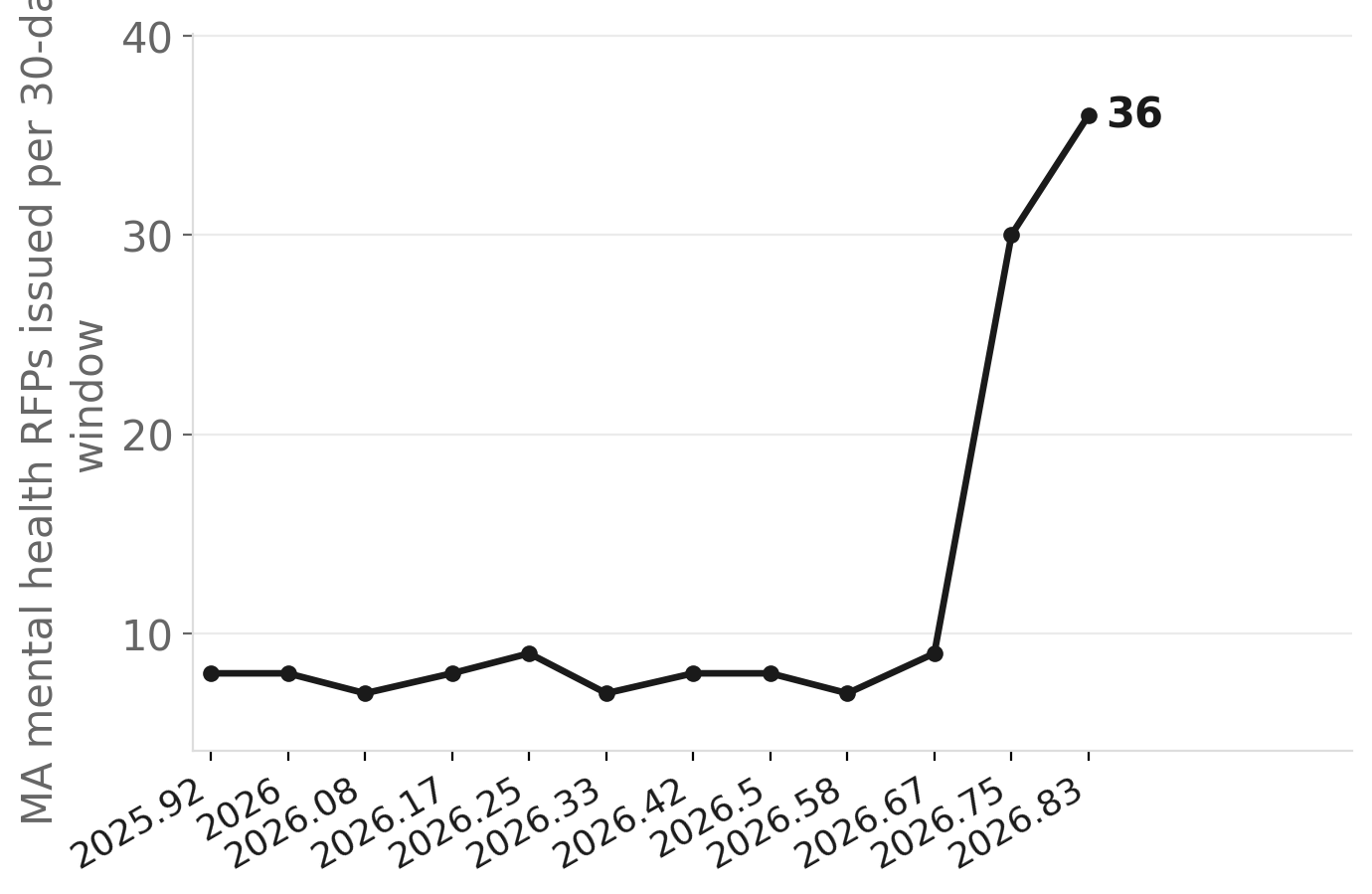
Massachusetts issued 36 mental health procurement solicitations in the last 30 days, nearly 4.5 times the state's monthly baseline of roughly 7.9. That is not a routine procurement cycle. It is what happens when a record state appropriation, a new federal crisis grant, and the sudden termination of other federal funding all arrive at the same time.
Three agencies are driving the surge. The state Department of Public Health issued 13 requests for proposals, the Department of Mental Health issued 9, and the Boston Public Health Commission added 4 more. Together they account for about 72 percent of the spike. The contracts under procurement span 988 crisis line staffing, DMH master training agreements running through 2037, court clinic services for the Massachusetts Trial Court, school counseling programs, and community-led crisis response pilots.
The clearest single trigger is the FY2027 state budget Governor Healey signed in mid-2026, which allocates $1.34 billion to the Department of Mental Health, a record. The enacted budget also includes $132 million for children's mental health and $14.3 million for suicide prevention, including 988 lifeline funding. Record appropriations do not automatically produce services; they produce procurement obligations. When a line item at that scale gets enacted, DMH has to issue master service agreements and new RFAs to actually spend the money, and those solicitations are showing up now, roughly four months after the governor's signature.
Source: NationGraph.
Layered on top of that is a separate federal obligation. SAMHSA awarded Massachusetts DPH a $4.1 million 988 Behavioral Health Crisis Services cooperative agreement starting September 30, 2026, part of a national pool exceeding $211 million for states building out crisis line infrastructure. Federal grants of that kind come with contracting requirements of their own. A state agency that accepts $4.1 million to build 988 capacity must then go find the vendors to build it, which means RFPs. The timing places that obligation squarely in the October-November window where the spike appears.
The third force is less constructive and more urgent. In January 2026, the Trump administration terminated hundreds of HHS grants nationally, an action estimated to have wiped out roughly $2 billion in federal health funding. Governor Healey confirmed that at least $5 million in Massachusetts grants were cut directly, with tens of millions more at risk statewide, including the $19.9 million SAMHSA Community Mental Health Block Grant that flows through DMH to fund community-based services for adults with serious mental illness. That block grant is currently active through September 2027, but providers are not waiting to find out whether it survives. WBUR reported in January that Massachusetts providers began scrambling immediately after the terminations, and the state's response, legal action from AG Andrea Campbell, plus accelerated state-funded contracting, reflects an institutional judgment that the federal money cannot be counted on.
The distinction between these three funding streams matters. The state's $1.34 billion DMH appropriation is state money; it does not depend on the federal grants and was not created in response to their loss. The SAMHSA 988 cooperative agreement is federal money with its own contracting obligations. The community mental health block grant is a separate federal stream that is at risk of termination. All three are flowing through Massachusetts agencies simultaneously, and each one generates its own downstream procurement wave. The result is what the numbers show: a single month that looks like half a year of normal contracting activity.
Boston's BPHC offers one concrete illustration of how the institutional-reform dimension of this wave works. In June 2026, the commission issued both a service RFP and a separate external evaluator RFP for a community-led, non-carceral mental health crisis response pilot. The evaluator RFP signals that the city is not just buying more of what already exists; it is building a new model and commissioning the research to assess it. That is a different kind of procurement, but it is counted in the same 36-RFP wave.
For Massachusetts residents, the near-term effect is a contracting market that will look very different by early 2027 than it did a year ago. Providers with capacity to absorb new state contracts are in demand. Agencies without that capacity may find themselves squeezed out of a procurement cycle moving faster than usual. The longer-term question is whether the state budget can sustain a $1.34 billion DMH baseline if federal block grant dollars actually disappear, or whether the record appropriation was partly underwritten by an assumption that federal flows would continue.
The next signals to watch: whether the SAMHSA Community Mental Health Block Grant survives federal review through its September 2027 end date, and whether the AG's legal challenge to the January terminations produces any recovery of the flagged $5 million. If neither happens, the procurement wave of fall 2026 may turn out to be the first round of a longer process of substitution.