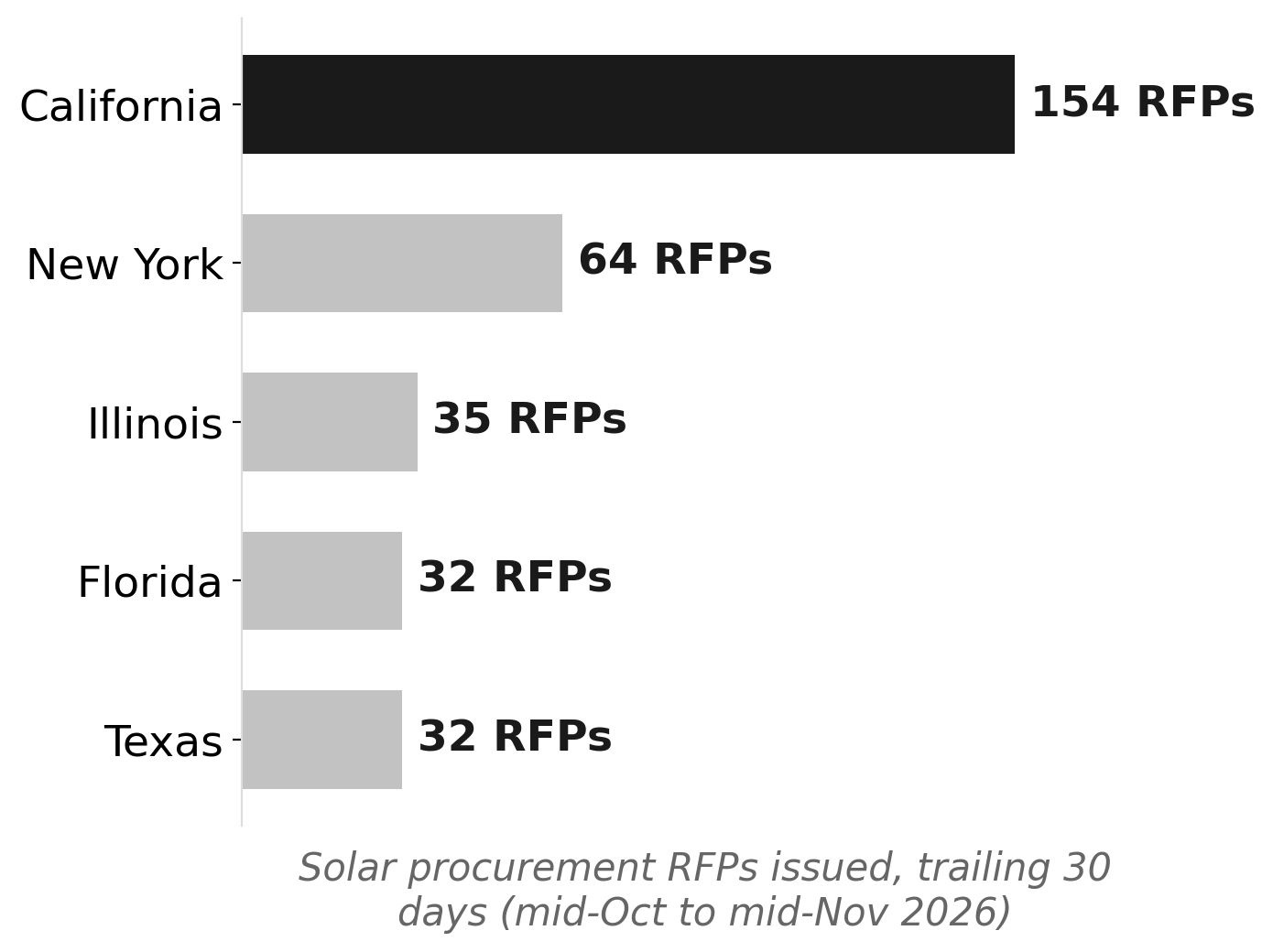
New York's public agencies issued 64 solar procurement RFPs in the trailing 30 days through mid-November 2026, against a 12-month monthly average of about 12.8, a fivefold spike that makes the state the second-busiest solar procurement market in the country, behind only California, despite having a fraction of its size.
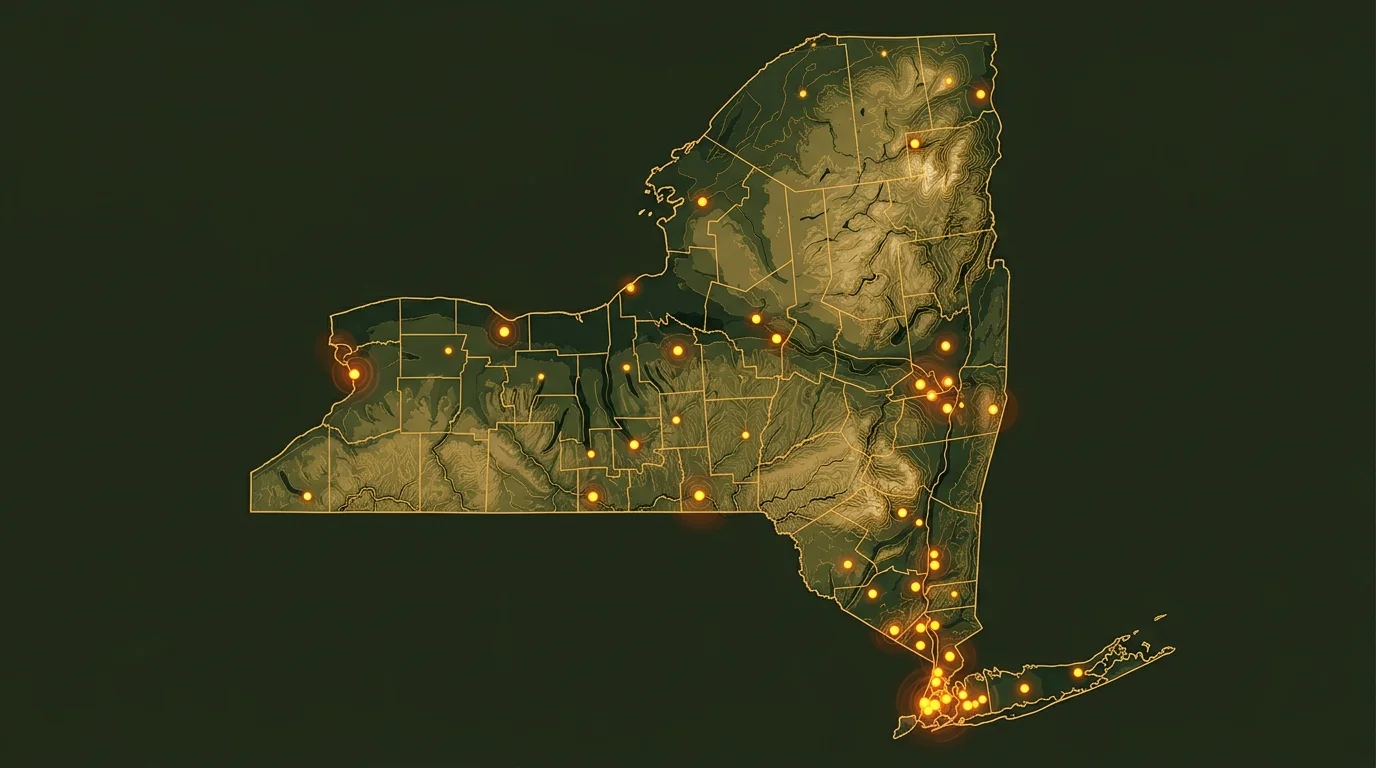
The surge is not an artifact of a single state agency moving in bulk. Of the 72 RFPs recorded in October alone, 55 entered the database on a single day from 46 distinct agencies, a batch-sync event that confirms real procurement activity had been accumulating independently across dozens of municipalities, counties, school districts, and public authorities. The entity breakdown makes the bottom-up character unmistakable: 28 municipal governments, 14 county agencies, 9 educational institutions, and 7 from the New York Power Authority.
Three distinct mechanisms, arriving in close succession, explain why so many different public entities reached the same decision at roughly the same moment.
Source: NationGraph.
The most immediate trigger is a federal deadline. The commercial solar Investment Tax Credit under Section 48E, a 30% credit available to governments and nonprofits through a direct-pay election, has an unforgiving new clock. The "begin construction" safe harbor under the One Big Beautiful Bill passed on July 4, 2026; projects that did not meet that threshold now must be fully placed in service by December 31, 2027 to claim the credit. As the Solar Finance Fund explains, that placed-in-service requirement is not a paperwork formality, it is a hard cutoff, and 14 months from project award to energized system is a tight construction window for public procurement. Every county treasurer and school business official doing the math arrives at the same answer: issue an RFP now or forfeit the credit.
The second mechanism is Governor Hochul's September 22, 2026 Energy Infrastructure Development Plan, which directed $300M in state appropriations through the Sustainable Future Program. Two hundred million went to the NY-Sun program, administered by NYSERDA, expanding solar incentives for single-family homes, multifamily buildings, businesses, and local municipalities. A separate $100M went to NYPA for renewable energy financing under its legislatively authorized renewables mandate. These are distinct programs doing different things: NY-Sun lowers the installed cost threshold for municipal buyers purchasing solar from private developers; the NYPA tranche enables NYPA to develop, own, and operate projects as a public developer. Governor Hochul's announcement framed both as responses to New York's Climate Leadership and Community Protection Act gap: the state has deployed roughly 7 gigawatts of solar against a 10-gigawatt target by 2030.
The third mechanism is NYPA's own pipeline. Its December 2025 Updated Renewables Strategic Plan outlined 39 solar arrays statewide, and that plan has since cascaded into direct procurement activity. In September 2026, NYPA announced the 240-MW Rich Road Solar project in St. Lawrence County and broke ground on the 20-MW Somers Solar project in Washington County. Those announcements signal to county and municipal partners that NYPA co-development is a live option, which pulls additional RFPs from local governments that want to position themselves as project sites or off-takers.
The geographic spread matters as much as the volume. New York's solar procurement is fragmented by design: hundreds of municipalities, dozens of counties, scores of SUNY campuses, and independent school districts each control their own capital budgets and procurement calendars. That fragmentation is exactly why the RFP surge looks municipal-led rather than centrally directed. When the federal credit deadline, the state funding announcement, and NYPA's project pipeline all land within the same fiscal quarter, the distributed structure of public procurement becomes a multiplier rather than a bottleneck.
For residents, the near-term consequence is construction activity: rooftop and ground-mount installations on public buildings, school roofs, and county facilities, most of which will need to break ground well before the end of 2026 to reach operational status by December 2027. NY's high electricity rates make the economics compelling even at the municipal scale, a 30% federal credit applied via direct pay, stacked with NY-Sun incentives, can cut net project cost roughly in half for eligible facilities.
The signal to watch next is contract awards. RFPs are intentions; signed contracts with construction timelines are commitments. If the volume of awards in January and February 2027 matches the RFP surge, New York will have locked in one of the largest single-year expansions of public solar capacity in its history. If the awards lag, because contractor capacity, permitting, or interconnection queues can't absorb the demand, the December 2027 deadline becomes a bottleneck rather than a catalyst.