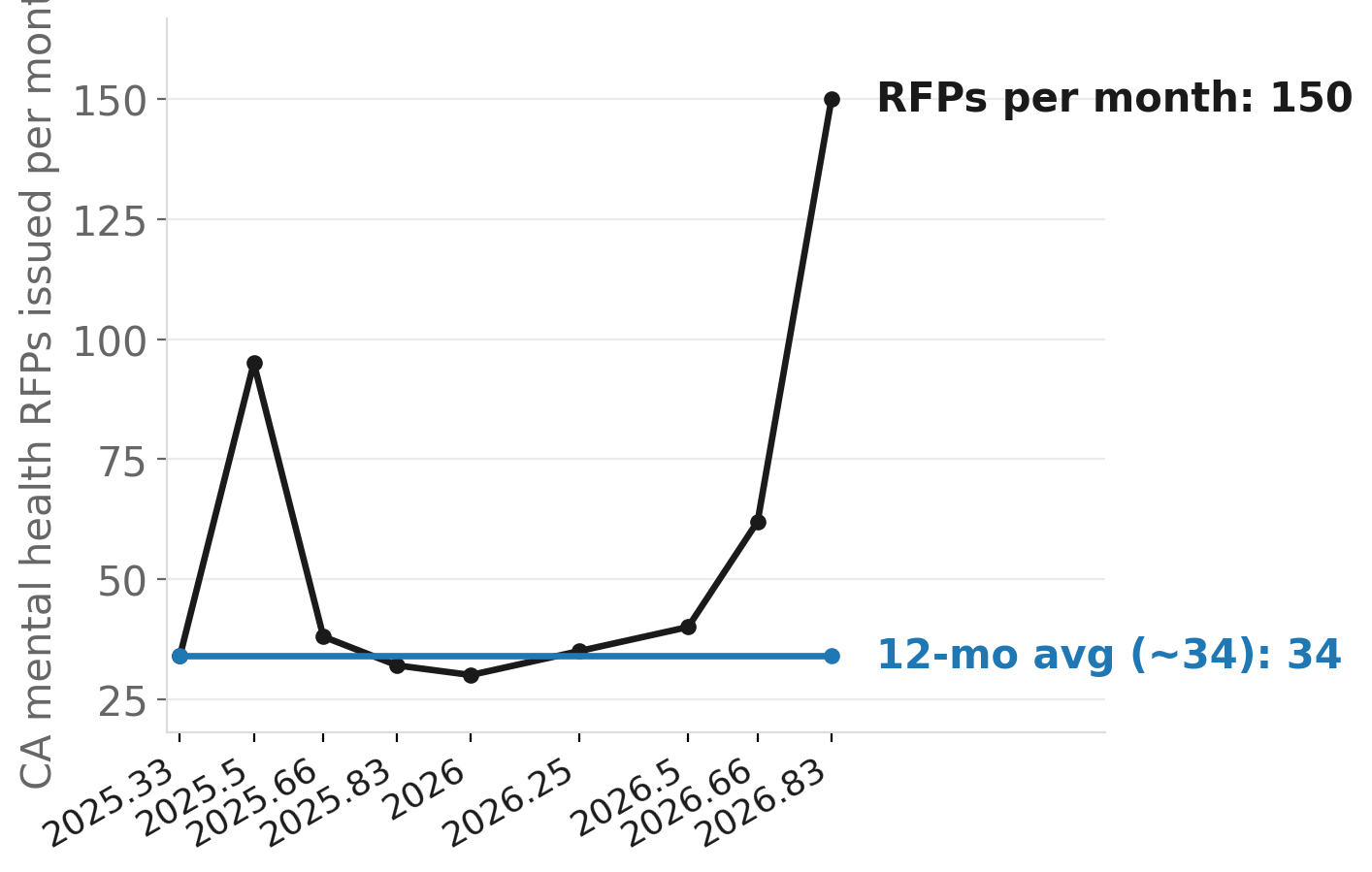
California counties issued 127 mental health RFPs in the last 30 days, 3.7 times the trailing 12-month monthly average of roughly 34. October 2026 alone produced 150, the highest single-month count in an 18-month dataset. The counties driving the surge include Ventura County Behavioral Health, LA County Department of Mental Health, Alameda, Solano, Sonoma, and Shasta, but the more important fact than which counties are leading is why all of them moved at the same time.
The answer is structural. California voters approved Proposition 1 in March 2024, which contained two distinct pieces of legislation. The first, the Behavioral Health Services Act (SB 326), replaced the 20-year-old Mental Health Services Act and required every one of California's 58 counties to submit a new DHCS-approved three-year Integrated Plan by June 30, 2026, with implementation beginning July 1. The second, the Behavioral Health Infrastructure Bond Act (AB 531), authorized $6.6 billion in state bond funding for capital construction of behavioral health facilities. These are separate mechanisms doing separate things, but they share an administrator (DHCS) and a political moment, and they arrived simultaneously.
The July 1 date is the load-bearing fact in the procurement surge. Because every county had to rebuild its spending plan from scratch under a new statutory framework, and because those plans all went live on the same day, California effectively manufactured a synchronized procurement event that has no precedent in this sector. At least 12 RFPs issued in October explicitly name the "Behavioral Health Services Act" in their titles, spanning Ventura, Solano, Tulare, Sonoma, and Santa Cruz counties. These are not routine contract renewals. They are new frameworks requiring new providers, new service categories, and in many cases new reporting structures.
Source: NationGraph.
One mandate in particular is generating a distinct sub-wave. The BHSA requires counties to allocate 30 percent of their behavioral health dollars to housing interventions starting in FY2026-27, a category that did not exist under the old MHSA. That requirement is now appearing in RFPs directly: Solano County has issued an RFP for Recovery Residence Housing, San Bernardino for Permanent Supportive Housing, San Francisco for Housing and Navigation Services. Counties that never ran housing procurement programs are now doing so, often for the first time, under a deadline they cannot move.
Running alongside the BHSA services wave is the capital construction pipeline driven by the bond program. DHCS announced $1.18 billion in BHCIP Round 2 awards in March 2026, funding 66 projects across 130 facilities. Nine BHCIP capital RFPs have been issued in California in the last 90 days alone. On October 30, Governor Newsom announced the opening of the first Prop 1-funded facility, the Ritter Center in Marin County, and reinvested $146 million in bond funding for new projects in LA and Shasta counties. BHCIP has now awarded $6.1 billion across 437 projects since 2021, with a projected reach of 5.4 million Californians annually in outpatient settings. The capital RFPs are construction and design contracts, not service contracts; they fund the physical infrastructure that the BHSA service contracts will eventually operate inside. Both waves are real, and conflating them obscures the double pressure now hitting California's behavioral health supply chain.
Behind both is a substantial federal backdrop. Active HHS mental health grants to California, from SAMHSA, NIMH, and related agencies, total $2.83 billion across 1,136 currently active awards, flowing through DHCS, universities, and community providers. That existing federal infrastructure is part of what makes the county-level procurement surge legible: California was already running a large behavioral health system; Proposition 1 did not build it from zero. What the new law did was force a simultaneous retooling of how every county within that system spends its money.
For providers, nonprofits, clinical staffing firms, residential operators, housing developers, the wall of RFPs represents both opportunity and strain. Responding to a competitive government RFP requires legal review, budget modeling, and staff time. When 150 RFPs drop in a single month across dozens of counties, smaller organizations face a triage problem: which contracts are worth pursuing, and which will they have to let pass. The Steinberg Institute has flagged workforce capacity as a primary constraint on BHSA implementation statewide. An RFP wave that outpaces the available provider pool produces unspent allocations, delayed services, and re-procurement cycles, outcomes counties are now working to avoid.
The next signal to watch is contract award velocity. RFP volume tells you how much counties intend to spend; award announcements tell you whether the market can respond. If the gap between solicitations and executed contracts widens through early 2027, it will indicate that the synchronized rollout has produced a demand shock the provider market is not yet equipped to absorb. DHCS has set reporting requirements tied to the Integrated Plans; those reports, due in 2027, will be the first systematic look at whether the contracts being solicited right now are actually getting filled.