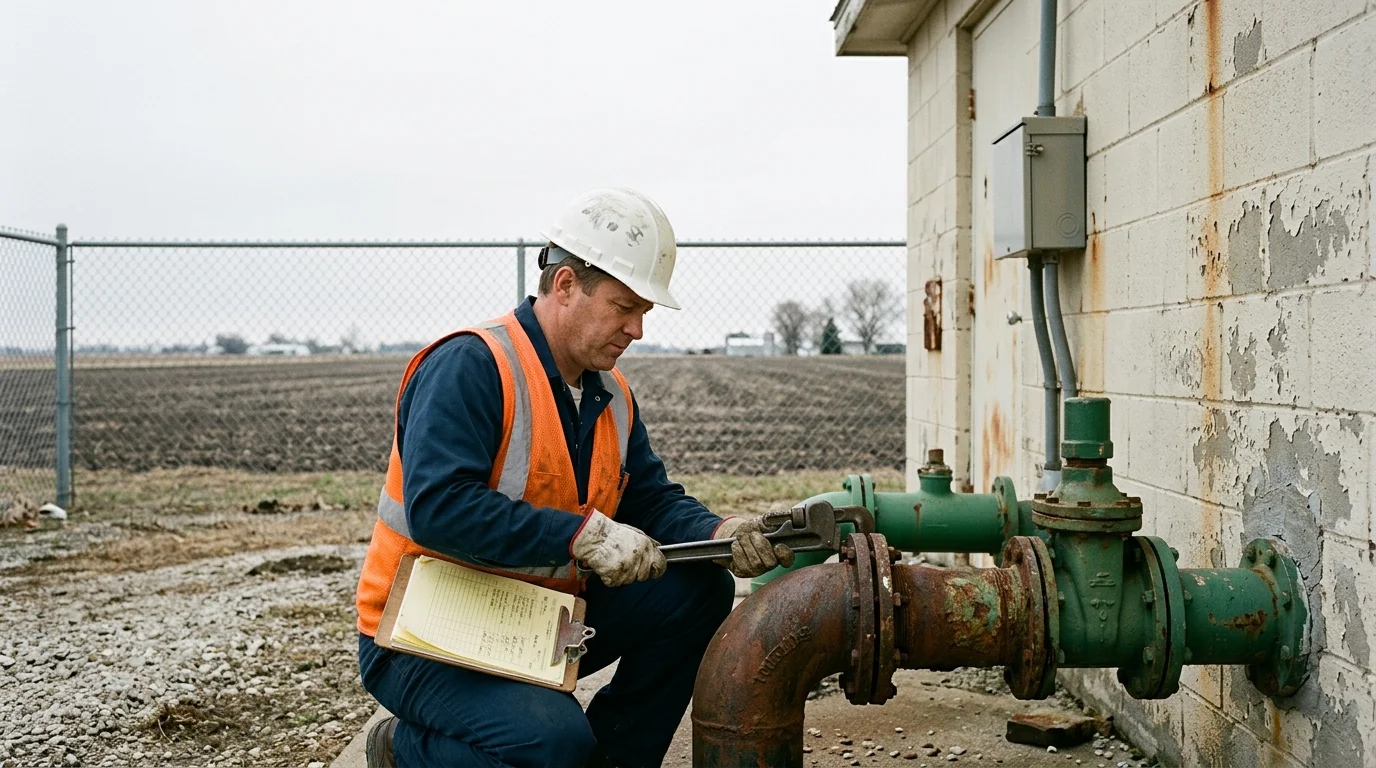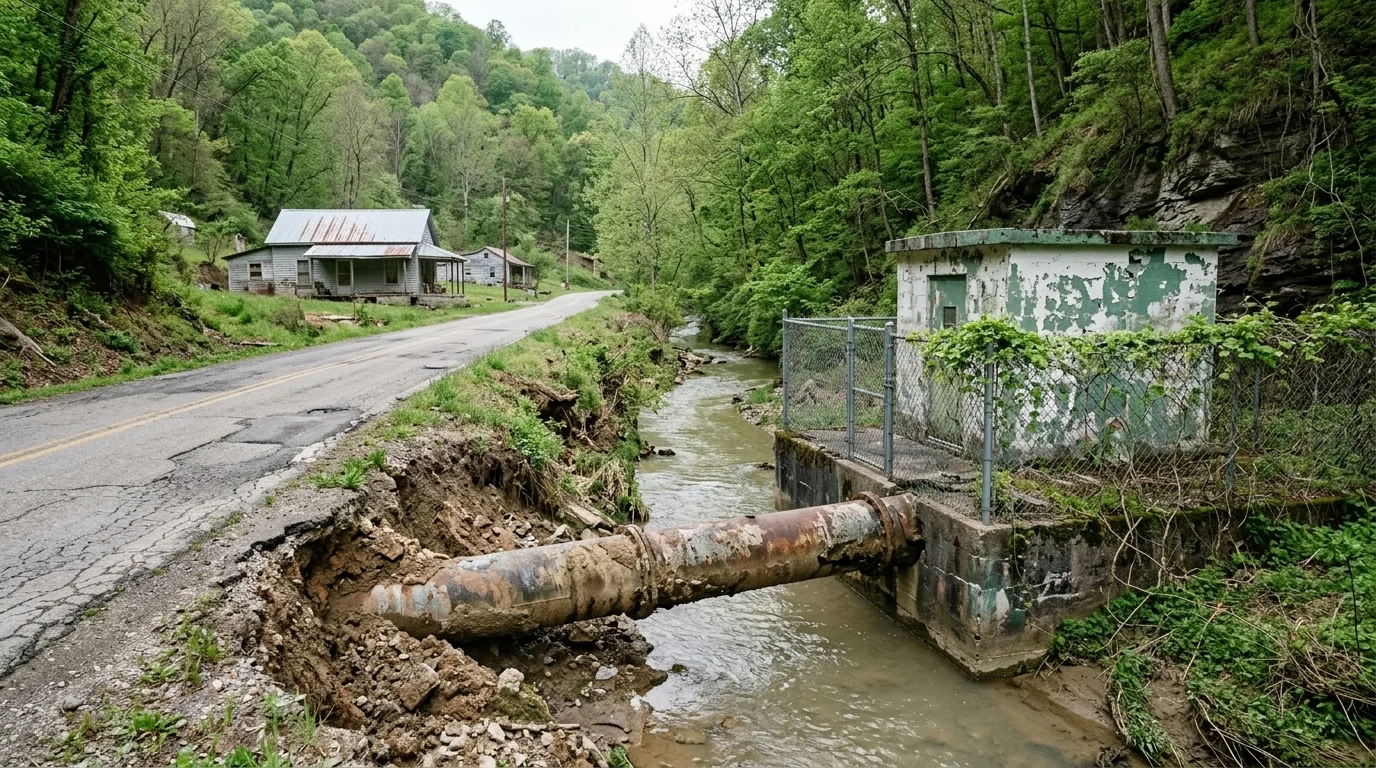
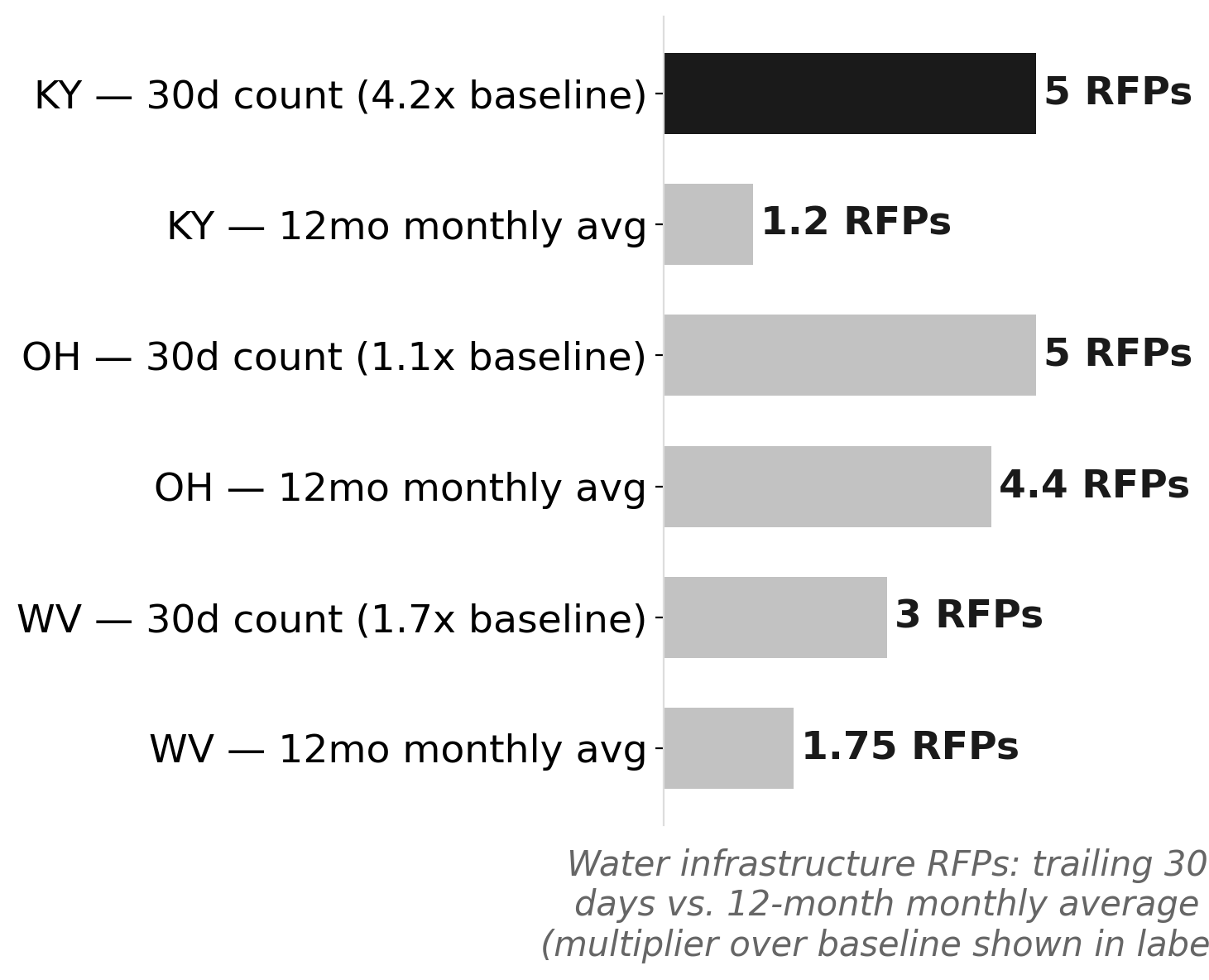
Kentucky issued five water infrastructure RFPs in the 30 days ending September 21, 2026, a rate 4.3 times the state's trailing 12-month average of roughly one per month. The burst is concentrated in Eastern and Southern Kentucky, and it marks something specific: the moment the grant pipeline finally meets the procurement calendar.
The money was not sudden. Federal dollars for Eastern Kentucky water systems have been accumulating since the July 2022 floods inundated Letcher, Knott, Perry, and Breathitt counties and destroyed infrastructure that was already decades past useful life. What changed this summer is that three distinct federal programs reached their execution trigger at nearly the same moment.
On August 12, 2026, Congressman Hal Rogers and USDA Rural Development Kentucky State Director Travis Burton announced more than $30 million for nine water and wastewater projects across eight Southern and Eastern Kentucky counties. The largest single award, $10.9 million in USDA-RD funds, goes to the City of Jackson to replace its wastewater treatment plant, which the 2022 floods damaged beyond repair. Letcher County's Fleming-Neon community received $5.4 million to replace 37,000 linear feet of waterlines. Knott County received $4.6 million for its flood-damaged wastewater plant and sewer lines. A separate $1.5 million award, combining ARC and USDA-RD funds, will replace 20 miles of water lines in Hazard.
Source: NationGraph.
Running parallel to those direct grants, the Kentucky Infrastructure Authority has been absorbing a fresh round of Bipartisan Infrastructure Law State Revolving Fund capitalizations: $31.4 million in new Clean Water SRF funds and $30.3 million in Drinking Water SRF funds, both starting July 1, 2025, on top of additional tranches still in drawdown. Those programs flow from EPA to KIA to local utilities as low-interest loans with forgivable principal components, and they are a different mechanism than the USDA-RD direct grants or the Army Corps earmarks. They are not the same program. But KIA's annual Call for Projects cycle, which for FY2027 opened September 25, 2025, requires local utilities to complete engineering procurements before they can draw funds. That calendar requirement alone forces a wave of RFPs every fall.
The third stream is Rogers's FY2026 appropriations bill, which included a $10 million Army Corps Section 531 earmark dedicated exclusively to water and wastewater projects in Kentucky's 5th Congressional District. The U.S. House passed that energy and water funding bill in September 2025, and construction-ready projects are now entering procurement.
The RFPs that appeared in September 2026 reflect all of this converging at once. The Kentucky River Area Development District posted the KY 15 Waterline and Sewer Extensions project in Kenton County. The City of Pikeville issued two on-call engineering solicitations covering water and sewer design work in Pike County. The Montgomery County Industrial Authority posted Phase 1 utility infrastructure for the Walters Industrial Park. These are not the same project or the same program. They are independent local actors, each responding to a different federal funding signal, all arriving in the same window.
The comparison to neighboring states makes the Kentucky specificity clearer. Ohio issued five water infrastructure RFPs in the same 30-day window, which sounds equivalent, but Ohio's monthly baseline is 4.4 RFPs, so its recent count is actually below average. West Virginia posted three, against a baseline of 0.58 per month, which is elevated but still a smaller absolute number. Kentucky's spike is not a regional Appalachian phenomenon driven by shared funding. It is a Kentucky procurement burst, driven by the particular layering of KIA's revolving fund cycle, the Rogers district announcements, and the four-year lag between flood damage and construction-ready grants.
That lag is the structural story. Grant awards announced in 2022 and 2023 required environmental reviews, preliminary engineering, and state-level processing before local utilities could solicit contractors. The EPA's active grant portfolio to KIA and Kentucky EEC now exceeds $619 million across 59 currently running grants. The RFP count in September 2026 is the downstream signal that the money is finally moving from ledger to pipe.
For residents of Pike, Letcher, Knott, and Perry counties, the practical change is the one that has been a long time coming: contractors bidding, timelines forming, construction starting. The communities receiving USDA-RD awards have formal obligation deadlines that make the procurement urgency real, not aspirational.
The next signal to watch is KIA's FY2027 Call for Projects, which closes December 16, 2025. The projects selected in that cycle will produce the next wave of engineering RFPs, most likely in mid-2026. If the September 2026 burst is the first genuine peak in 18 months of procurement data, the next one is already being shaped by applications being filed now.