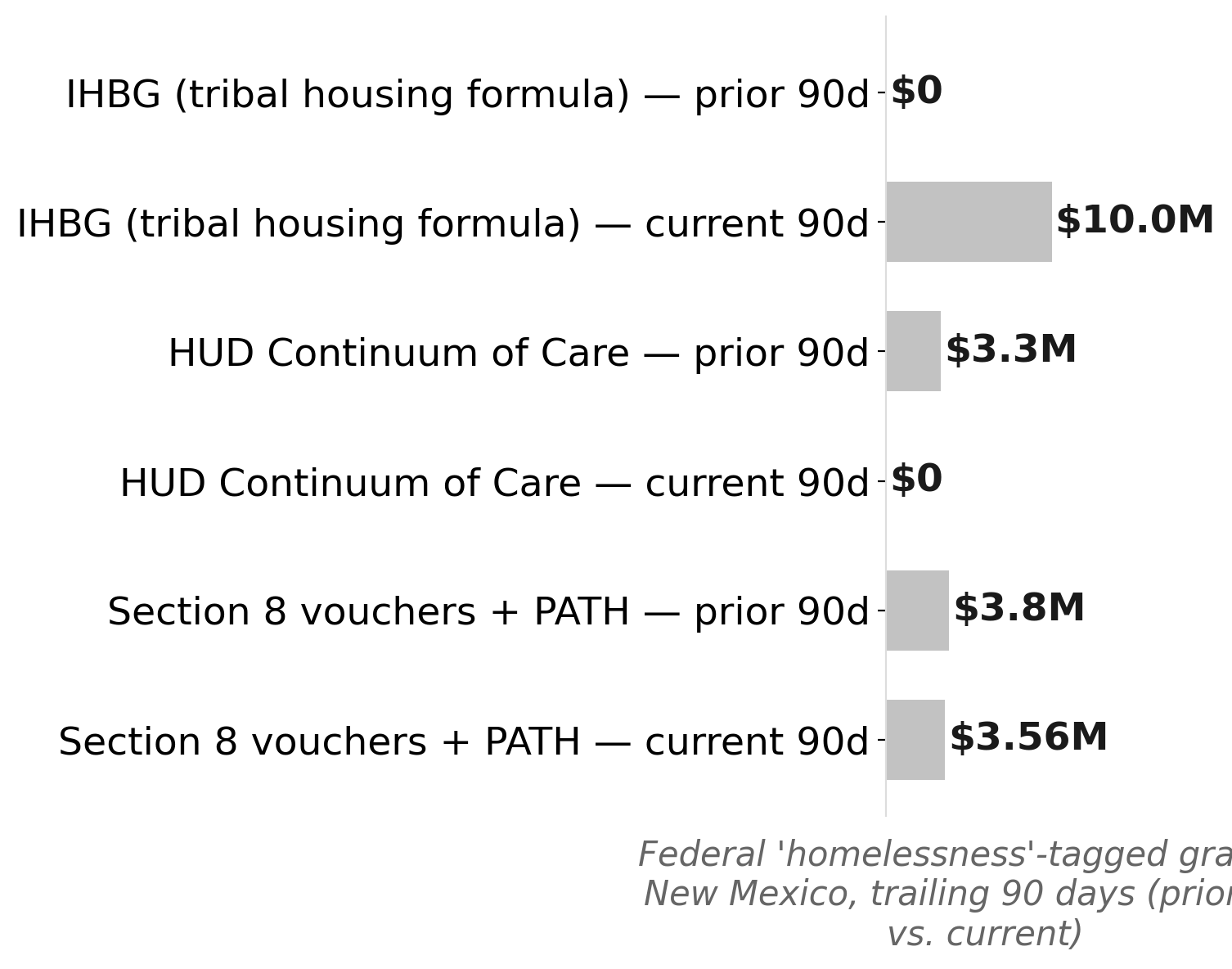
Federal grants tagged to homelessness in New Mexico have reached $13.6 million in the trailing 90 days, up 90% from $7.1 million in the same window a year ago. That number looks like progress. It is not, or at least not in the way it appears.
Of that $13.6 million, $10 million, 74% of the total, consists of two Indian Housing Block Grants delivered on September 8, 2026, to the Pueblo of Jemez Housing Authority and the San Felipe Pueblo Housing Authority, each receiving $5 million. These are formula grants authorized under the Native American Housing Assistance and Self-Determination Act (NAHASDA), distributed as part of HUD's FY2026 national IHBG announcement covering roughly 600 tribal communities. They fund construction, rehabilitation, and housing services for low-income tribal families. They cannot be redirected to an Albuquerque shelter. They are not a response to urban homelessness, and they are not what most readers would picture when they see a 90% funding increase.
The remaining $3.6 million in the current window breaks down into Section 8 voucher renewals distributed across more than ten housing authorities statewide and a single PATH grant of $360,794 to the New Mexico Health Care Authority for outreach to people experiencing homelessness with serious mental illness. What is entirely absent from the current 90-day window is the program that has historically anchored New Mexico's homelessness response: HUD's Continuum of Care.
Source: NationGraph.
A year ago, the same 90-day window included $3.3 million in CoC grants to the City of Albuquerque, a $1.06 million Department of Education grant for homeless children, and a PATH award. Now CoC grants are at zero. That is not a coincidence.
In November 2025, HUD issued a Notice of Funding Opportunity that threatened to cut New Mexico's CoC allocation by roughly 70%, from approximately $17 million annually to somewhere between $5 million and $6 million. That followed HUD's failure to meet its statutory March 4, 2025 deadline to obligate $3.6 billion in congressionally appropriated CoC funds nationwide. Senator Martin Heinrich and 14 Senate Democrats wrote to HUD Secretary Scott Turner demanding the funds be released. As of this writing, the CoC pipeline to New Mexico's nonprofits and local governments remains frozen.
The human scale of that freeze is not abstract. Sarita Nair, secretary of New Mexico Workforce Solutions, told a Senate committee in January 2026 that CoC reductions would affect 10,000 people currently in permanent supportive housing across the state. Monet Silva, director of the NM Coalition to End Homelessness, separately sought $12 million from the legislature to backfill the anticipated federal loss.
Governor Michelle Lujan Grisham's administration has responded with an unusually aggressive use of state appropriations to absorb the federal withdrawal. The FY2027 budget, signed March 11, 2026, directed $100 million toward housing and homelessness within the general fund: $50 million to the New Mexico Mortgage Finance Authority, $30 million to Workforce Solutions for homelessness initiatives, and $20 million to a housing revolving fund. According to the Legislature's Finance Committee, New Mexico has appropriated over $500 million for housing needs over the last three years. The governor also created an Office of Housing within Workforce Solutions in April 2025, a structural shift that signals the state is no longer treating federal CoC dollars as a given.
This matters because New Mexico is unusually exposed to both sides of the divergence. The state is home to 23 federally recognized Pueblos and tribal nations, among the highest concentrations in the continental United States, making it a significant recipient of NAHASDA-formula dollars that flow regardless of what HUD does to CoC. At the same time, it has one of the nation's highest poverty rates, an estimated 20,000 people experiencing homelessness annually, and a shortage of up to 32,000 affordable housing units, a crisis concentrated in cities where CoC-funded nonprofits do most of the work.
The IHBG grants flowing to Jemez and San Felipe are real investments in real housing need. Tribal communities in New Mexico face severe overcrowding and chronic housing deficits that predate the current federal standoff, and the NAHASDA formula has long been an underfunded tool for addressing them. But these grants cannot substitute for CoC dollars in the budgets of urban shelters, rapid rehousing programs, or the nonprofits operating permanent supportive housing in Bernalillo County.
The 90% year-over-year increase in federal homelessness grants to New Mexico, in other words, reflects a formula that the Trump administration did not cut, not a renewed federal commitment to addressing homelessness. The programs that serve people sleeping in Albuquerque tonight are running on state appropriations and borrowed time, waiting to see whether HUD restores the CoC funding or whether the $100 million New Mexico has committed from its own general fund proves sufficient to hold the line.
The next signal to watch is HUD's FY2026 CoC competition results. If the agency completes that cycle, and at what funding level, it will determine whether the state's $500 million substitution strategy was a bridge or a permanent replacement.