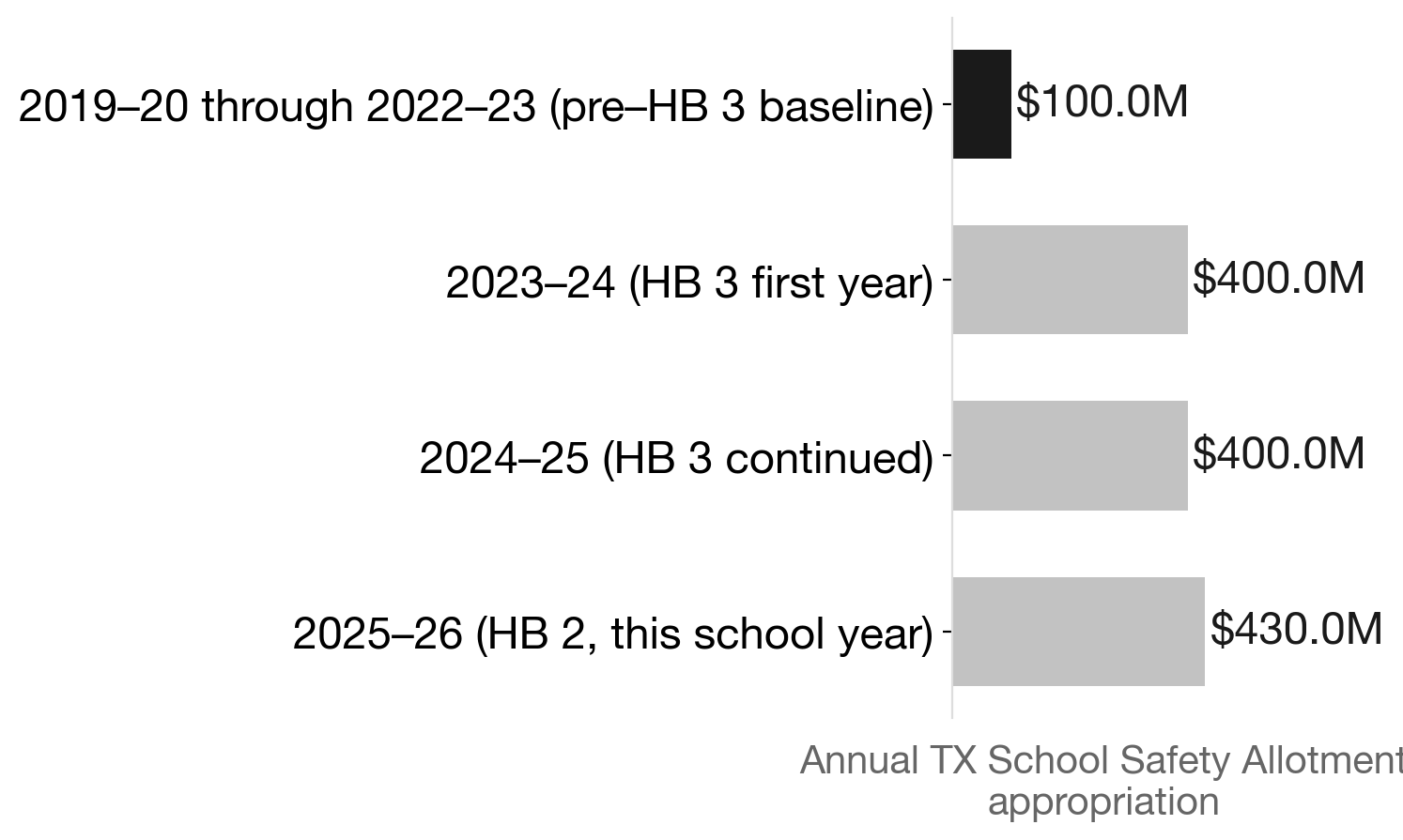
Texas school districts filed 10 school safety RFPs in the last 30 days, against a baseline of roughly 3.8 per month, a 2.7x spike that looks modest until you understand what is driving it. The real story is not the count. It is the $430 million that arrived in district accounts this school year with a compliance deadline already running, and the scramble that follows when 1,200 school systems all go shopping for the same equipment at once.
Governor Abbott signed House Bill 2 on June 4, 2025, committing what analysts have described as the largest school safety investment in Texas history. The legislation more than doubled the School Safety Allotment: the per-student rate rose from $10 to $20, and the per-campus base jumped from $15,000 to $33,540. For a typical 600-student campus, that means roughly $46,000 per year in dedicated safety funding, up from about $21,000. According to KUT's reporting on HB 2, it was the first time most districts would have enough money to fund both technology and personnel from the same stream rather than choosing between them.
Layered on top of the money is a hard equipment deadline. SB 838, passed in the same legislative session, mandated silent panic alert technology in every Texas classroom effective the 2025-2026 school year. Every teacher, every room, the same school year the new allotment arrived. Districts that fail to meet that requirement face state audits and civil penalties, consequences that were largely theoretical under earlier safety legislation but are now written into the statute.
Source: NationGraph.
The urgency is not hypothetical. A January 2025 Texas Senate Education Committee report found that more than half of Texas districts still could not meet the one-armed-officer-per-campus requirement imposed by HB 3 back in 2023, two full years after that law passed. The funding gap was a primary reason. HB 2 was designed to close it. But closing a two-year compliance deficit while simultaneously installing classroom-by-classroom panic alert systems, all before the first audit cycle, is not a planning exercise. It is a procurement sprint.
Humble ISD, a Harris County district, illustrates what that sprint looks like in practice. Since late July 2026, Humble has issued more than 10 iterative amendments to a single "School Safety Products and Services" RFP, accounting for nearly the entire 30-day spike in the statewide count. Ten revisions to one bid is not a sign of a district that knows what it wants. It is a sign of a district working through vendor availability, scope uncertainty, and specification changes in real time, because the market it is buying into did not anticipate $430 million arriving at once across more than 1,200 districts simultaneously.
The congestion is visible across the state. More than 20 Texas districts, including Denton ISD, Cypress-Fairbanks ISD, Mission CISD, and Ector County ISD, each hold between 10 and 30 active school safety RFPs on procurement platforms, the accumulated legacy of the post-HB 2 wave. Suppliers of panic alert systems, security cameras, and armed-officer staffing contracts are being asked to respond to bids from Houston to El Paso to the Panhandle at the same moment. As one analysis of the Texas safety law requirements notes, the SB 838 mandate alone requires a classroom-level hardware rollout at a scale the vendor ecosystem has not previously faced in a single state in a single year.
Federal dollars are adding another layer. Eleven active DOJ Stop School Violence grants totaling approximately $9.6 million are flowing to Texas districts this cycle, including $1 million each to Uvalde CISD, Harlingen CISD, and El Paso ISD, and $930,000 to the Harris County Department of Education. Uvalde's inclusion is notable: three years after the May 2022 shooting that reshaped Texas school safety politics across three successive legislative sessions, the district is still in the federal grant queue alongside the state allotment.
For the parents and staff in affected districts, the most immediate change is practical: panic alert buttons in classrooms are not optional this year, and the officer on campus is closer to a legal requirement than it has ever been. Whether the vendor market can absorb the demand in time is the question that Humble ISD's 10-round bid process is asking out loud.
The next signal to watch is the state's first audit cycle under the new penalty provisions. Districts that entered the 2025-2026 year still short on compliance have until those audits begin to show receipts. The procurement spike is, in that sense, a deadline made visible.