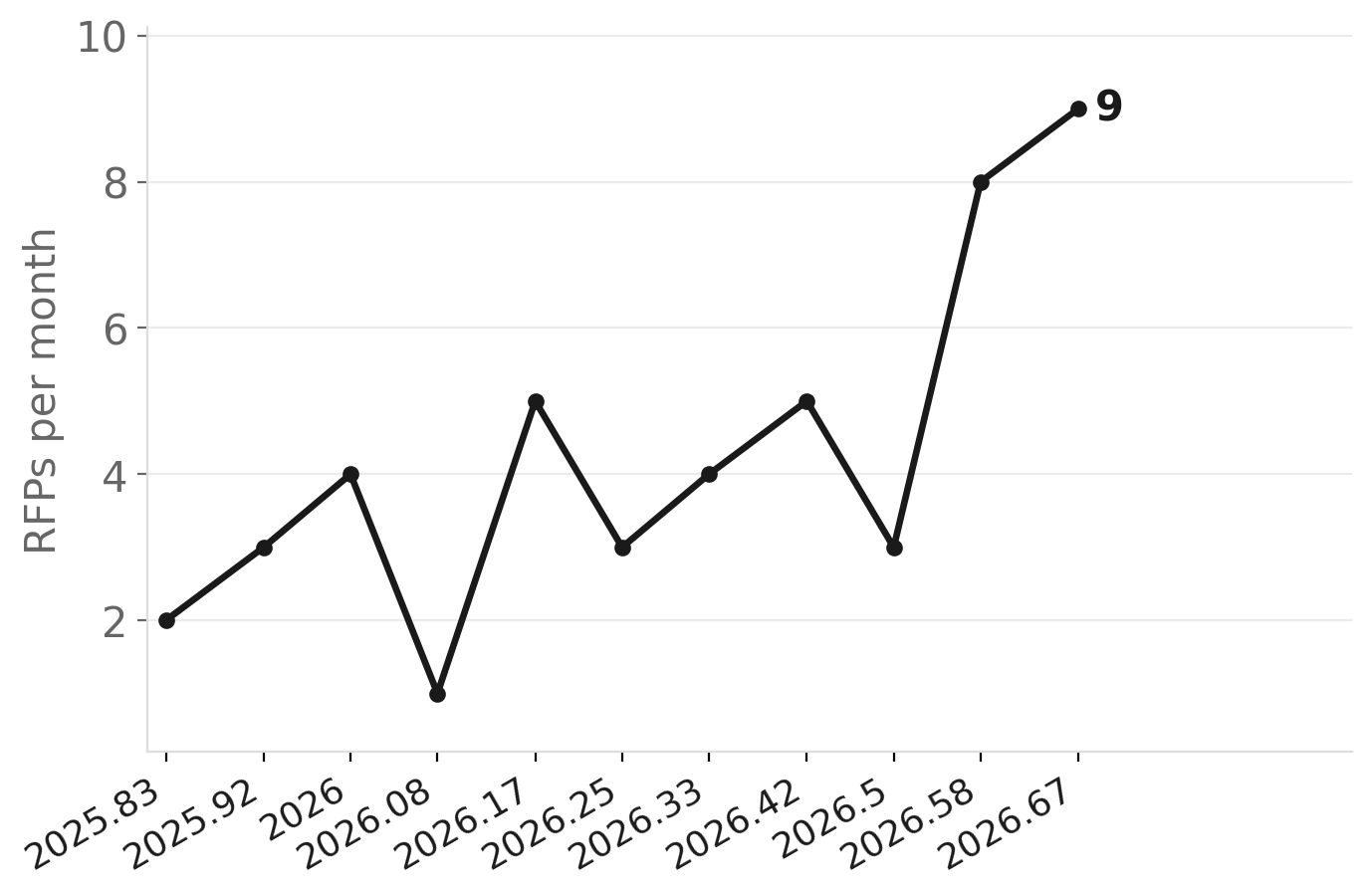
New York municipalities issued 9 water infrastructure RFPs in the last 30 days, double the state's trailing monthly average of roughly 4.5, and the acceleration is not random. Two deadlines are converging: the IIJA's supplemental water funding authorization expires September 30, 2026, closing the final chapter of a $50 billion federal water investment era, and the New York Environmental Facilities Corporation closed a $425 million competitive grant round on July 27. Communities that won awards from that round are now legally required to enter procurement to access the money.
The procurement surge is showing up across the state's geography and project types, which is itself a signal. Cortland is seeking vendors for cybersecurity and water systems work. Oneonta has posted a water district needs analysis. The Monroe County Water Authority is out with a utility location contract. Buffalo and Rockland County have active solicitations for underground utility work. This is not one agency running ahead of schedule, it is dozens of communities responding to the same funding clock simultaneously.
The state-level contrast makes the case even more clearly. Pennsylvania and New Jersey, both of which have their own aging water infrastructure and access to the same federal programs, are running at 0.56x and 0.33x their own monthly averages respectively. New York is the only major Northeast state above its baseline. That divergence points to something specific about New York's pipeline, not a regional surge in activity.
Source: NationGraph.
The specific mechanism is New York's hybrid funding architecture, which Governor Hochul's administration has been assembling aggressively over the past year. The EFC's Water Infrastructure Improvement Act grants and Intermunicipal Water Infrastructure Grants, a state competitive program that has delivered $3.4 billion to municipalities since 2015, sit on top of the federal IIJA Clean Water and Drinking Water State Revolving Funds, which together hold over $1.1 billion in active EPA grants flowing through EFC. Layered on those is the voter-approved 2022 Environmental Bond Act, a $4.2 billion state bond bill that extends New York's water funding runway beyond the federal expiration. And separately, the state's LIFT program, a $100 million state appropriation, covers lead service line replacement costs that the federal grants don't fully reach, shielding ratepayers from the gap.
These are four distinct programs with different legal authorities, different funding sources, and different application cycles. But they share one practical chokepoint: EFC board approval, which is the gateway to procurement. When EFC approves a financing package, the clock starts. Between October 2025 and January 2026 alone, Governor Hochul announced over $758 million in EFC water financing packages covering cities from Southampton to Schenectady to Bath. Each of those approvals was a procurement obligation waiting to be triggered.
The federal side of the equation has its own urgency. The EPA announced $2.9 billion in final-year IIJA lead pipe replacement funding in May 2026, the last tranche of what was a $3 billion annual authorization running from FY2022 through FY2026. After September 30, the supplemental era is over nationally. Nationally, H1 2025 IIJA water project awards were already 53 percent lower than H1 2024 as federal uncertainty slowed discretionary grants, making the state-administered EFC pipeline comparatively more active and more critical.
New York's backlog makes the deadline particularly consequential. EFC's own FY2026 Clean Water SRF Intended Use Plan identifies over $7 billion in statewide demand for clean water projects while EFC can fund roughly 23 percent of that through subsidized financing. New York also carries one of the highest lead pipe inventories in the country, concentrated in pre-1986 cities whose service line records are incomplete and whose replacement costs run well above national averages.
The state's bond act money and LIFT program will survive September 30. EFC will keep approving financing packages and municipalities will keep filing applications. But the end of the IIJA supplemental era removes the largest single federal funding source that New York has been layering its state programs on top of. Communities that move into procurement now are locking in project financing while the full stack is still available. Communities that miss this window will compete for a smaller pot.
The next signal to watch is EFC's board calendar through September. Any additional approvals before the 30th create new procurement obligations, and potentially extend the RFP spike into October as grantees execute. Congress has shown no clear path to reauthorizing IIJA's water titles, so the September 30 date remains hard. Whether New York's state pipeline alone can sustain the pace of investment that nine RFPs in thirty days represents is the open question heading into FY2027.