Nine California institutions issued a homelessness-response RFP for the first time in over a year during the past 30 days, a number that stands against five such issuances in Washington and three in New York over the same window. The jurisdictions range from Fresno County and Humboldt County to the city of Richmond, El Segundo, Oakland Housing Authority, Sacramento City College, and San Mateo County. The service types span street outreach, substance use treatment, emergency shelter vouchers, legal services, and behavioral health contracting. This is not a single program activating; it is a dormant tier of California local government coming back online at the same time.
The timing is not accidental. California's Homeless Housing, Assistance and Prevention program, a state appropriation administered by the Department of Housing and Community Development, has been the primary infrastructure for homelessness funding across counties and Continuums of Care for years. HHAP Round 6 funds, long delayed by bureaucratic processing, only became fully available to all California regions as of May 2026. Simultaneously, AB 179, signed by Governor Newsom in July 2026, locked in $900 million for HHAP Round 7 in FY 2026-27, but attached conditions that did not exist in prior rounds: local matching contributions, Prohousing designation compliance, and demonstrated spending activity as a prerequisite for access. Jurisdictions that cannot show procurement movement risk losing a seat at the Round 7 table.
That squeeze is what a Mendocino County senior program manager described to CalMatters in January 2026: "They're holding the counties' feet to the fire." The quote captures the mechanism precisely. Smaller jurisdictions that absorbed HHAP funds in prior rounds but let procurement lapse, because their capacity was thin, or because the state's accountability frameworks were softer, now face a structural deadline. Issue an RFP and begin spending, or lose eligibility for the next round.
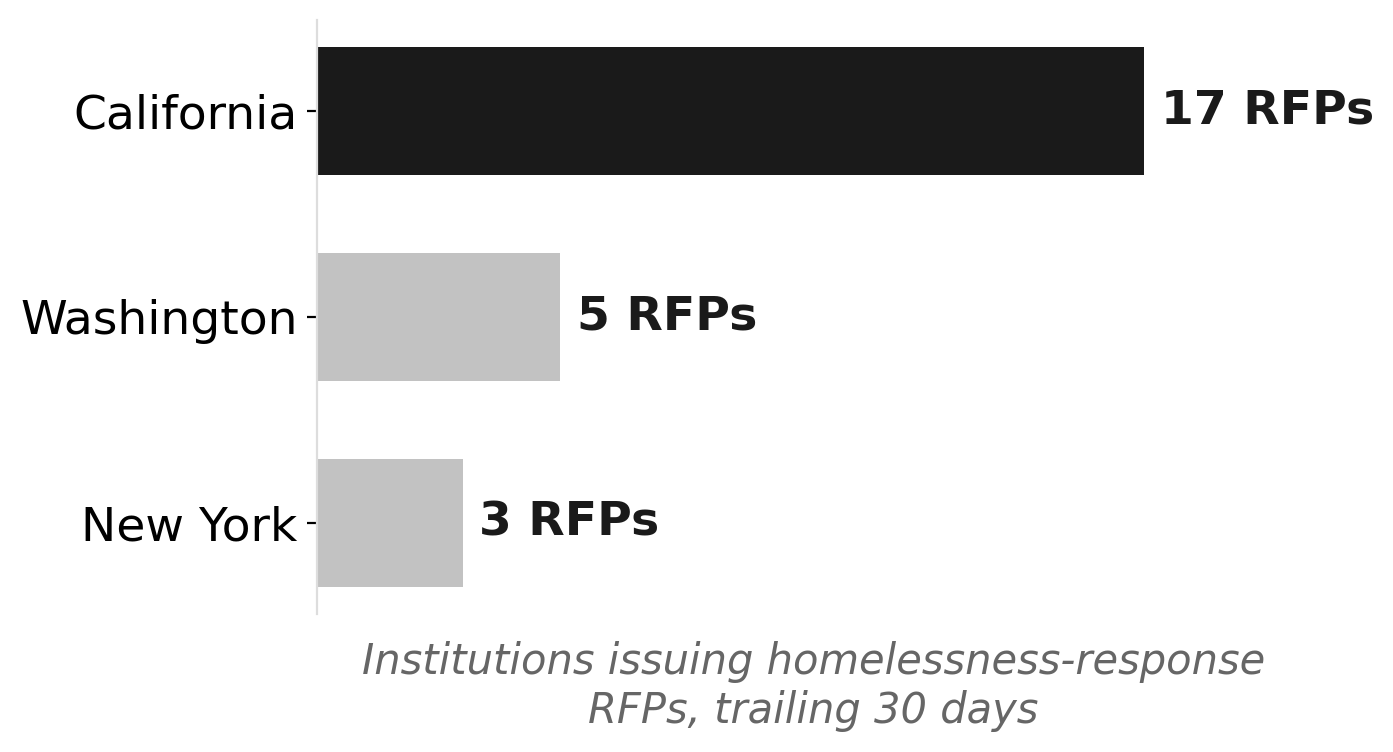
Source: NationGraph.
Fresno County's new RFP is a clear illustration of what this pressure looks like in practice. The county is not renewing an existing contract; it is soliciting bids for what it describes as a "newly designed regional street outreach program", a structural rebuild from the ground up. Fresno was explicitly cited in a January 2026 Governor's press release as a site where the state's SAFE Task Force connected people with shelter following California's reported 9% drop in unsheltered homelessness in 2025, the first such decline in 15 years. The administration has used that data point to argue that tighter performance accountability justifies the new Round 7 conditions, a logic that is now pushing counties like Fresno to redesign programs rather than simply extend them.
It is worth being precise about what is driving this wave and what is not. HHAP is a state appropriation, distinct from two other active California funding streams that are also flowing through the homelessness system right now. HUD's Continuum of Care program, a federal grant, provides ongoing funds to housing authorities and homelessness agencies independently of HHAP, the LA Housing Authority holds an active $17.8 million CoC award, San Francisco's Department of Homelessness and Supportive Housing holds $16.2 million. Those grants operate on their own federal cycles and are not the source of this month's procurement activation. Separately, California's Proposition 1 behavioral health bond, a $6.4 billion state bond bill passed in 2024, is funding behavioral health infrastructure and Homekey+ housing through DHCS and HCD on its own disbursement schedule. All three streams are active in California simultaneously. But it is HHAP's Round 7 conditions under AB 179, with their explicit spend-down accountability requirements, that are directly pulling dormant jurisdictions back into the procurement market.
The March 2026 CARE Court announcement added another layer to the accountability architecture: $291 million in supportive housing and behavioral health funds distributed to counties with performance benchmarks attached. The state is running multiple accountability clocks at once.
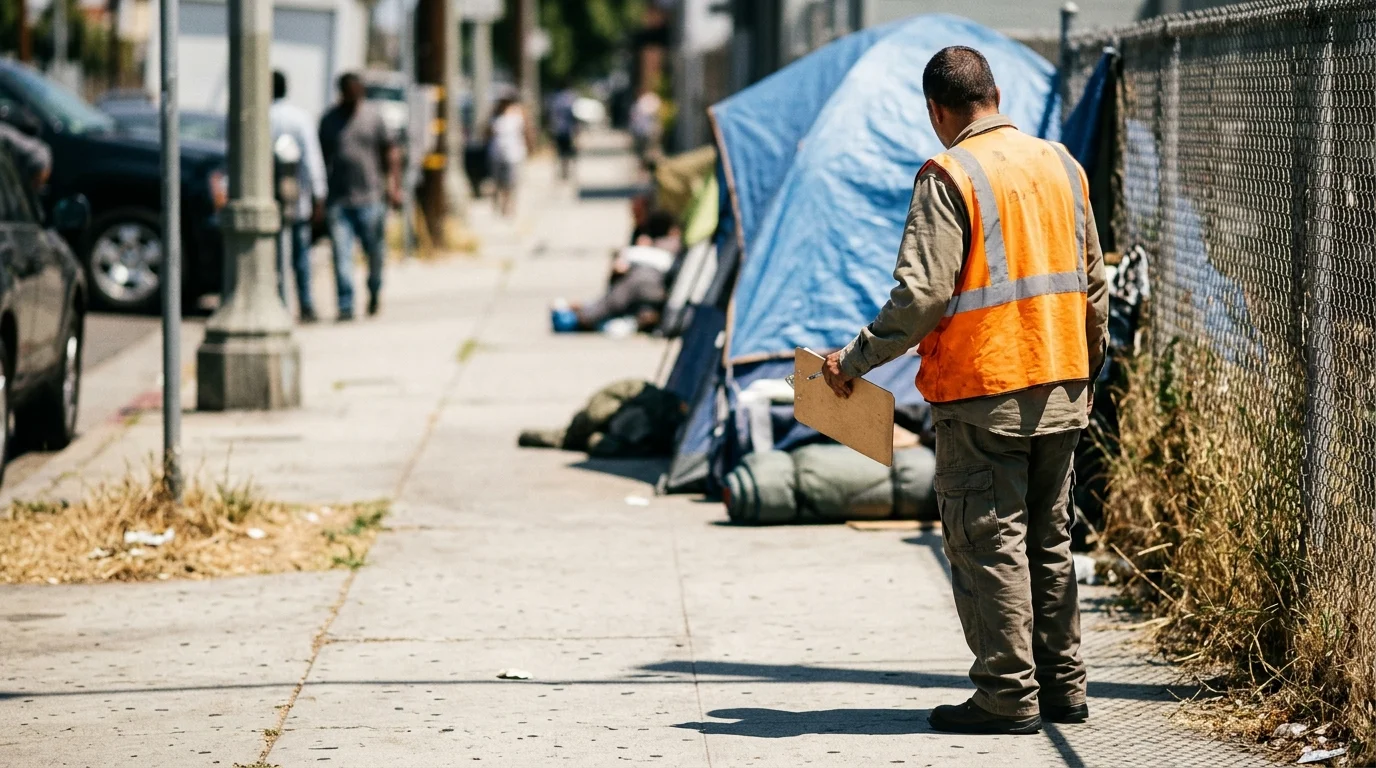
For residents in the cities and counties now entering the market, the immediate consequence is that service contracts that did not exist six months ago will now be competed and awarded over the next several months. Street outreach in Fresno, a homeless day center in Richmond, substance use services in El Segundo, these are real service gaps being filled under real procurement timelines. The quality and speed of what gets stood up will depend on whether local agencies can attract qualified providers in a compressed window.
The next signal to watch is whether these jurisdictions complete their procurements and demonstrate spending activity before the Round 7 application window opens. AB 179's accountability conditions mean that issuing an RFP is the beginning of the test, not the end of it.