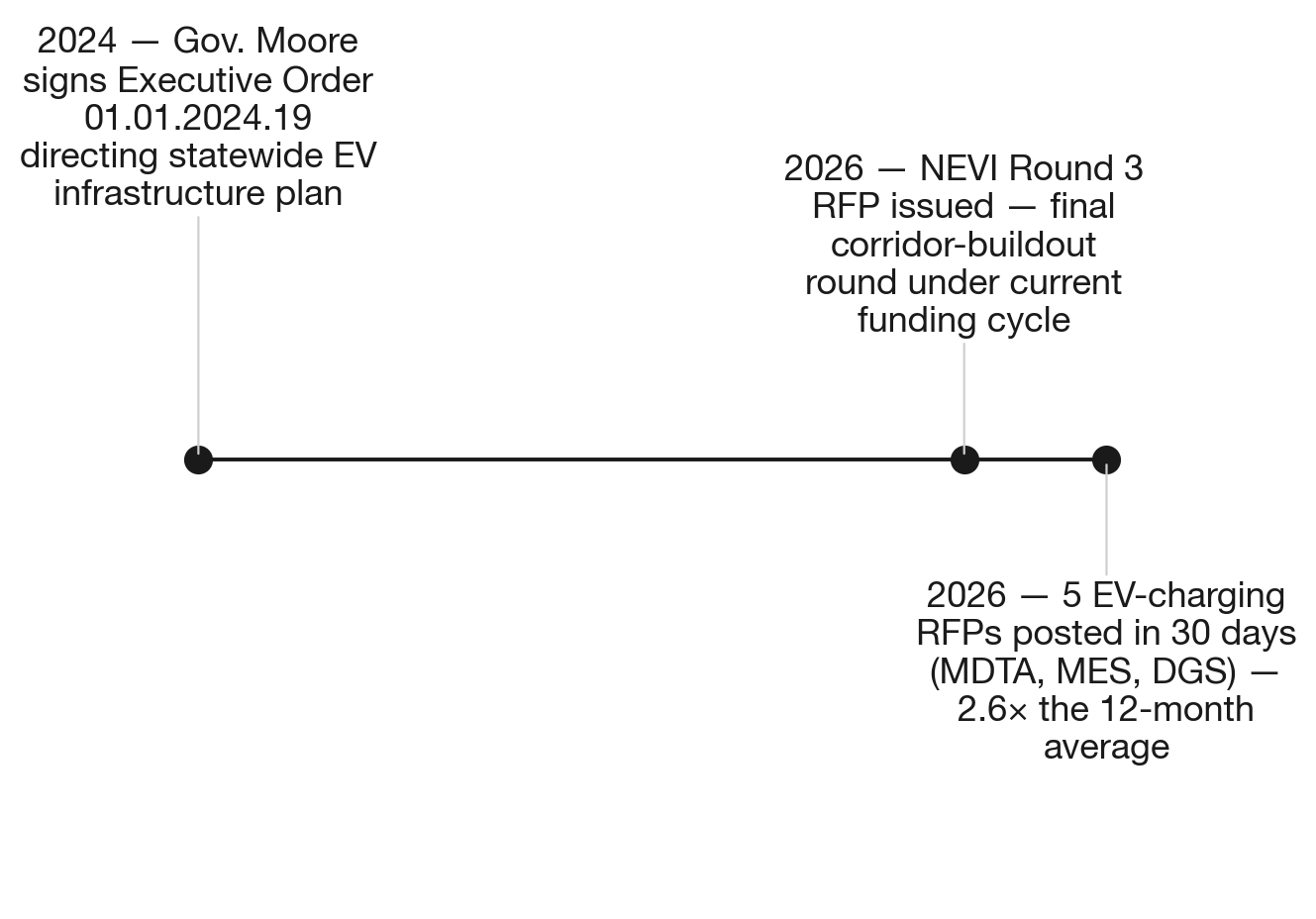
Maryland agencies posted five EV charging-related RFPs in the last 30 days, against a 12-month monthly average of roughly 1.9, a 2.6x spike that reflects something specific: the state's $63 million federal EV charging program has a hard clock on it, and the clock is running out.
The burst is not a one-month anomaly. The 2026 baseline was already elevated, running three to four solicitations per month in March, May, and July. The current surge lands on top of that already-accelerated floor. Two agencies account for most of the volume: the Maryland Transportation Authority has posted bids covering MARC rail wayside power upgrades and comprehensive ITS and electrical engineering services, while the Maryland Environmental Service has issued two linked solicitations for electrical infrastructure at Janes Island State Park, including EV charging stations. The Maryland Department of General Services added a statewide supplies-and-equipment solicitation out of its White Oak facility. Taken together, they trace the outline of a buildout moving from state transportation corridors down into park infrastructure and general procurement.
The driver is a convergence of two deadlines arriving within months of each other. On March 17, 2026, MDOT launched NEVI Round 3, the final corridor-buildout round under Maryland's FFY 2022-2026 federal apportionment. Then on May 18, 2026, MDOT published Maryland's first Zero Emission Vehicle Infrastructure Plan, a five-year roadmap built on that same $63 million NEVI allocation and issued under Gov. Moore's Executive Order 01.01.2024.19. The ZEVIP gave counties and local partners a framework for deployment through 2031, and it immediately translated into downstream agency procurement actions.
Source: NationGraph.
MDOT currently has three active NEVI grants with roughly $12 million in obligated federal funds, with performance windows running to 2036. Rounds 1 and 2 have already committed to 27 sites, 150 DC fast chargers, and approximately $16 million combined. Round 3 targets the remaining corridor gaps, along I-95, I-70, I-68, and US-50/301, that would complete Maryland's piece of the East Coast charging spine. The funding cycle ends in FFY 2026, which means agencies that have not yet contracted cannot assume the money will simply roll over.
That urgency is reinforced by the political environment around federal EV funding. Maryland joined a multistate lawsuit to protect NEVI funds from a Trump administration executive order that froze EV charging infrastructure spending. The litigation signals that Maryland is treating the remaining NEVI window as genuinely at risk, not just procedurally finite. When federal dollars are both time-limited and legally contested, the incentive to obligate quickly becomes acute.
On the demand side, Maryland has crossed 100,000 registered EVs and is legally committed to a much steeper ramp. The state's Advanced Clean Cars II mandate, modeled on California's rules, requires 43 percent of new vehicle sales to be zero-emission starting with model year 2027. Gov. Moore issued a separate executive order giving manufacturers some compliance flexibility on sales penalties for 2027 and 2028, but the infrastructure investment has not slowed, if anything, the flexibility on the vehicle side makes the charging side more urgent, since consumer adoption needs a functional network to accelerate against.
For Marylanders, the practical effect of this procurement wave depends on where they live and how they travel. The MDTA bids suggest that MARC rail stations and major corridor facilities are the near-term priority, which tracks with NEVI's federal requirement that funded sites sit within one mile of an Alternative Fuel Corridor. State park charging, represented by the Janes Island solicitation, is a secondary layer aimed at recreational and rural coverage. The ZEVIP's five-year window through 2031 means local governments now have a published state framework to align their own planning against, something that was not available before May.
The next signal to watch is how Round 3 bids close and whether MDOT can fully obligate its remaining NEVI apportionment before the federal fiscal year ends. If the multistate litigation succeeds in protecting NEVI funds, Maryland's buildout timeline holds. If it does not, the current procurement surge may represent the last reliable federal funding cycle the state can count on for corridor charging, making the contracts being written right now more consequential than they might otherwise appear.