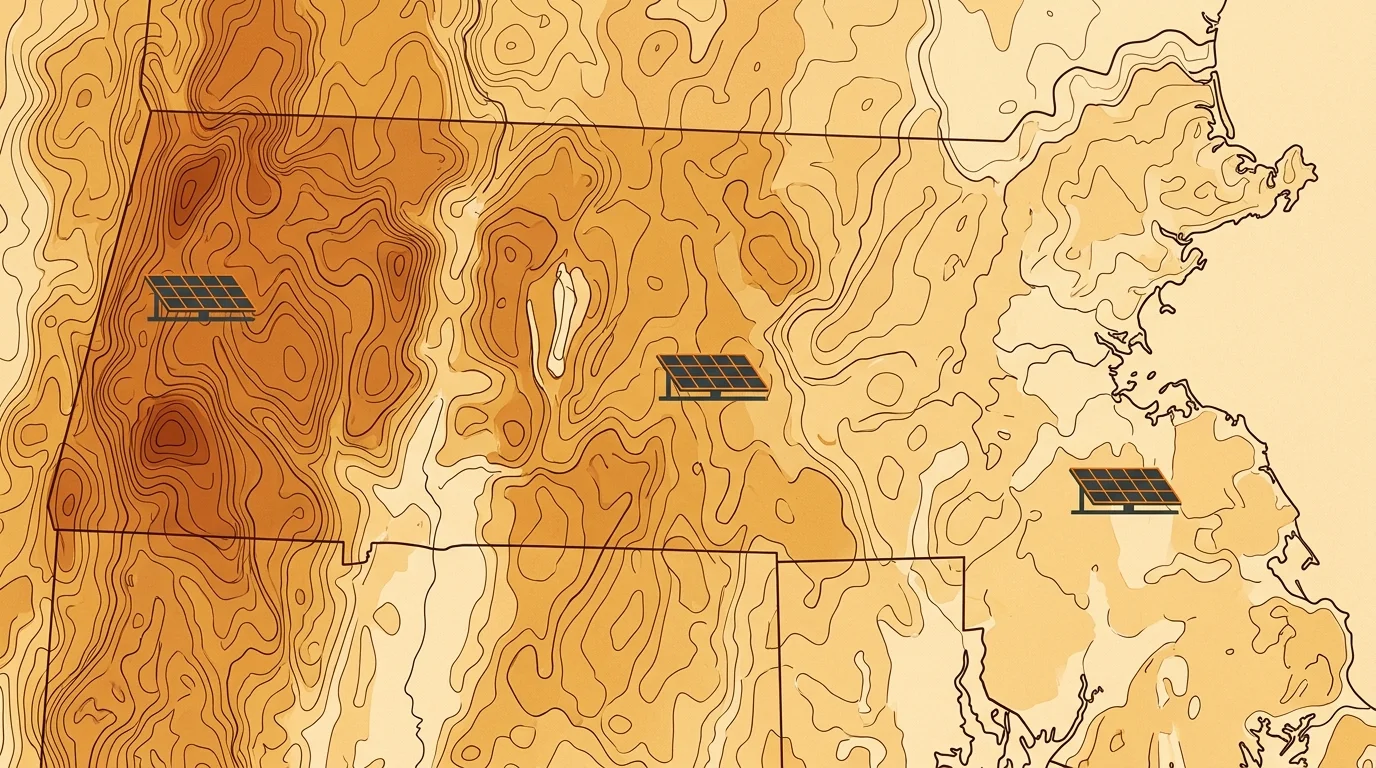
Seven Massachusetts institutions issued solar RFPs in the 30 days ending September 13, 2026, all of them returning to procurement after a gap of more than a year. In the equivalent window a year earlier, the count was zero.
The timing is not coincidental. Two interlocking forces compressed what had been a slow, uncertain return to action into a single late-summer window. The Massachusetts Department of Energy Resources resolved the last major regulatory uncertainty for SMART 3.0 on August 5, 2026, when the public comment period on its June emergency rulemaking closed. And the clock on SMART 2.0 is running out: applications close December 31, 2026, a hard cutoff that leaves municipalities fewer than four months to lock in incentive rates under either program.
The result is a small but telling cluster of deals, and what makes this cluster meaningful is not the volume but the composition. These are not the large school districts or regional utilities that drove Massachusetts' strong Q1 and Q2 activity (80 and 94 RFPs, respectively). They are towns and agencies that had sat out the market entirely, many of them because the economics never quite closed under SMART 2.0.
Source: NationGraph.
Royalston is the clearest illustration. A Worcester County town of roughly 1,300 people, it has issued a land-lease RFP to put solar on its capped municipal landfill, exactly the kind of stranded asset that generates no revenue and costs money to monitor. Under SMART 3.0, landfill and brownfield projects qualify for up to 10 MW of incentive-eligible capacity, double the standard 5 MW cap, and carry an additional per-kWh adder on top of base rates. For a town without the budget to break new ground, a capped landfill it already owns is suddenly worth something.
The same logic is playing out across different project types. Yarmouth and Andover have issued rooftop PV RFPs structured as power-purchase agreements, a financing model that requires no municipal capital outlay and transfers project risk to a private developer. The Somerville Housing Authority is seeking community solar bill-credit subscriptions specifically for low-income tenants, a structure that SMART 3.0 explicitly rewards with a dedicated low-income offtaker adder. Needham's DPW issued an on-call solar maintenance contract, a quieter signal that earlier installations are now mature enough to require service.
What ties these together is the SMART 3.0 public-entity offtaker adder, a provision the Healey-Driscoll administration specifically designed for municipalities, housing authorities, and school districts. By improving the per-kWh return for projects where a public body is the offtaker, DOER changed the math for towns that had run procurement processes before and walked away because developer interest was thin or financing terms didn't pencil out. Andover's Sanborn Elementary rooftop project, for instance, is a re-bid, meaning the town had already tried and stalled.
The regulatory timeline matters here. SMART 3.0's emergency regulations were finalized in August 2025 and the first program year opened for applications in October 2025, but a second round of emergency changes filed in June 2026 left some uncertainty about final adder rates and eligibility rules through the summer. The August 5 comment-period close resolved that uncertainty. Towns that had been watching and waiting had their answer just weeks before this procurement cluster formed.
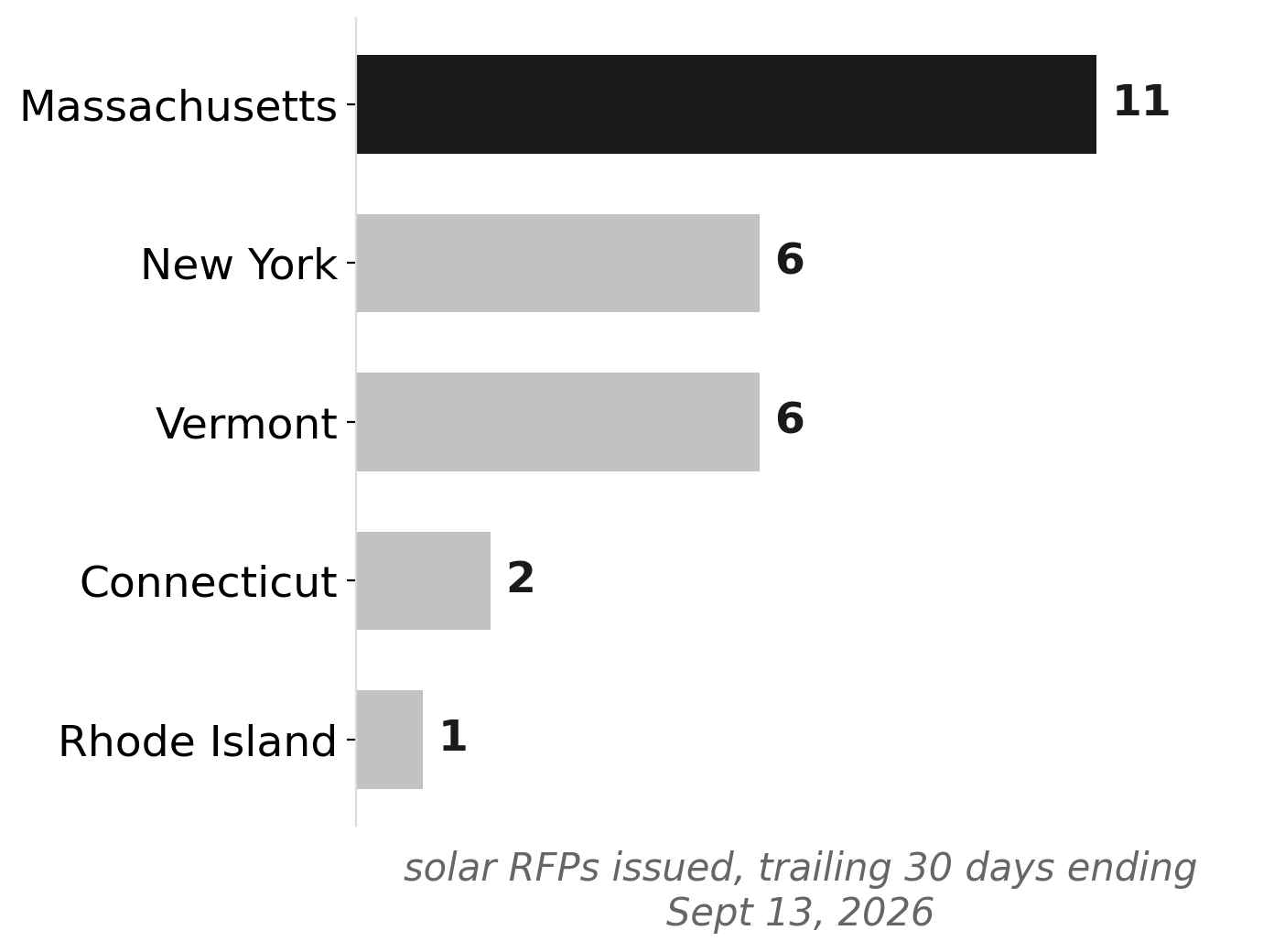
Massachusetts logged 11 solar RFPs in the trailing 30-day window, more than any other New England state, New York and Vermont each recorded six, Connecticut two, Rhode Island one. But the more useful comparison is internal: after a softer Q3 (25 RFPs through mid-September), the re-entry of dormant institutions suggests the program is reaching communities it had not previously captured, rather than simply cycling through the same pool of active municipal buyers.
The City of Medford offers a parallel data point. A $1.15 million federal DOE grant awarded in December 2024 is funding a resilient community solar demonstration at Carr Park and the Madeleine Dugger Andrews School through the end of 2026. That project is a federal construction grant, separate from SMART's per-kWh payment structure, but it points to the same phenomenon: public-facility solar is attracting capital from multiple directions simultaneously.
For residents in towns that have been slow to act, the immediate question is whether local officials move fast enough. The December 31 SMART 2.0 deadline is fixed; SMART 3.0 is open, but program-year capacity caps mean earlier applications face less competition for incentive allocations. Towns issuing RFPs now will need to select developers, negotiate contracts, and file applications within a window that gets tighter every week.
The next signal to watch is whether this cluster represents a one-time deadline response or the leading edge of a broader wave. DOER's program-year capacity data, published periodically, will show whether the public-entity allocation is filling faster than prior years. If it is, the towns that waited longest may find the queue ahead of them longer than they expected.