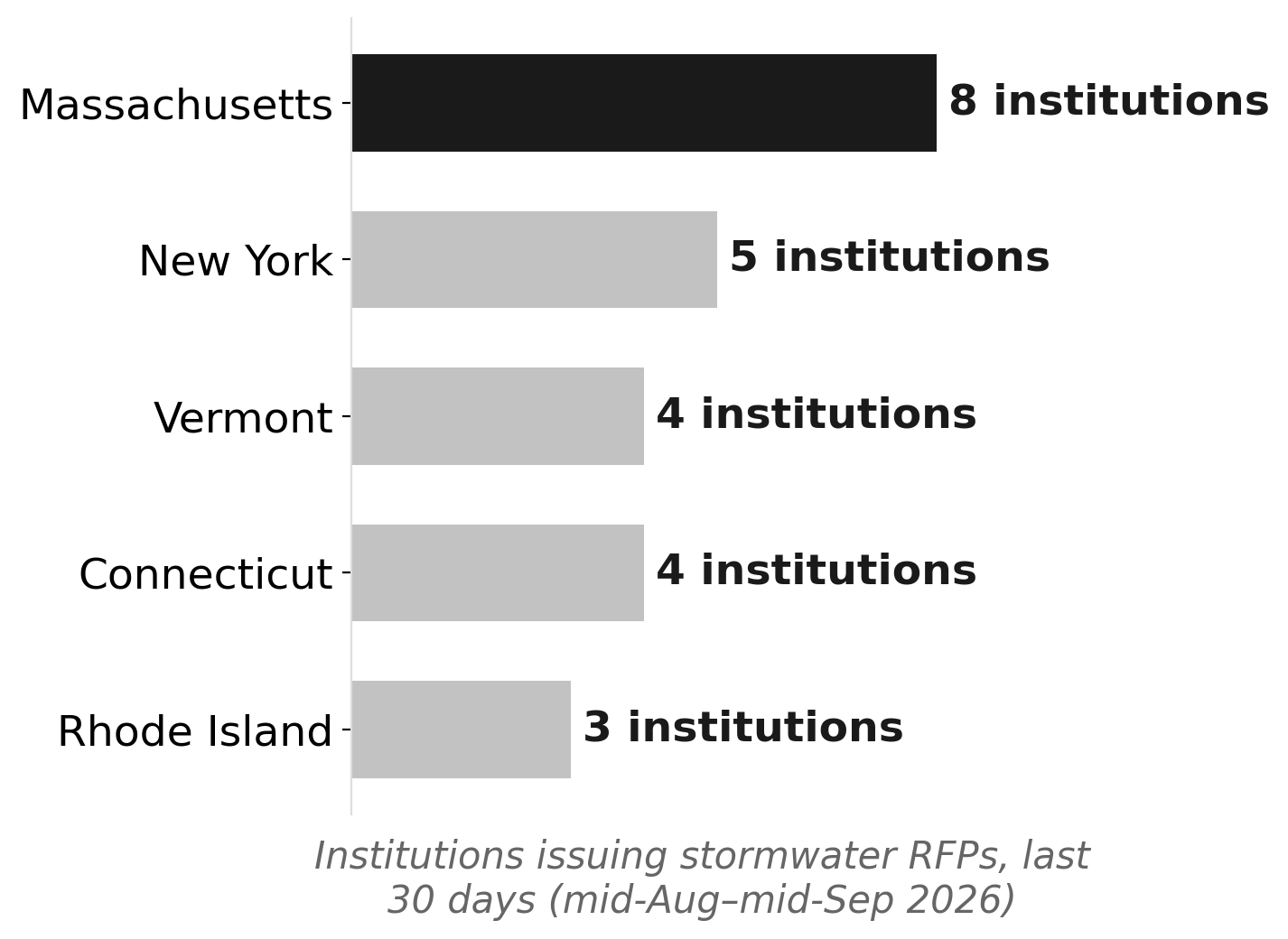
Seven Massachusetts municipalities issued a stormwater management RFP for the first time in more than a year during the 30 days ending mid-September 2026, up from zero such first-timers in the comparable prior period. August 2026 alone saw 10 distinct institutions put out 15 stormwater solicitations, making it the single busiest month for new entrants in the trailing 18-month window. No comparable burst appears anywhere else in New England: Massachusetts led the region with 8 active institutions and 14 RFPs in the most recent 30-day period, ahead of New York (5), Vermont (4), Connecticut (4), and Rhode Island (3).
The institutions entering the market are not clustered in one corner of the state. Wellfleet, on the outer Cape, and Gloucester, on the North Shore, are issuing their first solicitations alongside Melrose in Middlesex County, East Brookfield in Worcester County, and the Central Massachusetts Regional Planning Commission, which coordinates procurement for a coalition of smaller towns. Their procurement activity points to two forces arriving at the same moment: a regulatory stick and a competitive grant carrot, and the two should not be confused for a single program.
The stick is EPA Region 1's 2024 Draft MS4 General Permit. Unlike most states, Massachusetts receives its municipal stormwater permit directly from EPA rather than through a state-level intermediary, which means the permit carries federal NPDES enforcement weight the moment it is finalized. EPA put the revised draft on public notice in November 2024 and held a virtual public hearing in May 2025; the comment period is closed and finalization is now visible on the horizon. The new permit covers more than 260 Massachusetts municipalities and adds requirements that did not exist in the 2016 version: catch basin upgrades, nature-based street design standards, integrated asset tracking, and stormwater treatment on permittee-owned property. For most of the last four years, towns tolerated this ambiguity because the 2016 permit had been in administrative continuation since July 2022, effectively frozen in place. That grace period is ending.
Source: NationGraph.
The carrot is MassDEP's MS4 Municipal Assistance Grant, a separate state competitive program that funds the planning and capital work municipalities need to achieve permit compliance. MassDEP held a pre-application information session on August 11, 2026, signaling that a formal Request for Response for the FY27 cycle is imminent. The estimated allocation is roughly $250,000, awarded on a coalition basis, meaning individual towns must partner with a regional planning entity to be eligible. MassDEP was explicit at that session that stormwater receives lower priority for funding than drinking water and wastewater projects and that municipalities face increased pressure to meet local funding needs with fewer state and federal resources. The practical consequence: towns that cannot show a current stormwater modeling plan or BMP inventory when the RFR drops will not be competitive.
Melrose's solicitation captures exactly what is at stake. The city is procuring a "Citywide Stormwater Modeling and Alternatives Analysis", the specific type of planning document that both satisfies new permit requirements and satisfies grant eligibility criteria. A modeling study commissioned now can be submitted as part of a coalition application before the FY27 RFR closes; the same study commissioned after the permit is finalized arrives too late to affect the grant cycle. The procurement calendar, not the regulatory calendar, is setting the pace.
The financial backdrop is substantial. The Massachusetts Clean Water Trust holds $141.6 million in active federal Clean Water State Revolving Fund obligations through 2032, providing below-market loan capacity for stormwater and wastewater capital work. A separate $587,000 EPA Sewer Overflow and Stormwater Reuse Municipal Grant runs through September 2029. These are distinct funding streams with different purposes and different administrators: SRF money flows as loans through the Trust, while the MassDEP grant is a direct competitive award. Towns drawing on both will need to track them separately.
For smaller communities, the coalition structure changes the math. East Brookfield (population roughly 2,200) and Wellfleet (roughly 3,600) would face prohibitive per-capita costs if they procured stormwater planning alone. By entering the market through the Central Massachusetts Regional Planning Commission or a Cape-based coalition, they share consulting costs, pool data assets, and become eligible for grant tiers that require multi-municipality participation. The RFP activity from these towns is, in part, an application for membership in a coalition that already has a grant pipeline.
The next signal to watch is the MassDEP FY27 RFR release date. When it publishes, the window for municipalities to finalize their consultant contracts, collect baseline data, and prepare a coalition submission will compress quickly. Towns that issued RFPs in August and September will have a lead; towns still on the sidelines will face a shorter runway and a thinner consultant market. EPA's finalization timeline for the MS4 permit itself remains unannounced, but every month that closes without a release date is a month fewer municipalities have to build the compliance programs the permit will require from day one.