Seven Massachusetts municipalities that had gone quiet on housing procurement for more than a year all issued housing-related RFPs in the last 30 days, a cluster that signals something beyond routine budget cycles. The towns are not acting because they suddenly want to build housing. They are acting because, after December 31, 2026, the cost of inaction stops being abstract.
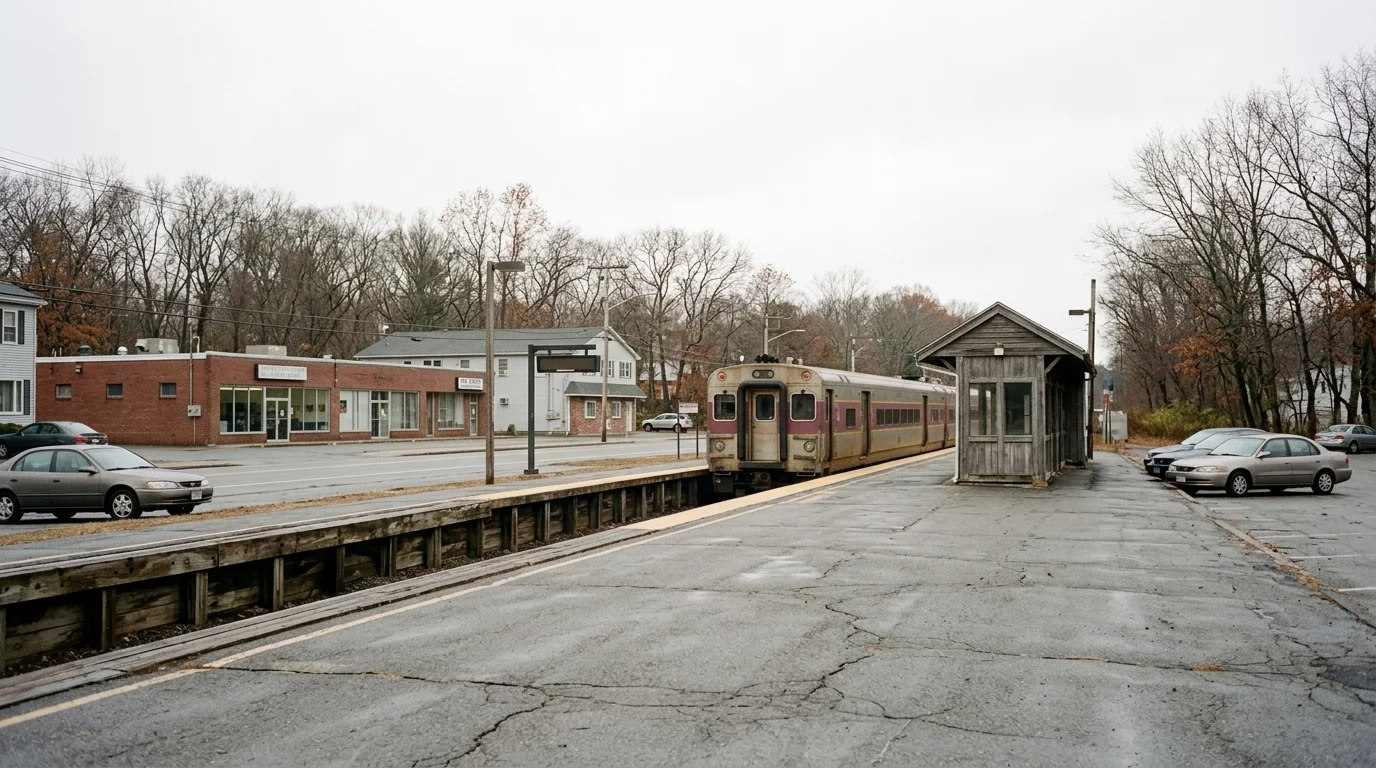
The December 31 date is the final compliance deadline under the MBTA Communities Act (M.G.L. c.40A §3A) for so-called "small adjacent" municipalities, the last cohort of the 177 transit-served communities the law covers. As of February 2026, 12 of those communities had still not adopted the required multifamily-by-right zoning near transit stations. Towns like Carver and Rehoboth are running out of runway. But even communities that cleared the zoning bar months ago are now scrambling, because the Healey administration has turned MBTA compliance into the price of admission for a wide basket of competitive state grants funded by the Affordable Homes Act, and the fiscal year won't wait.
Under EOHLC's FY27 program guidelines, the MBTA Communities Catalyst Fund, the Housing Choice Grants, the HousingWorks Infrastructure Program, and the Community Planning Grants all explicitly bar non-compliant communities from most grant activities. The Affordable Homes Act (Chapter 150, signed August 2024) authorized $5.16 billion in state bond spending, including $25 million for Community Planning Grants and $175 million for Housing Choice Infrastructure. That money is sitting there. Towns that have not adopted compliant zoning cannot touch it. The result is a trap: a community needs planning money to design the zoning that would make it eligible for planning money. Hiring a consultant to draft a Housing Production Plan or a zoning bylaw is the only way out.
Source: NationGraph.
The October RFPs show exactly that dynamic playing out. Danvers issued a Housing Production Plan consultant RFP, the foundational document that most grant programs require before a community can apply. Concord issued an RFP for a Regional Housing Services Office coordinator, the administrative infrastructure needed to manage housing programs at scale. Marblehead went further, releasing an RFP to study converting Coffin Elementary School into housing, a school-to-residential conversion that requires both zoning flexibility and a development partner. These are not the moves of communities that are comfortable with the status quo. These are communities buying time to get compliant before the next grant cycle opens.
The urgency is reinforced from two directions. The Massachusetts Attorney General's second advisory on Section 3A enforcement, issued in mid-2025, warned that non-compliant communities would face civil enforcement suits and the loss of discretionary state grant funding. The Supreme Judicial Court confirmed the law's constitutionality in a January 2026 opinion, removing the last procedural escape route. What was once a mandate with uncertain teeth now has both judicial backing and a credible enforcement threat attached to it.
A separate federal layer adds pressure without being part of the state mechanism. Yarmouth's $1.5 million affordable housing development RFP, flagged as federally funded with a December 4 deadline, is almost certainly tied to HOME Investment Partnerships or CDBG flows administered through HUD. A July 2026 federal housing bill tied a portion of CDBG funding to housing production metrics, meaning that communities failing to show progress on production face a secondary financial penalty that operates independently of anything Beacon Hill has done. The state and federal clocks are running simultaneously.
None of this has yet translated into housing at scale. A January 2026 Boston Foundation report found that the MBTA Communities Act had put roughly 7,000 units into the pipeline across 34 communities, real, but modest, relative to the scale of the mandate and the state's housing shortage. The gap between compliant zoning and actual construction remains wide. What the current procurement wave represents is not the housing getting built; it is towns purchasing the professional capacity to make that next step possible.
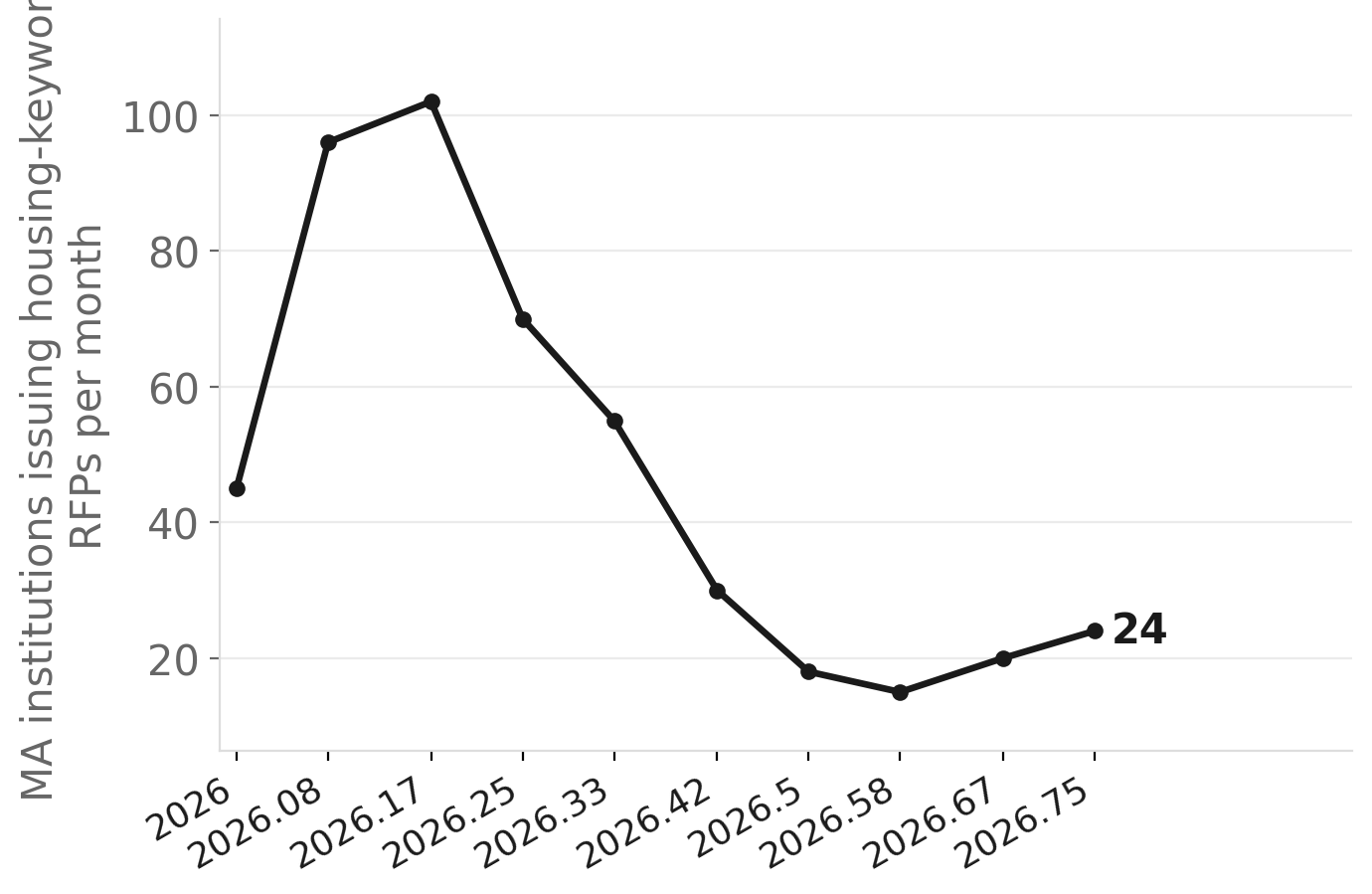
The broader 30-day picture reinforces this reading. October 2026 shows 24 distinct Massachusetts institutions issuing housing RFPs, well below the February-March 2026 peak of 96 to 102 institutions per month, which likely reflects the prior compliance scramble, but sharply elevated from the summer trough. The re-entry of towns that had gone silent for 12 or more months is the tell. These are not communities that have been steadily working the problem. They are communities that paused, watched, and are now moving because the deadline is close enough to feel real.
The next signal to watch is whether EOHLC's FY27 grant awards, expected in early 2027, reflect a meaningful jump in applications from communities that completed their compliance steps in Q4 2026. If the October procurement wave produces approved zoning bylaws and Housing Production Plans by year-end, the grant competition for Catalyst Fund and Community Planning dollars will be sharper than it has ever been. Towns that move now will be positioned. Towns that don't will have to explain to their residents why the infrastructure money went somewhere else.