Ohio water systems issued 11 procurement requests in the trailing 30 days, more than double the 12-month monthly average of 4.6, and the spike has almost nothing to do with a sudden burst of engineering ambition. It has everything to do with a calendar date: September 30, 2026, when the Infrastructure Investment and Jobs Act's five-year water infrastructure authorization expires and three streams of federal funding stop flowing.
The numbers behind that deadline are substantial. Ohio currently holds $644 million in active Clean Water State Revolving Fund commitments across nine federal grants, $56 to $85 million in active Drinking Water SRF tranches, and $91 million in active WIIN Emerging Contaminants grants, a combined federal footprint that has made Ohio one of the most SRF-dependent states in the Midwest over three decades. In May 2026, EPA awarded Ohio an additional $201.7 million for lead service line replacement, the fifth and final IIJA lead-pipe round, closing out $305 million distributed to more than 140 Ohio communities since 2021. That same month, a federal memo confirmed Ohio's FY2026 PFAS emerging contaminants allotment at $20.89 million.
All three programs, the Clean Water SRF, the Drinking Water SRF, and the WIIN Act's Emerging Contaminants in Small or Disadvantaged Communities grant, are distinct mechanisms doing different things. The SRFs are EPA capitalization grants to Ohio EPA, which then sub-awards as below-market loans and, for disadvantaged communities, outright principal forgiveness. The EC-SDC program passes through to localities as direct grants for PFAS testing, planning, and treatment. But they share a delivery channel (Ohio EPA's Division of Environmental and Financial Assistance), a purpose (getting water infrastructure funded in communities that can't do it alone), and a hard stop: the IIJA authorization window closes on September 30. Ohio EPA's own PY2026 WPCLF Program Management Plan designates this as the last program year of IIJA Supplemental and Emerging Contaminants capitalization grants.
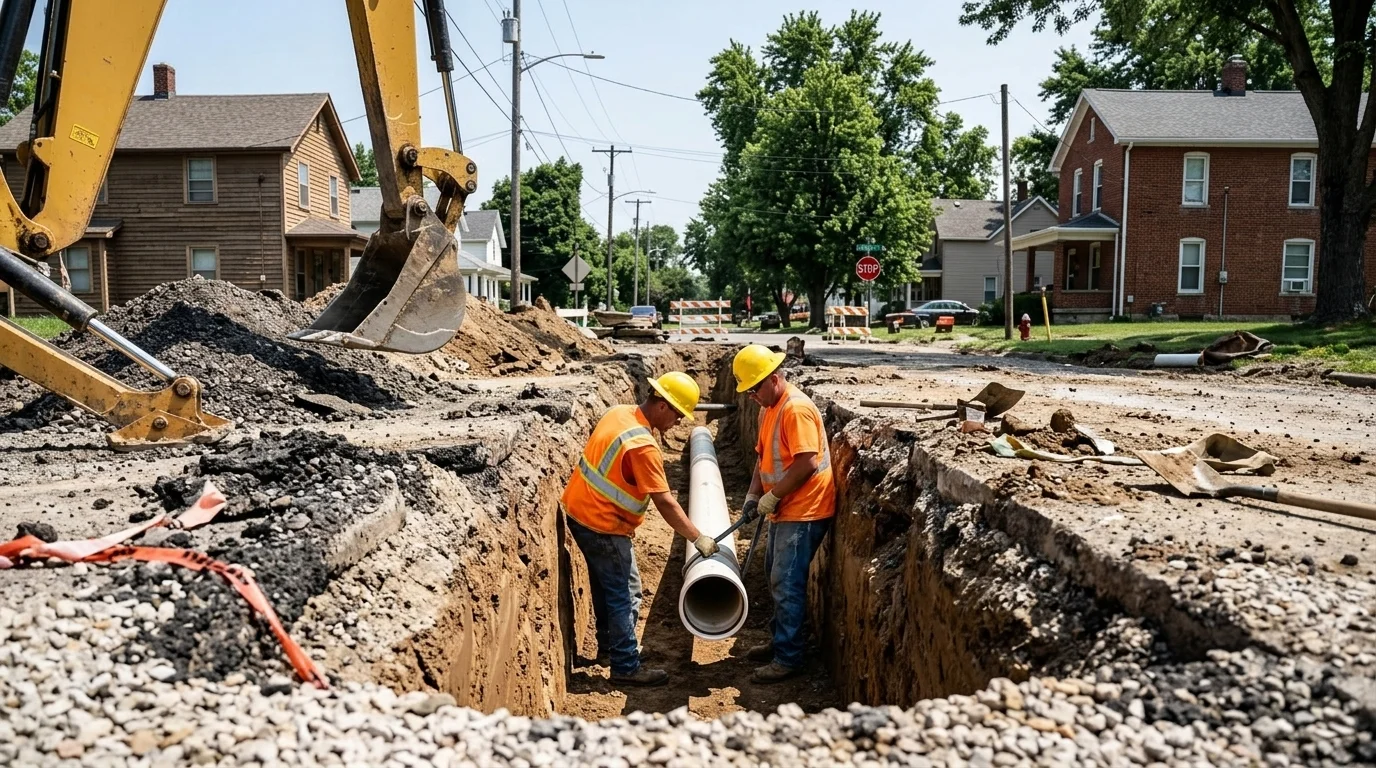
The procurement geography of the current surge reflects how broadly these funds have been distributed. The City of Fairfield in Butler County accounts for four of the recent RFPs, including a waterline replacement and a water interconnection project. Dublin (Franklin County) is moving on a booster station. Port Clinton in Ottawa County, which received a $3.45 million EPA Congressionally Mandated Project grant in January 2026, has appeared in two separate RFPs within the same 30-day window. The Village of Antwerp in Paulding County, a rural community in the state's northwest corner, is procuring a new water treatment plant. Montgomery County rounds out a list that spans urban, suburban, and rural systems alike.
The breadth matters because it signals that this is not a story about a handful of well-staffed big-city water departments getting to the finish line first. It is a catch-up sprint across a system that has historically moved slowly. One analysis found that as of mid-2025, only roughly 15.5% of Ohio's $808 million IIJA SRF allotment had been sub-awarded to local water utilities, meaning the state was sitting on most of its federal commitment with the expiration clock already running. The current RFP spike, which also showed elevated activity in February and a secondary peak projected for August, is consistent with communities compressing years of project development into a few months of procurement activity.
The pressure is compounded by what comes after September 30. Congress has not introduced reauthorization legislation. The White House's FY2026 budget proposed a 31.5% cut to SRF appropriations, turning whatever communities don't obligate now into a funding gap rather than a delay. The American Water Works Association's recent analysis projects a $56.6 billion annual shortfall once IIJA expires. And the PFAS treatment compliance deadline sits at 2029, meaning systems that don't lock in grant-backed contracts now will face those mandates without federal subsidy.
For a resident in one of Ohio's 1,400-plus public water systems, the practical stakes are straightforward. Lead pipe replacement funded through the DWSRF's principal forgiveness provisions costs the local utility nothing out of pocket, which means it costs ratepayers nothing. PFAS treatment infrastructure funded through EC-SDC grants carries the same logic. Ohio EPA Director John Logue has described these SRF grants as a win-win requiring no extra cost to communities, but that calculus only holds if local procurement closes before the federal authorization does.
The next signal to watch is whether the August RFP volume holds or accelerates. Communities that issue RFPs in the next 60 days still have a plausible path to contract execution before September 30. Those that don't will be negotiating a very different cost structure for the same projects starting October 1.