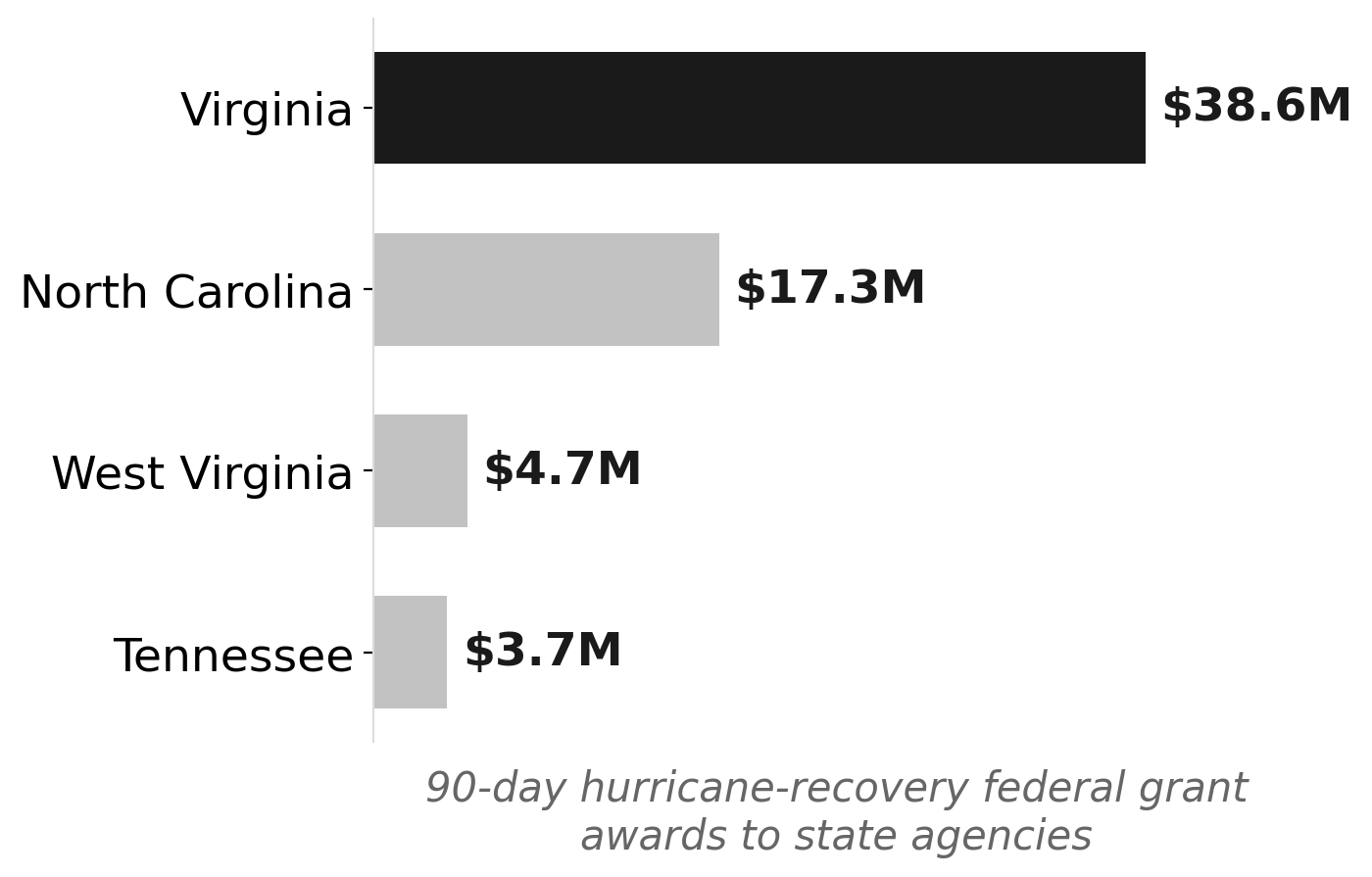
Federal hurricane recovery grants flowing into Virginia have jumped to $38.6 million in the past 90 days, up 139 percent from $16.1 million in the same window last year, and nearly all of that increase traces back to a single agreement signed September 8, 2026: a $38.56 million, 10-year cooperative deal between the USDA Forest Service and the Virginia Department of Forestry.
The timeline on that agreement is the detail worth sitting with. Emergency relief moves in months; this commitment runs through August 2036. Washington and Richmond are not treating Southwest Virginia's forest landscape as something that will recover on its own. They are treating it as a managed problem for the next decade.
The mechanism behind the grant is called Good Neighbor Authority (GNA), a cooperative tool that lets the Forest Service contract directly with state forestry agencies to perform vegetation management on National Forest land, bypassing slower competitive grant cycles. The American Relief Act, 2025 poured $6.35 billion into the USDA Forest Service for disaster recovery from major natural disasters between 2022 and 2024, explicitly including Hurricane Helene, and GNA agreements are the primary delivery channel. According to the USDA Forest Service's disaster recovery operating plan, the agency is using GNA consistently across Helene-affected states: North Carolina's Forest Service signed a parallel $65 million, 10-year GNA agreement on essentially the same model.
Source: NationGraph.
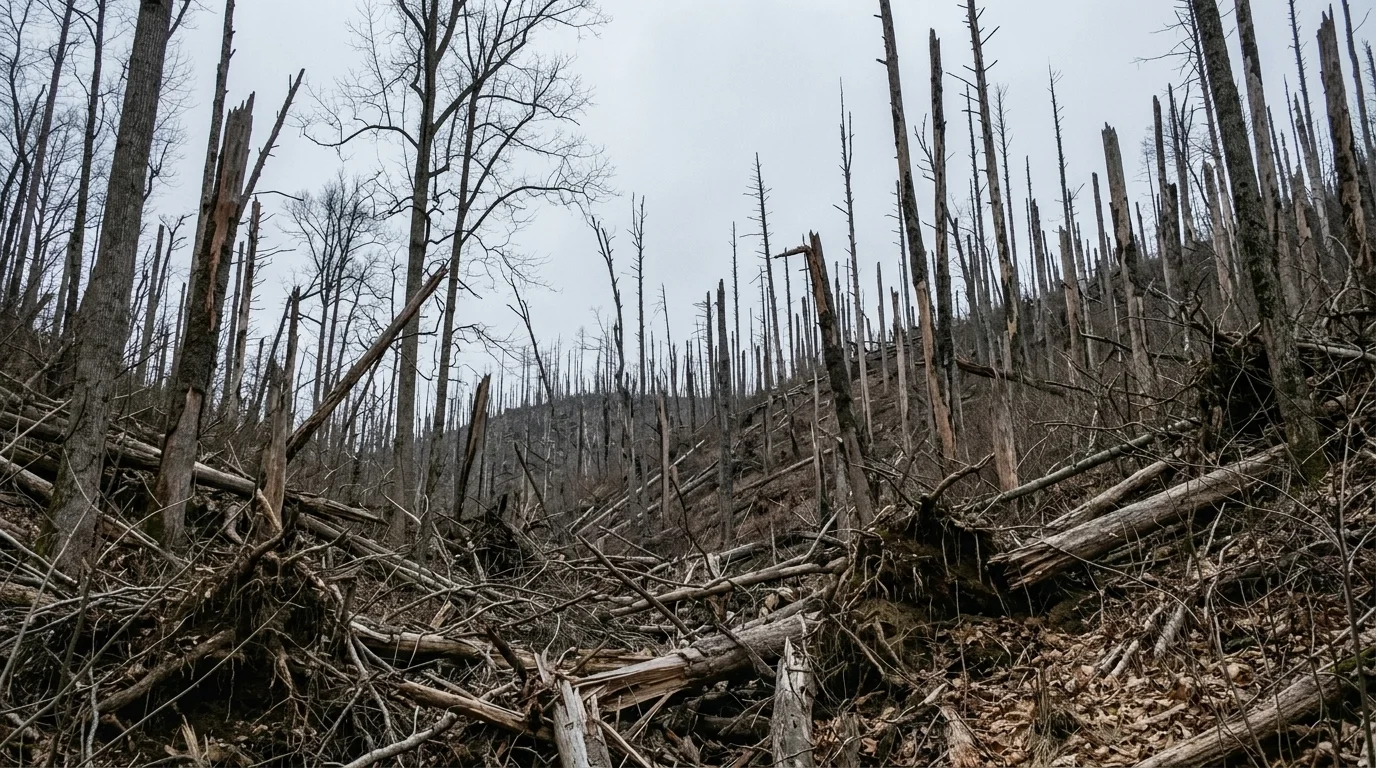
Virginia's grant scope reads like a public-safety document as much as an environmental one. The agreement funds a dedicated wildfire hazard mitigation and prescribed burning crew, roughly 250 acres of hazardous fuel removal, and 1,000 acres of prescribed fire. The reason for the scale is written into the grant language itself: dead and downed trees from Helene have dramatically elevated fuel loads across Jefferson National Forest, creating conditions that the Forest Service describes as "likely to be of increased complexity." The storm that killed two Virginians, knocked out power to 310,000 residents, and destroyed more than 200 homes across Washington, Wythe, Smyth, and Grayson counties also left behind the raw material for the next disaster. The prescribed burning isn't ecological grooming; it is near-term hazard reduction.
Southwest Virginia's geography amplifies every part of this problem. The region's mountain communities depend on a sparse road network with almost no redundancy. At Helene's peak, more than 50 roadways were impassable. Route 58, the main artery connecting Damascus to Konnarock in Washington County, was effectively destroyed. VDOT and the Forest Service rebuilt it five months ahead of schedule, a milestone celebrated in May 2025. The Virginia Creeper Trail, which drew roughly 1,000 visitors a day before the storm and contributed an estimated $61 million annually to the regional economy, had half its 34-mile length catastrophically damaged; the Forest Service has targeted a full reopening by the end of 2026.
The forestry GNA is one of three distinct federal channels now converging on the same disaster, and they should not be read as a single program. The second channel is a $60.9 million Farm Recovery Block Grant that USDA Secretary Brooke Rollins signed with the Virginia Department of Agriculture and Consumer Services in July 2025, making Virginia the second state nationally to receive that aid. That money, authorized under the same American Relief Act, 2025 but administered through USDA's Farm Service Agency rather than the Forest Service, covers infrastructure, timber, and plasticulture losses for private agricultural producers across 27 Virginia localities. The third channel is $32.5 million in EPA revolving-fund capitalization grants, split between the Clean Water and Drinking Water State Revolving Funds, which flow through Virginia DEQ and the State Board of Health as loans and principal-forgiveness grants to local water utilities damaged by Helene.
That combined portfolio, roughly $106 million in active federal commitments across six agencies, looks large on paper. The reality on the ground is more measured. Only about $3.6 million has actually been outlayed so far, almost entirely through DOT. The vast majority of the federal commitment is contractually obligated but not yet spent, which means the spending surge that Southwest Virginia will actually feel is just beginning.
For residents and local governments in the disaster declaration counties, Grayson, Smyth, Tazewell, Washington, Wise, Wythe, and the City of Galax, the next signal to watch is whether the Virginia Department of Forestry stands up the prescribed-burn crew this winter, when conditions typically favor controlled fire. The GNA gives VDOF the authority and the funding to move quickly; the operational question is whether staffing and weather cooperate before the next high-fire season. The Creeper Trail's year-end reopening target is the other near-term marker: tourism revenue in Washington County will not meaningfully recover until hikers and cyclists come back, and the trail's condition is a visible proxy for how much of the forest itself has been stabilized.