California public entities issued 56 cybersecurity procurement solicitations in the trailing 30 days, against a 12-month average of roughly 6.7 per month. That 8.4x spike is not a coincidence, and it is not driven by a single event. It is the product of two distinct federal funding streams arriving at their spend-down phase at the same moment that a cascade of high-profile breaches made doing nothing politically impossible.
The dominant entity type in the surge is K-12 school districts, which account for 20 of the 56 October RFPs. The geographic spread covers Los Angeles, San Bernardino, Riverside, Orange, San Diego, Stanislaus, Monterey, Humboldt, and Santa Cruz counties. California is issuing more of these solicitations than any other state: Texas, the next closest, issued 46 over the same period. New York issued 18. Florida issued 13.
Two federal programs are driving the procurement clock. The first is the FCC's Schools and Libraries Cybersecurity Pilot Program, a three-year, up-to-$200M initiative funded through the Universal Service Fund and administered separately from E-Rate. The FCC selected more than 700 participants in January 2025 and has been issuing Funding Commitment Decision Letters in waves ever since; as of July 2026, $129.2M had been committed to 571 participants. The mechanism matters: grantees cannot invoice USAC for reimbursement until they have contracted with a vendor through a competitive procurement process. Every school that received a commitment letter is, by design, an institution that must now publish an RFP.
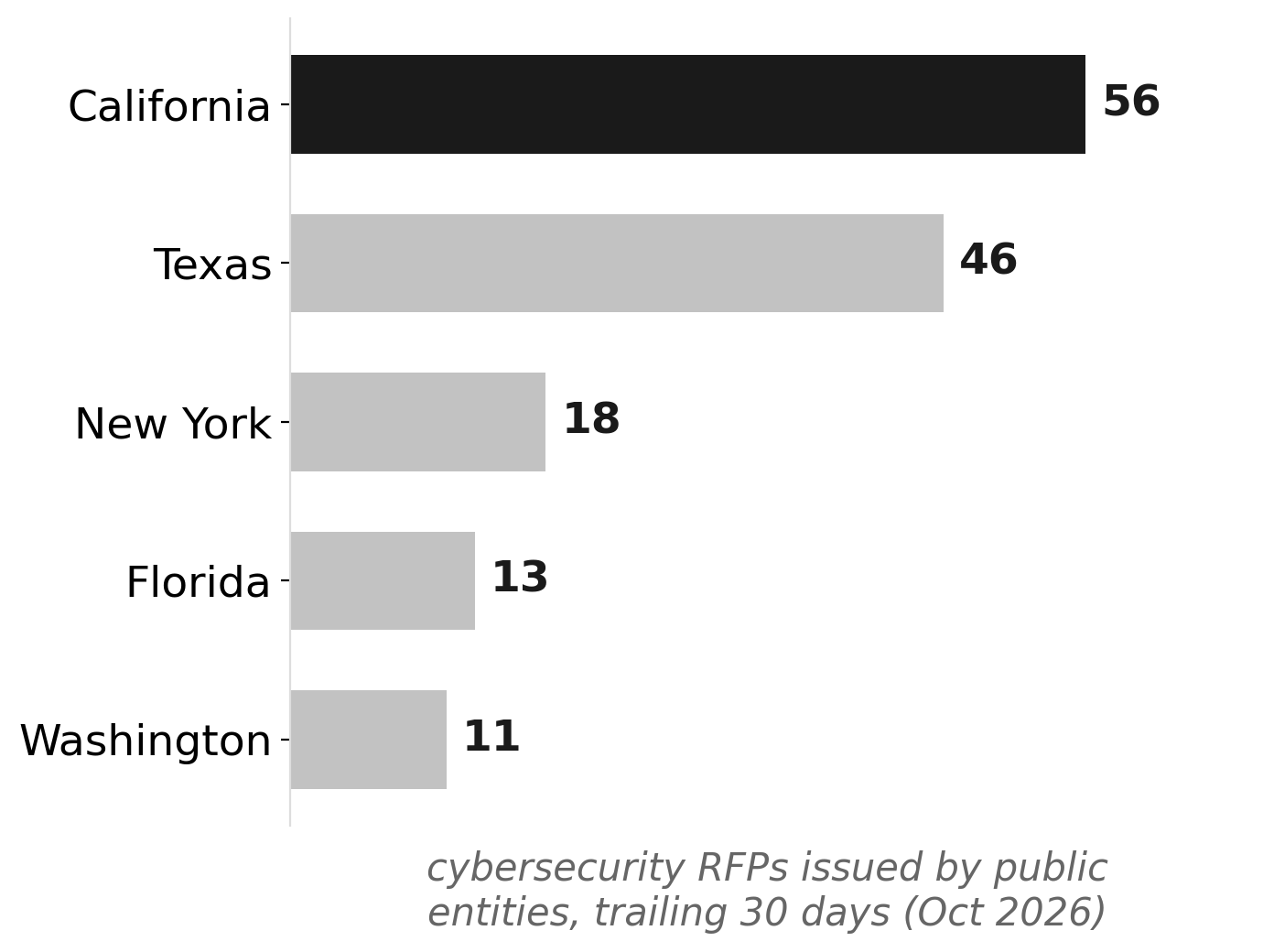
Source: NationGraph.
The second program is the CISA State and Local Cybersecurity Grant Program, FFY 2024 cycle, administered in California by Cal OES. This is a separate federal block grant, funded through DHS appropriations rather than the Universal Service Fund, with a $9.68M Local and Tribal pool and a $1.82M State Agency pool for the current California cycle. Cal OES opened the FFY 2024 competition in January 2026, subgrant awards landed in late 2024, and the 26-month performance period runs through August 2028. Local recipients, including Modesto City Schools, the City of Riverside, and Alameda County, received awards ranging from $65,000 to $250,000. The clock on all of them is now running.
These are not the same program. They fund different eligible entities, flow through different federal agencies, and carry different matching requirements. The SLCGP requires a 30% cost match; the FCC pilot does not. Both, however, share the same structural consequence: grantees must competitively procure before they can spend, and the combination of both programs maturing at once has produced a synchronized RFP burst that dwarfs anything in California's recent procurement history, outside a brief peak in July 2025 when the first FCC commitment-letter wave hit.
The political urgency layered on top of that funding pressure is considerable. In May 2026, Long Beach Unified's Canvas grading platform was hit by an apparent ransomware attack that took down teacher gradebooks. The San Diego Community College District suffered what it called the largest cyberattack in its history the same month. Oceanside Unified experienced a network disruption in August 2026, days before student registration opened. Then, between October 17 and 19, the California Department of Education disclosed that a contractor breach had exposed the names, birthdates, addresses, and disability status of millions of students, with unauthorized access running from May through September 2026 and records going back to 2006. As of October 29, the California School Boards Association itself was claimed by the Booba Project ransomware group, an incident that, if confirmed, would represent a direct hit on the institution representing every school board in the state.
According to Education Week, the CDE breach is among the largest exposure events in K-12 history. For district administrators sitting on unspent federal grant dollars, that disclosure converted an administrative deadline into a reputational emergency.
The RFP titles visible in California's October solicitations reflect both the compliance and the threat environment: FCC Cybersecurity Pilot Program compliance packages, SCADA and operational technology infrastructure upgrades, zero-trust software deployments, CrowdStrike renewals, and Cal OES SLCGP pass-through spend. Rowland Unified issued three separate solicitations. Orange County Transportation Authority and East Bay Municipal Utility District, neither a school district, also appear in the October list, which signals that the SLCGP's broader local-government eligibility is generating non-education procurement alongside the school-district surge.
For residents in any of the counties represented, the practical consequence is straightforward: vendors are being selected right now, and contracts signed in the next 60 to 90 days will determine what security infrastructure California public institutions carry into 2027. The next signal to watch is whether the CDE breach produces state-level mandates that extend procurement obligations beyond the districts and agencies that already have grant funding, or whether a confirmed CSBA ransomware incident prompts the legislature to revisit California's patchwork of school-district security requirements before the next budget cycle.