California issued roughly 68 genuine wildfire-related RFPs in October 2026, a volume 6 to 10 times higher than the 5 to 11 per month recorded in the preceding six months and the highest single-month count in at least 18 months. The number is not a sign of a new emergency. It is the sound of dozens of agencies all racing the same grant clock at once.
The proximate cause is Proposition 4, the $10 billion California Climate Bond that voters approved in November 2024, which dedicated $1.5 billion specifically to wildfire and forest resilience. Governor Newsom signed AB 113 on September 18, 2026, locking in $329.5 million in new Prop 4 wildfire spending for FY2026-27 and pushing the cumulative total appropriated through that allocation to roughly $929.5 million, about 61 percent of the full $1.5 billion. That signing started a countdown for agencies that had been waiting to spend.
Three overlapping Prop 4 grant programs then compressed their downstream procurement deadlines into the same narrow window. CAL FIRE's $70 million Wildfire Prevention Grants program closed applications in July 2026; awardees are now executing contracts. The $30 million Regional Wildfire and Landscape Resilience Grant Program, launched in May 2026, is in a similar phase. And the California Fire Foundation's Proposition 4 grant window opened October 19, 2026, directly inside the spike window, prompting a fresh round of sub-applicants to immediately begin hiring the consultants they need to compete. Layered on top of all of this: CAL FIRE's Forest Health Research Program has full proposals due November 14, 2026, a hard deadline that has accelerated procurements statewide.
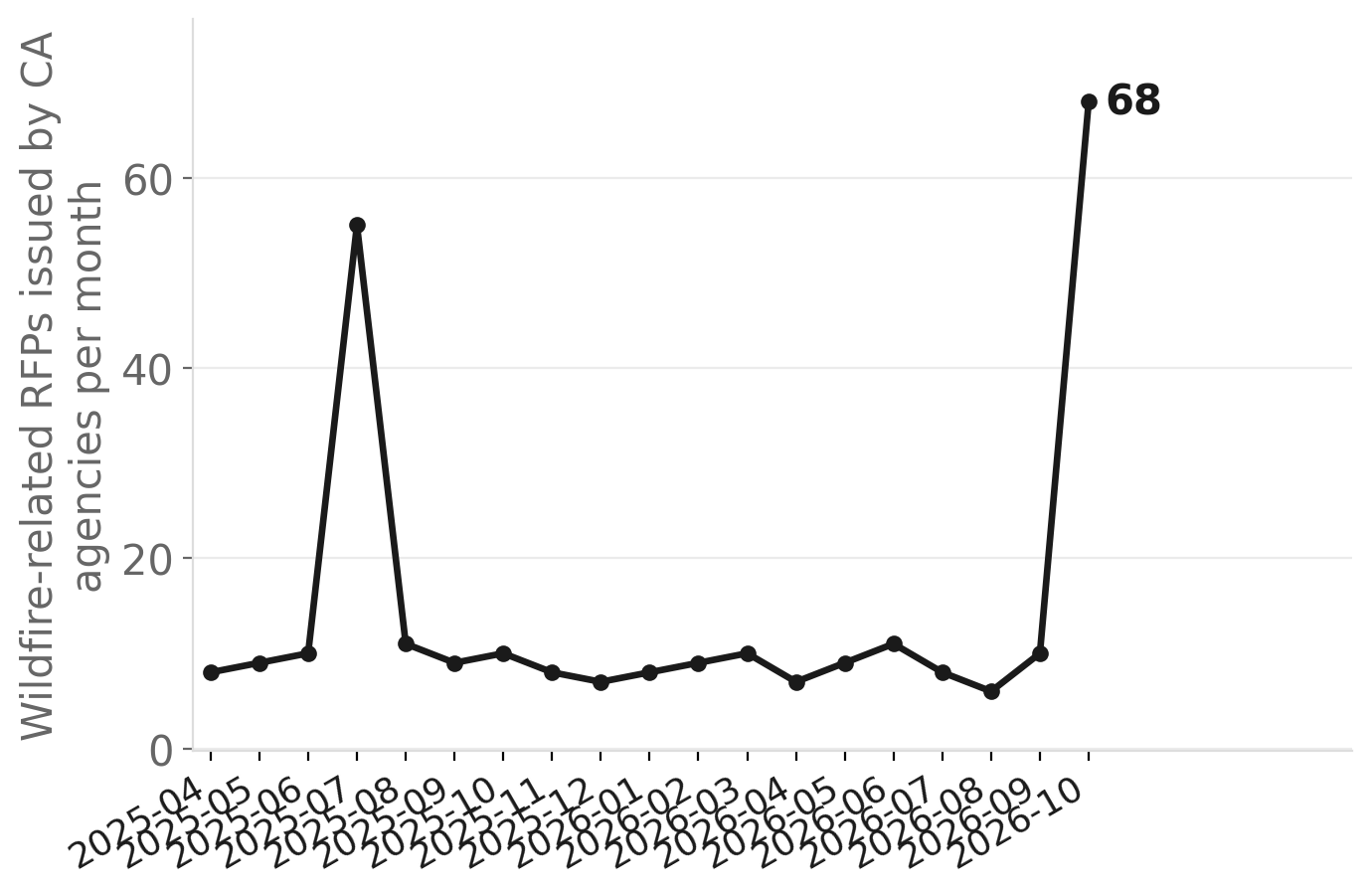
Source: NationGraph.
The result is that CAL FIRE itself leads October's RFP count with 11 solicitations in 30 days. The Office of Energy Infrastructure Safety follows with 3, and Tehama, Mendocino, and Contra Costa Counties each issued 2 to 3. State conservancies, including the Sierra Nevada Conservancy, San Diego River Conservancy, and Santa Monica Mountains Conservancy, have added to the pile. The RFP categories tell the story of grant-execution procurement rather than emergency response: fuel breaks and mastication projects, community wildfire protection plan drafting, wildfire vulnerability assessments, utility facility hardening. These are the planning and construction contracts that flow after a grant is awarded, not after a fire ignites.
What makes the October surge structurally unusual is that Prop 4 is a California state general obligation bond, not federal money. The procurement calendar is entirely independent of FEMA appropriations or federal grant cycles. Federal Community Wildfire Defense Grants, funded through the Infrastructure Investment and Jobs Act, are also active in California, with Trinity County RCD holding a $7.95 million award that began in September 2025. But that program targets a different applicant pool and runs on a separate timeline. It is supplementary context, not the driver. Similarly, the $118 million that AB 113 directed from the Greenhouse Gas Reduction Fund toward wildfire resilience adds to the total state commitment but is a distinct, volatile revenue stream tied to cap-and-trade auction proceeds.
The pressure to move quickly has a fiscal logic behind it. The Sierra Business Council has noted that the 2026 wildfire allocation is still the state's second-smallest investment in wildfire resilience since 2019 in real terms, which raises the competitive stakes for organizations trying to capture a share of the funds that are available. The Wildfire Solutions Coalition has separately flagged that Prop 4 bond proceeds and GGRF revenues are both finite and volatile, a signal that agencies competing today may not find the same opportunity in future cycles. CAL FIRE has awarded more than $1 billion in wildfire grants since 2019, but the pace of appropriation has been uneven, and the memory of tighter years is fresh.
For California residents and local officials, the practical consequence is a thin market for qualified wildfire consultants and environmental planners. Dozens of fire protection districts, resource conservation districts, utilities, and county offices are simultaneously soliciting the same narrow pool of specialists. Agencies that move slowly on procurement risk losing their grant windows; those that move fast may find contractor capacity constrained.
The next signal to watch is the November 14 deadline for CAL FIRE Forest Health Research Program full proposals. If the October RFP surge is as large as the data suggests, the weeks immediately following that deadline should show a corresponding contraction, as agencies either secure contracts or lose the funding window. Whether the remaining 39 percent of Prop 4's $1.5 billion wildfire allocation gets appropriated in FY2027-28, and on what timeline, will determine whether October 2026 is a one-time convergence or the first of several annual scrambles.