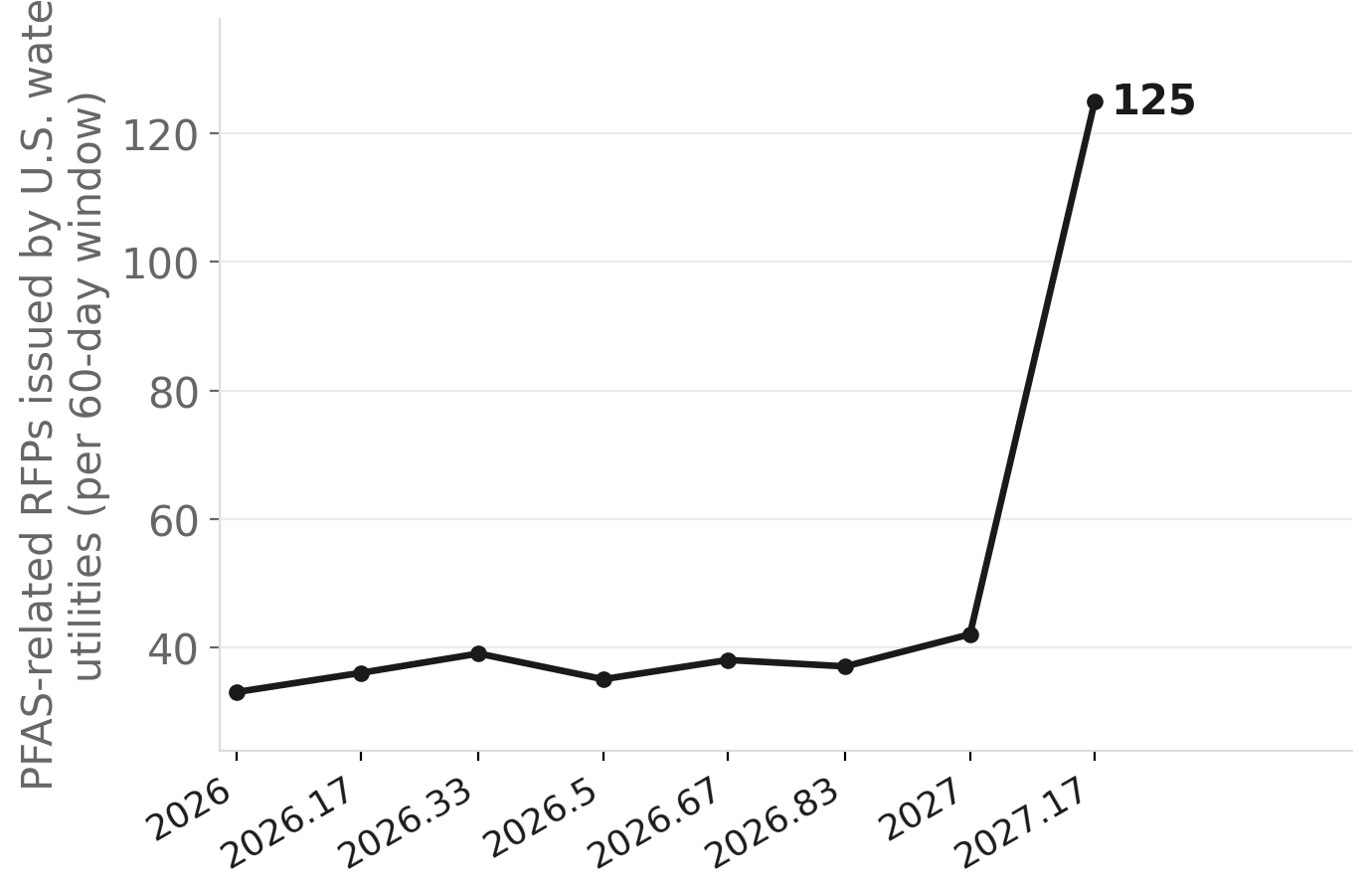
In the last 60 days, 125 public water systems across 20 states have issued procurement solicitations for PFAS testing and treatment infrastructure, roughly 3.5 times the prior 12-month bimonthly average of about 36. In the single week of October 19-25, 2026, 132 PFAS-related requests for proposals landed across 34 states simultaneously, more than the entire prior baseline in seven days. This is not a gradual ramp. It is a deadline response.
The deadline is April 26, 2027. Under the EPA's National Primary Drinking Water Regulation, finalized in April 2024, roughly 66,000 public water systems must complete initial PFAS sampling and deliver public notification of results by that date. The rule, which established the first legally enforceable maximum contaminant levels for six PFAS compounds including PFOA and PFOS, carries a monitoring deadline that EPA has explicitly confirmed is unaffected by any subsequent rulemaking. A separate May 2026 proposed rule would allow utilities to request an extension of treatment compliance from 2029 to 2031, but the 2027 monitoring and disclosure requirement is fixed. A utility that has not tested by April 2027 does not get extra time; it gets a public notice requirement.
That clock alone might have produced a modest uptick in procurement activity. What turned it into a national surge is the simultaneous arrival of federal money. On May 18, 2026, EPA announced $945.7 million in FY2026 Emerging Contaminants in Small or Disadvantaged Communities grant funding, authorized by the Bipartisan Infrastructure Law, flowing to states in allotments they can immediately sub-grant to local utilities. That announcement followed roughly $1.78 billion in EPA PFAS grants obligated over the prior 24 months. The money and the mandate are two distinct instruments, one a regulatory compulsion and one a federal subsidy, but they point at the same procurement window and the same class of buyers.
Source: NationGraph.
The states showing the highest institution counts, Massachusetts (15), California (14), New Jersey (11), Washington (10), and New York (9), are also among the largest recipients of Water Infrastructure Improvements for the Nation Act grants channeled through state environmental and health agencies. New York's Department of Health has received $125 million in WIIN emerging contaminant grants to sub-grant downward. New Jersey DEP has received $33.6 million, Massachusetts DEP $19.6 million, and Washington DOH $18 million, the latter part of a $20.7 million EPA award announced alongside the FY2026 EC-SDC grants. When state agencies hold earmarked grant dollars and a federal disclosure deadline is 18 months out, local utilities do not wait for a second invitation.
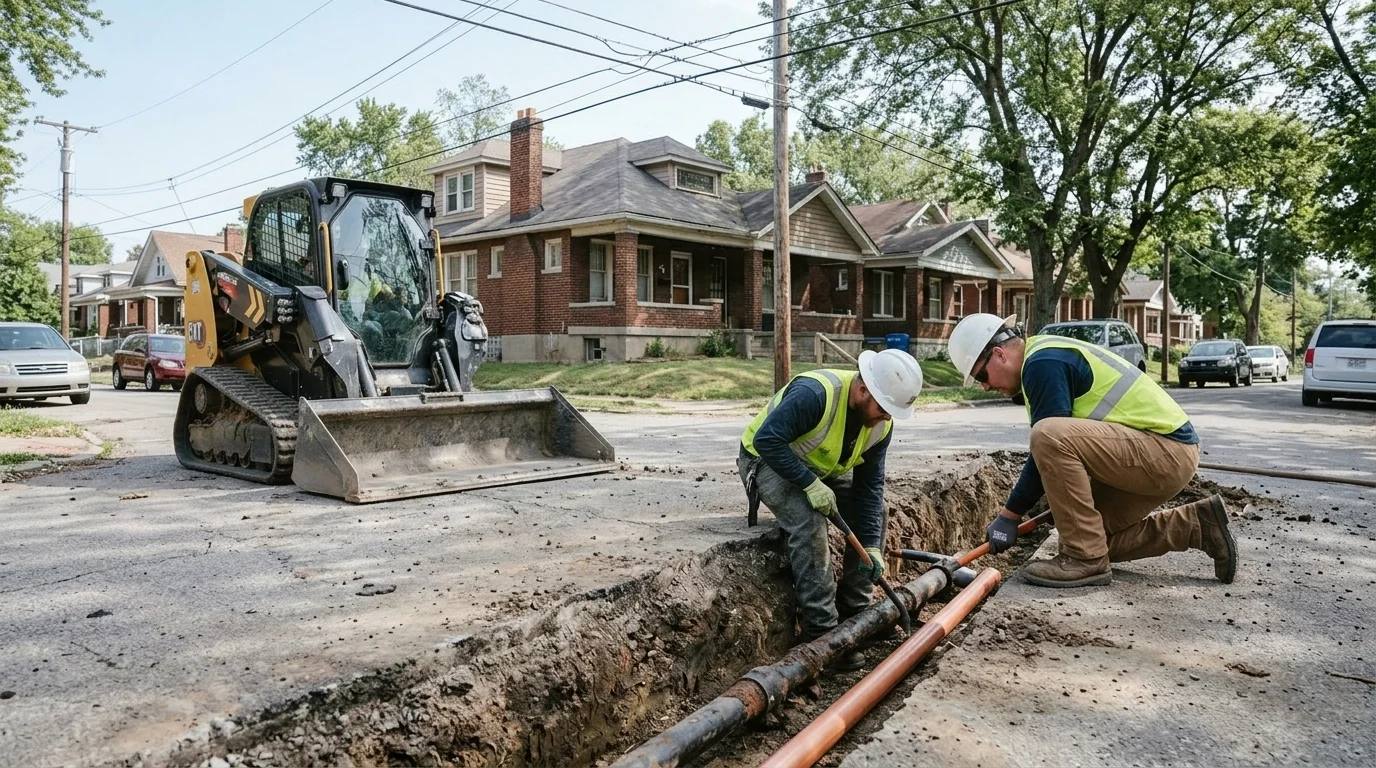
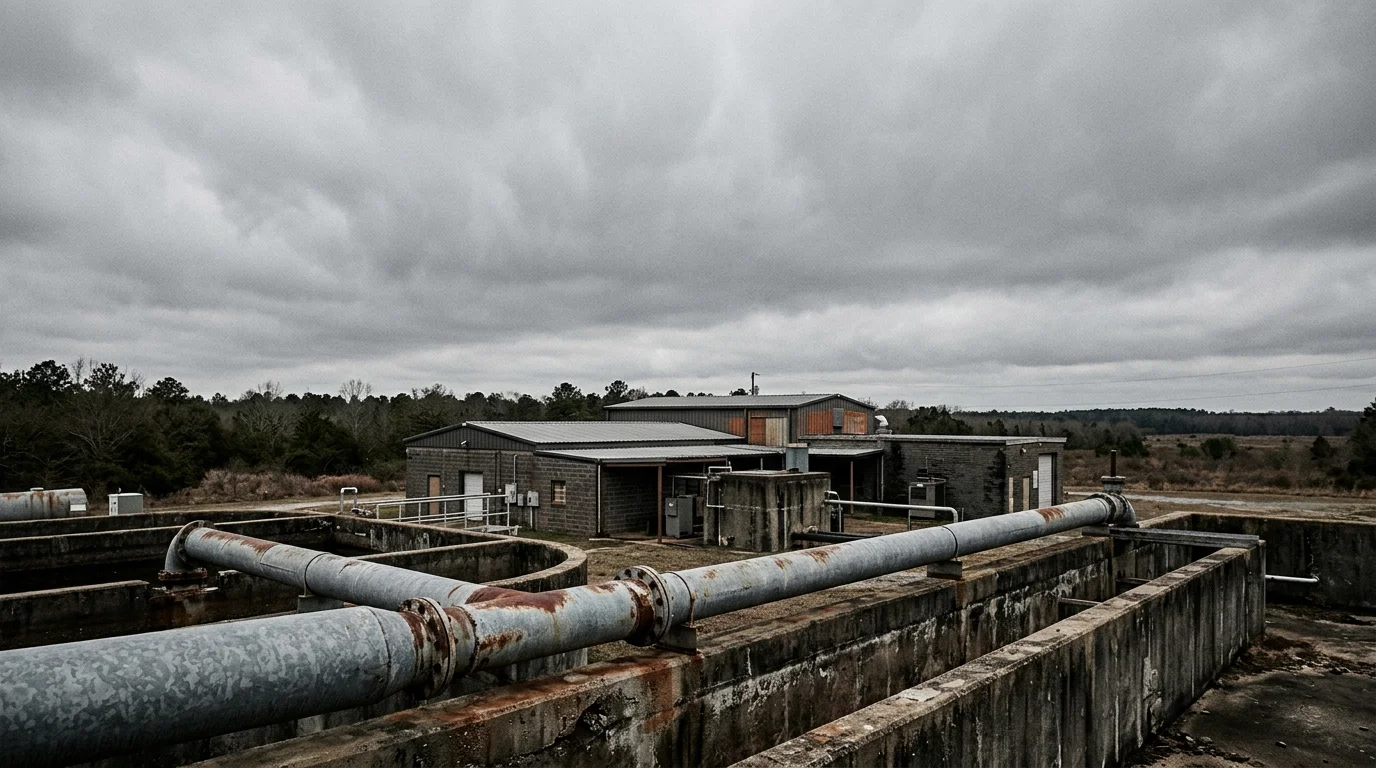
The RFPs themselves signal capital commitment, not preliminary planning. The solicitations catalogued in the last 60 days include granular activated carbon treatment systems, wellhead treatment facilities, engineering qualification solicitations for multi-year design-build contracts, and airport Aircraft Rescue and Firefighting foam decontamination projects. GAC systems, the most common treatment technology for PFAS removal, require months of procurement, engineering, and installation before they produce a single compliant sample result. A utility issuing a GAC RFP in October 2026 is aiming for operational capacity well before April 2027 monitoring begins, not after.
The airport ARFF decontamination solicitations, appearing in Alaska, Alabama, and other states, reflect a parallel but distinct federal driver. FAA and Department of Defense facilities contaminated by PFAS-laden aqueous film-forming foam face separate cleanup timelines under different federal authority, but their procurement activity is landing in the same 60-day window, widening the apparent surge.
Colorado's eight active institutions are worth noting separately. The state's PFAS history is concentrated along military-corridor communities where AFFF foam use has contaminated groundwater for decades. Frederick, Colorado, which NationGraph covered earlier this year, exemplifies how that legacy contamination is now colliding with the federal regulatory schedule: a municipality that has known about its PFAS problem for years is now under the same April 2027 clock as a New England utility discovering elevated levels for the first time.
For the roughly 6 to 10 percent of covered water systems EPA estimates will need treatment action to meet the new MCLs, the procurement math is simple and unforgiving. GAC systems for a mid-size utility take 12 to 18 months from RFP to operation. Engineering qualification processes add lead time before the RFP even goes out. The utilities issuing solicitations now are the ones that calculated backward from April 2027 and realized they are already close to the margin. Systems that have not yet begun procurement face a narrowing window before the monitoring deadline forces public disclosure regardless of treatment status.
Additional federal financing, including $4 billion in Drinking Water State Revolving Fund set-asides for PFAS infrastructure and more than $6.5 billion in available WIFIA low-interest loans, remains on the table for larger capital projects. But those vehicles move on longer timelines than the grant dollars states are already deploying. The next signal to watch is whether EPA's proposed 2031 treatment compliance extension is finalized, which would relieve pressure on the treatment buildout but would not move the monitoring deadline a single day.