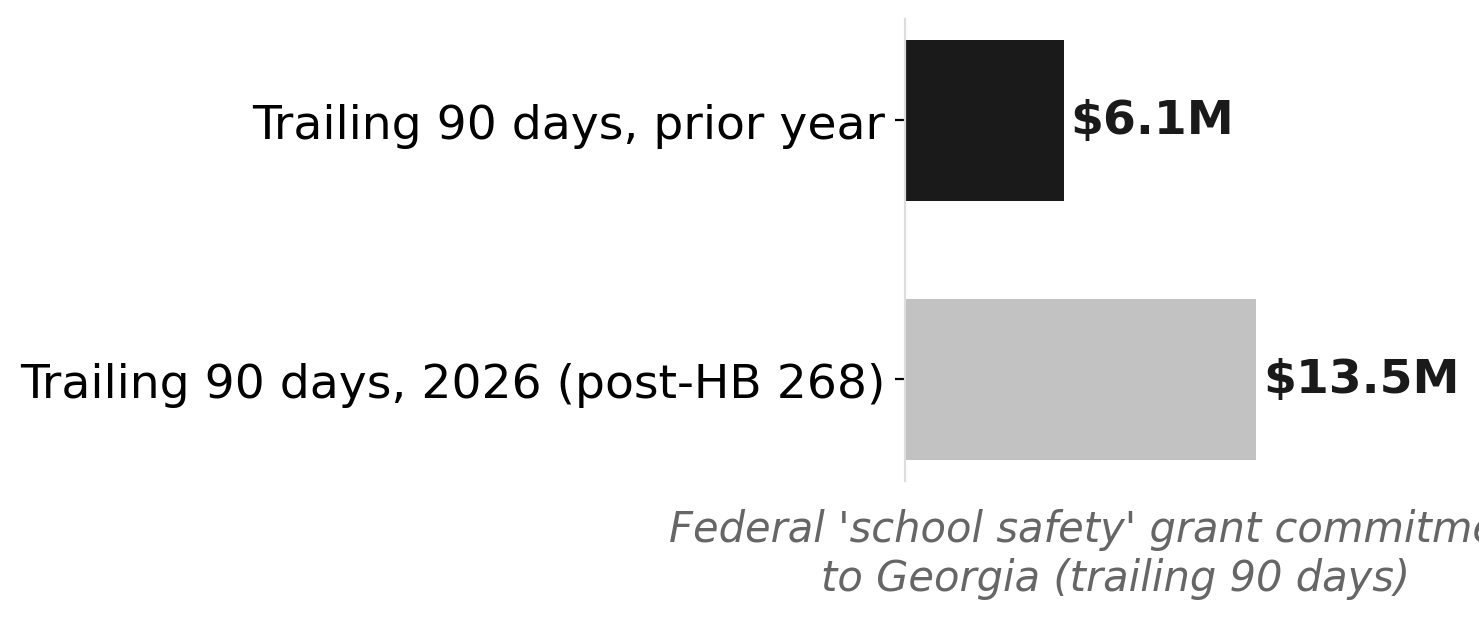
Federal school safety-related grants flowing into Georgia have hit $13.5 million in the trailing 90 days, more than double the $6.1 million recorded in the same window a year ago. The jump is not a coincidence of timing. Georgia's public schools are now operating under HB 268, the Comprehensive School Safety and Student Well-Being Act, signed in April 2025 and in effect since July 1, and many of its mandates carry a hard compliance deadline of July 1, 2026. Districts are reaching for every available federal dollar to meet requirements the state law compels but does not fully fund.
HB 268 was a direct legislative response to the September 4, 2024 shooting at Apalachee High School in Barrow County, the deadliest school shooting in Georgia history. The law requires panic alert systems, behavioral threat assessment teams, mental health coordinators, and digital campus mapping in every public K-12 school in the state. It passed the Georgia Senate 45-9 and the House 154-12, margins that signal political durability, and has been described by the Georgia Appleseed Center as "one of the most wide-reaching school safety and student support laws in the country."
The state is backing HB 268 with significant money of its own: roughly $135 million in state-funded support for FY2026, including approximately $61,000 per school in safety grants, $20 million for student behavioral health, and $7 million for student advocacy specialists. But state appropriations are not enough to cover everything, and federal grant programs whose eligible uses overlap almost exactly with HB 268's requirements are now drawing intensified competition from Georgia applicants.
Source: NationGraph.
Three distinct funding streams are converging here, and they should not be confused with one another. HB 268 is a state mandate law; its state-side dollars come through separate budget appropriations. Federal programs, primarily SAMHSA's Center for Mental Health Services grants, the Department of Justice's COPS School Violence Prevention Program, and the U.S. Department of Education's School Safety Enhancement Program, are independent competitive programs that predate HB 268 but whose funded activities now map closely onto what the law requires. The doubling of federal grant flow reflects HB 268-induced demand meeting pre-existing federal supply, not a single integrated program delivering money from Washington to Georgia classrooms.
The largest verified new federal award in the current window is a five-year, $1.5 million SAMHSA Center for Mental Health Services grant to the Georgia Department of Education, running through 2031. The award funds mental health services infrastructure in schools, precisely the kind of work HB 268's behavioral health and mental health coordinator mandates require. Two new DOJ COPS School Violence Prevention Program awards, $144,000 to Echols County and $143,000 to Chatham County, both started in October 2025, making them among the first federal SVPP dollars to reach Georgia counties in the post-HB 268 era.
Beyond these new awards, the active federal portfolio already supporting Georgia's compliance push is substantial. Northeast Georgia RESA holds an $8.7 million SAMHSA mental health grant running through 2028, and the Georgia Department of Behavioral Health and Developmental Disabilities holds a $1.47 million SAMHSA behavioral health grant through 2029, both of which overlap with the student mental health infrastructure HB 268 now mandates statewide.
The pipeline is not finished filling. The U.S. Department of Education's FY2026 School Safety Enhancement Program offers $93 million nationally to state educational agencies for physical security and statewide safety systems; Georgia's GaDOE is eligible, but any award from that program has not yet appeared in the grant data. The DOJ COPS SVPP program had an application deadline of August 4, 2026, meaning a new round of awards to Georgia districts could surface in the coming months.
A second bill, HB 1023, passed the Georgia House on February 24, 2026 and would require weapons detection systems at school entry points, providing $50,000 per school toward that cost. It is a separate piece of legislation from HB 268, with a different funding mechanism and a different scope, and its fate in the Senate remains unresolved as of publication. If it passes, it would add another layer of compliance requirements and, likely, another pull on federal and state safety dollars.
For Georgia families, the practical picture is this: schools are in an active construction and staffing phase, installing panic systems, hiring or contracting mental health coordinators, and building out threat assessment teams before the July 2026 clock runs out. The federal grant doubling is less a windfall than a measure of how many districts are simultaneously in motion. Whether the state grant base, the federal competitive programs, and whatever HB 1023 eventually brings are enough to get every one of Georgia's 2,200-plus public schools to full compliance by next summer is the question the data will answer over the next two reporting cycles.