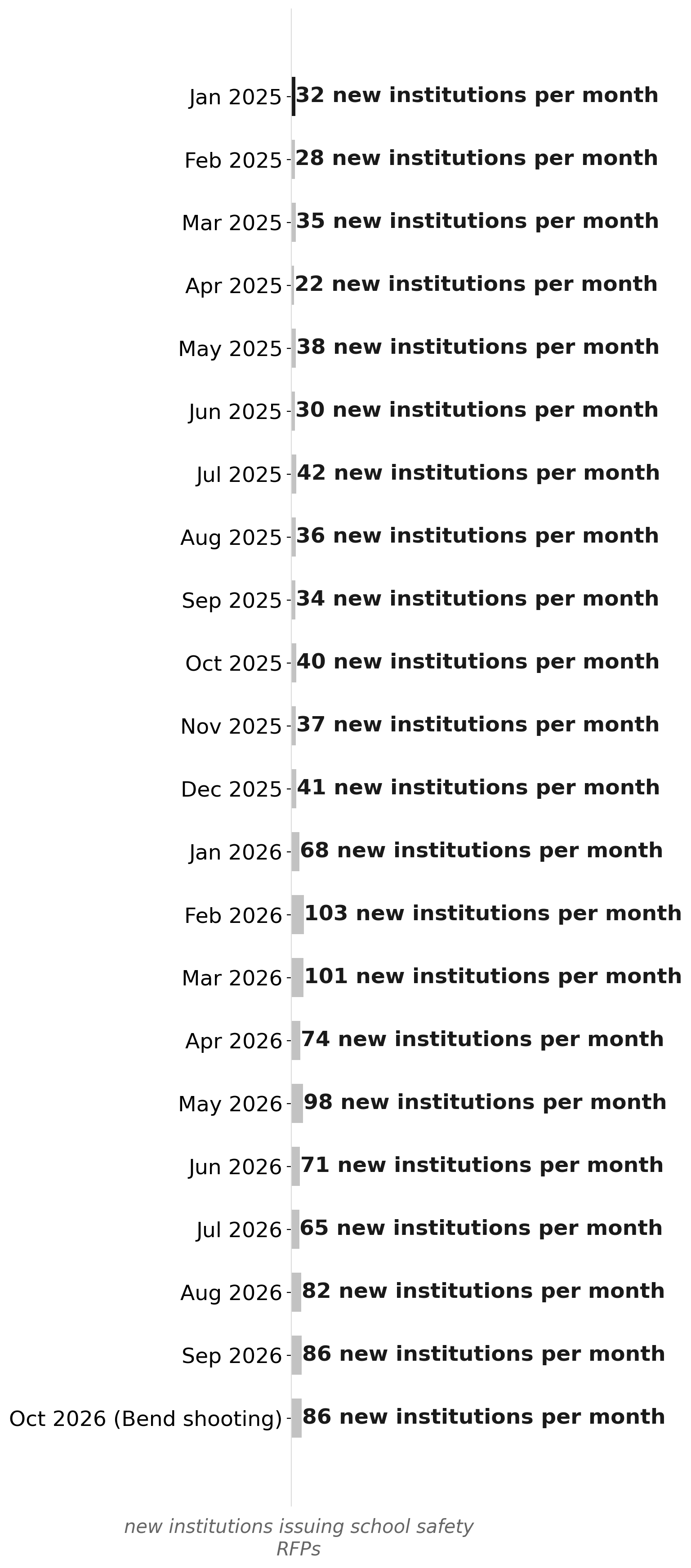
School safety procurements appeared across 300 institutions in 33 states in the past 60 days, roughly 3.5 times the prior 12-month bimonthly average of 86, and the shopping lists look nearly identical: wearable panic buttons, AI-enabled camera systems, anonymous tip platforms, access-control hardware, and SRO contracts. That similarity is not a coincidence. It is the signature of a federal grant compliance cycle, and 2026 happens to be the year three separate federal programs are simultaneously active, each with its own deadline, each funding a slightly different piece of the same campus security puzzle.
The three programs are distinct in purpose and in who receives the money. The COPS School Violence Prevention Program, boosted from $50 million to $73 million a year by the Bipartisan Safer Communities Act of 2022, flows directly to school districts for physical hardware: cameras, locks, metal detectors, panic buttons. The BJA STOP School Violence Program, running at roughly $125 million a year in FY2026, funds behavioral programming at the district and local-government level: threat-assessment teams, anonymous reporting tools, intervention training. The newest stream, the School Safety Enhancement program, added $93 million in competitive grants announced by the Department of Education on May 27, 2026, aimed at state educational agencies building statewide safety infrastructure. Its application window closed July 28. The timing maps almost exactly onto when the monthly RFP count began climbing: February, March, and May each registered 98 to 103 new institutions entering the market, compared to a pre-2026 monthly baseline of 22 to 42.
The states leading the procurement count also hold the largest active federal school safety grant portfolios. California, with 47 institutions issuing safety RFPs in the past 60 days, carries $451 million in total active federal obligations. Massachusetts, with 14 institutions, holds $282 million. Texas, with 15, holds $141 million. Grant money creates procurement activity; the correlation here is direct enough to read as causation.
Source: NationGraph.
Specific active solicitations illustrate how the federal template translates to local purchasing. Florida's Department of Education issued an RFP for a statewide mobile panic alert system, due November 10. A Massachusetts city issued a wearable panic button solicitation due November 17. Texas's Humble ISD posted a school safety products and services RFP due November 9. Nevada is seeking an anonymous tip management platform. The Bureau of Justice Assistance's own FY2026 STOP School Violence solicitation closed October 30. These are not independent local decisions; they are the downstream purchasing behavior of institutions working through grant-funded checklists on parallel timelines.
Then came October 15. The Silver Rail Elementary shooting in Bend, Oregon killed three children and a teacher, the deadliest K-12 shooting of 2026, and exposed specific security failures that made the national procurement wave suddenly look insufficient rather than excessive. The school's assigned SRO covered six or seven campuses and was not on site when the shooter jumped a fence and fired through locked glass doors. Oregon Governor Tina Kotek declared a state of emergency on October 27, directing the Oregon Department of Education to act. But Oregon is, by the standards of most leading-procurement states, a security outlier: state law does not mandate physical security equipment in schools, and the Oregon School Boards Association confirms that most districts fund security upgrades through general funds and facility bonds rather than state or federal programs. Bills requiring law-enforcement coverage at every Oregon school failed in committee during the 2025 session; new legislation is expected in 2027.
As of October 19, Education Week had counted 27 K-12 shootings with injury or death in 2026, with 17 killed. That figure, and the visibility of Bend, have added political pressure to what was already a financially driven procurement surge. The Bend-La Pine superintendent has said nothing is off the table, including razor wire, metal detectors, and additional SROs. But the superintendent's options are constrained by the same structural fact that made Silver Rail vulnerable: Oregon has no state mandate and no competitive grant pipeline comparable to what California, Texas, or Massachusetts are drawing from.
For the roughly 300 institutions now in active procurement, the next signal to watch is grant award notices. The SSE program's July application deadline means awards could be announced before the end of the calendar year, and districts that positioned their procurements to align with grant eligibility will be first in line. For states like Oregon, the question is whether the political pressure from Bend translates into a funding mechanism, a state bond measure, new legislative appropriation, or a push for federal formula dollars, before the next budget cycle closes.