Federal opioid grants newly started in Florida have reached $6.4 million in the trailing 90 days, nearly double the $3.3 million awarded in the same window last year, and every dollar of the increase is going to university laboratories and a single specialty treatment court, not frontline service delivery.
The surge is almost entirely driven by NIH's FY2026 renewal cycle. The University of Florida and the University of Miami each received $2.28 million, three-year NIH/NIDA awards to study pharmacological modulators of opioid signaling, grants designed to map the biology of addiction at the molecular level. Mayo Clinic Jacksonville received $780,000 over five years to test mindfulness-based interventions for chronic pain in spinal cord injury patients as a way to reduce opioid dependence. A separate $460,000 Trans-NIH award to the University of Miami is examining what the grant application describes as the "virtually unknown" delayed neuroimmune injury that follows a single sub-lethal fentanyl exposure. Seminole County's Adult Treatment Court accounts for the remaining $399,000, a five-year SAMHSA award to embed a licensed treatment coordinator in the court.
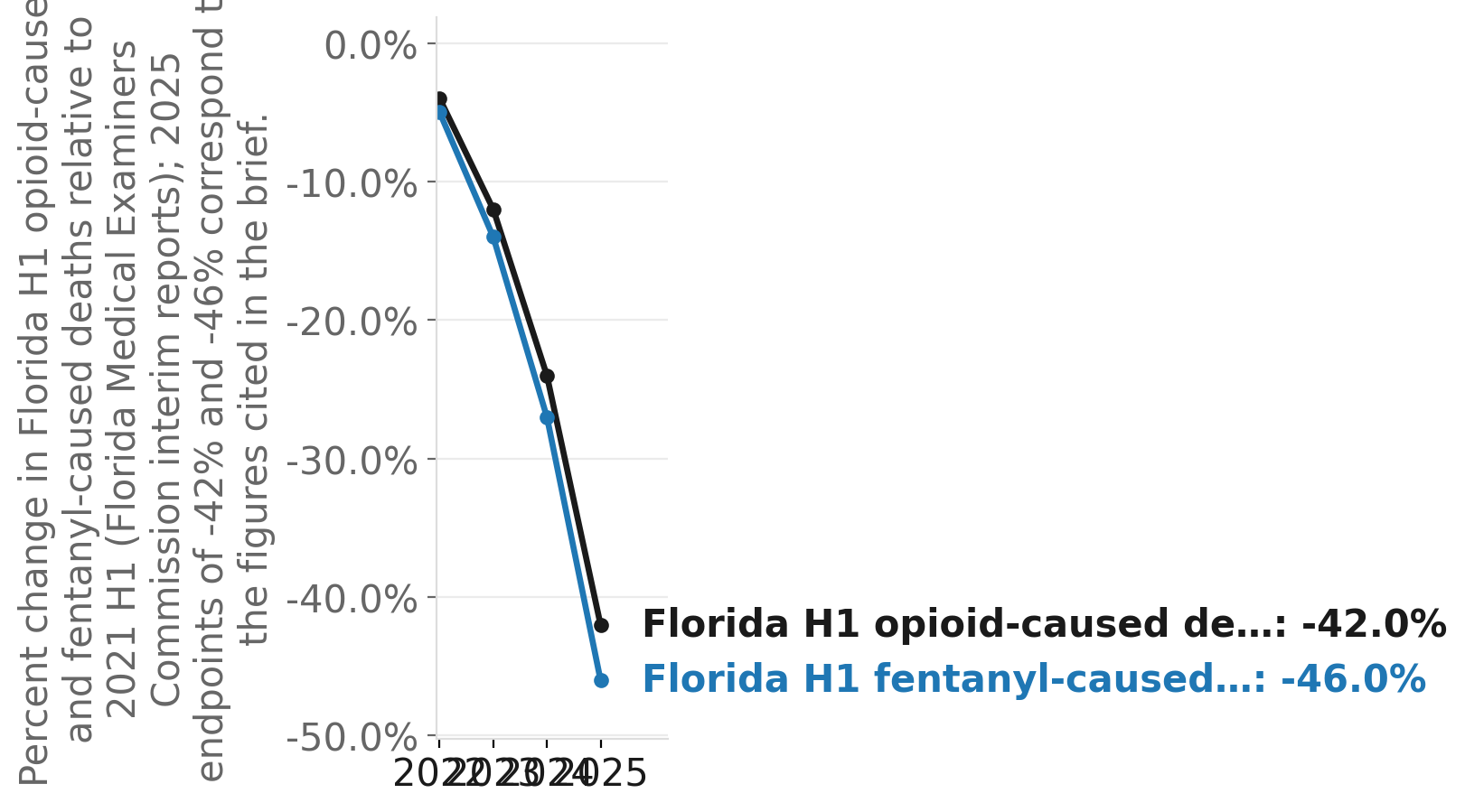
The timing looks paradoxical on its face. Florida's opioid-caused deaths fell 42% in the first half of 2025, and fentanyl deaths specifically fell 46%, according to the Florida Medical Examiners Commission's interim 2025 report. Nationally, overdose deaths dropped to roughly 70,000 in the year ending December 2025, the lowest count since 2019. The traditional crisis metrics are moving in the right direction.
Source: NationGraph.
But the NIH research agenda reflects a different reading of the moment. Researchers are increasingly focused on what the drug supply is doing next, not what it did last. Medetomidine is displacing xylazine as a fentanyl adulterant across the state, creating clinical complications that naloxone alone cannot fully address. And the University of Miami's neuroimmune grant signals that the field is opening a new question entirely: whether a single fentanyl exposure, survived without acute harm, triggers lasting biological injury that won't show up in overdose death statistics at all.
These NIH dollars fund laboratory and clinical research. They do not pay for treatment slots, harm reduction services, or recovery housing. Those functions run through two separate and much larger funding streams that operate in parallel. Florida's Department of Children and Families holds a $317.7 million SAMHSA State Opioid Response IV grant, active from September 2024 through September 2027, which funds prevention, medication-assisted treatment, and recovery services for uninsured and underinsured Floridians statewide. According to federal outlay data, only 51.4 percent of that grant has been disbursed, roughly $154 million in federal treatment dollars remains to be spent over the next year and a half. A December 2025 HHS Office of Inspector General audit found that DCF did not fully comply with federal reporting and oversight requirements on its prior SOR grant, flagging expenditure-monitoring deficiencies, a finding that carries weight given the scale of the current award.
A third stream runs entirely outside the federal system. Florida's share of the national opioid litigation settlement is projected to deliver more than $3.1 billion to the state and its subdivisions over 17 years. State trust fund dollars, not federal grants, are paying for the CORE Network, a coordinated opioid recovery infrastructure now active in 47 of Florida's 67 counties, with the remaining 20 onboarding in FY2025-26. In FY2024-25 alone, settlement funds covered $17.8 million in recovery housing and $8.25 million in peer support services.
Florida's position in the national landscape has shifted in ways the raw grant numbers alone don't capture. Ohio and West Virginia, the states most associated with the opioid crisis's peak, received $1.4 million and $147,000 respectively in new federal opioid grant starts over the same 90-day window. Florida's $6.4 million trails California ($7.0 million) and New York ($6.6 million) slightly, but it is competing with states defined by research infrastructure rather than burden alone. Florida's universities now hold more than $100 million in currently active federal opioid research grants, a portfolio more typical of a research hub than of a high-burden state, though Florida was, for much of the last two decades, both.
The policy debate over what is driving the death-rate decline has not settled. Governor DeSantis has credited law enforcement and immigration enforcement. Researchers and harm-reduction advocates point to shifts in how people are using drugs, injection giving way to smoking, which reduces overdose risk, and to changes in the adulterant mix. The NIH grants landing at Florida universities suggest the federal research establishment is less interested in adjudicating that debate than in staying ahead of whatever mutation the drug supply produces next.
The practical signal to watch: DCF's pace of outlaying its remaining $154 million in SAMHSA SOR IV funds over the next 18 months, and whether the OIG's oversight findings from the prior grant cycle prompt any structural changes to how Florida's managing entities report and reconcile expenditures. The treatment-delivery pipeline is large. Whether it moves without the friction that slowed the last one is the open question.