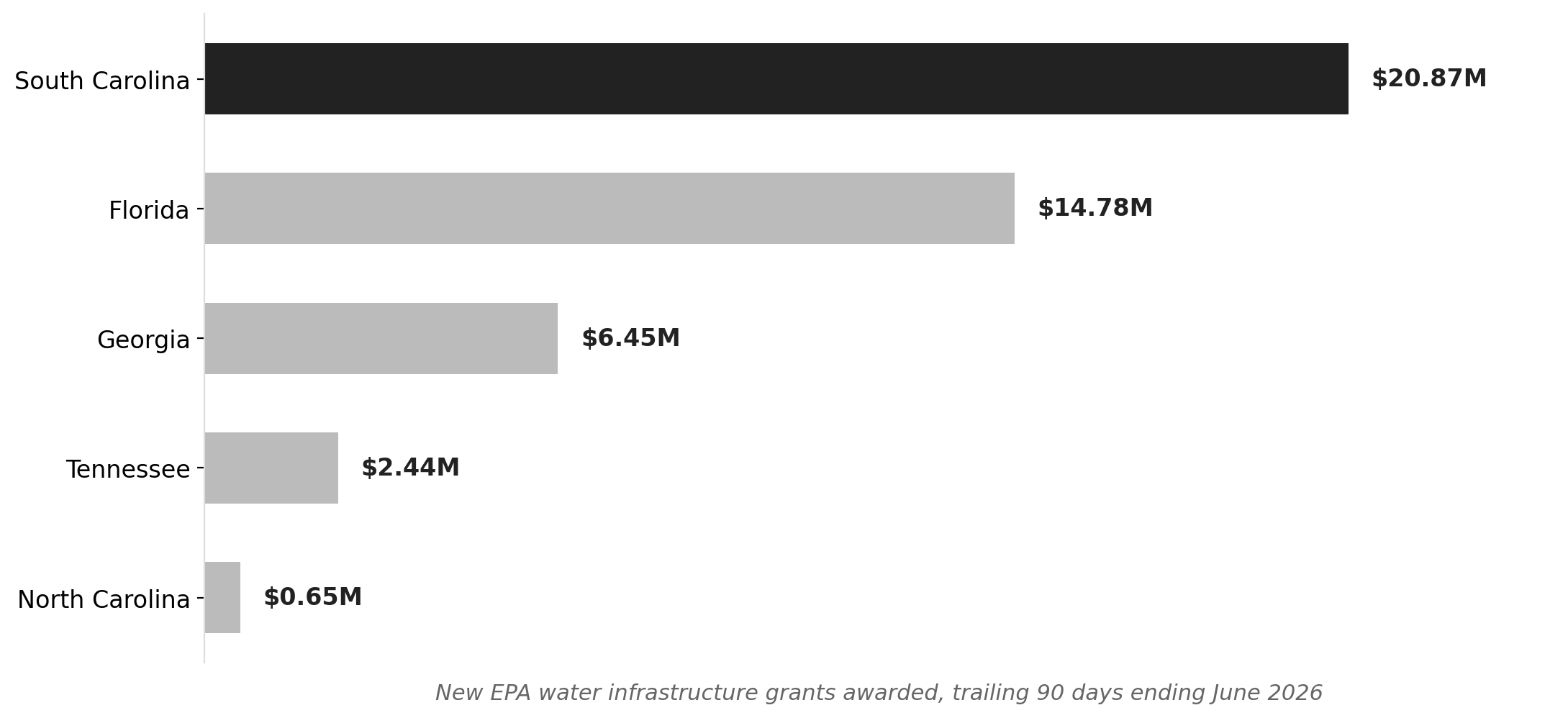
The EPA awarded South Carolina $20.87 million in water infrastructure capitalization grants in the 90 days ending June 2026, a 15,069% increase over the $137,600 the state received in the same window a year earlier. No neighboring state came close: Florida drew $14.78 million in the same period, Georgia $6.45 million, Tennessee $2.44 million, and North Carolina just $650,000.
Both grants landed on April 1, 2026 and flow entirely to the South Carolina Department of Environmental Services (SCDES). The larger, $17.77 million tranche goes to the Drinking Water State Revolving Fund; the remaining $3.10 million goes to the Clean Water SRF. Both carry seven-year performance periods running through 2033. Together they represent a sudden mid-cycle infusion into a state that typically sees its largest federal water capitalizations arrive in October, at the start of the federal fiscal year. An April award of this scale is unusual enough to signal something has changed.
Two forces are converging to explain it. The first is Hurricane Helene, which struck South Carolina on September 27, 2024, killed 49 people, damaged nearly 5,000 homes across 33 counties, and forced SCDES to assess 269 dams in the storm's immediate aftermath. Helene's damage extended well into the Upstate, where some communities lost water service entirely, a reminder that water infrastructure vulnerability in South Carolina is not confined to the coast. The EPA subsequently named South Carolina as an explicit recipient under its 2025 Supplemental SRF Appropriations for Hurricanes Milton and Helene (SA-HMW), creating a dedicated federal channel for storm-recovery capital flowing through the SRF programs.
Source: NationGraph.
The second force is a countdown. The Infrastructure Investment and Jobs Act's five-year water infrastructure authorization expires September 30, 2026. States that have not yet fully obligated their IIJA water allocations face a use-it-or-lose-it moment, and according to tracking by water infrastructure analysts, many have been slow to move dollars through the pipeline. That urgency is sharpened by a broader headwind: national IIJA water project award volumes in the first half of 2025 ran 53% below the same period in 2024, as federal staffing reductions and executive order uncertainty slowed EPA processing across the country. South Carolina's April 2026 awards are a conspicuous counter-trend against that national drag.
Not all of this money will move as loans. IIJA rules require states to provide additional subsidization, including principal forgiveness, for projects serving disadvantaged communities. SCDES administers its SRF pipeline through the SC Rural Infrastructure Authority, and South Carolina has a significant rural dimension to its water infrastructure needs. That means a portion of the $20.87 million could effectively function as outright grants to smaller systems that lack the rate base to service traditional SRF loans.
The April awards also sit inside a much larger active portfolio. SCDES currently holds roughly $487.7 million in active EPA water infrastructure grants across multiple SRF and WIIN program tranches. The new $20.87 million is incremental capitalization on top of that base, not a standalone rescue package. What makes it notable is the timing: it arrived outside the normal federal fiscal year cycle, it was explicitly linked to storm recovery, and it came while the broader national flow of IIJA water dollars was slowing.
The political backdrop matters too. The White House has proposed roughly $2.4 billion in reductions to SRF programs in FY2026, and $2.3 billion in broader IIJA rescissions were enacted earlier this year. Drinking Water and Clean Water SRFs were exempted from those rescissions, preserving their funding streams, but the proposed future cuts create uncertainty about what comes after September 2026. For state water agencies, that makes the next four months an important window.
What this means practically for South Carolinians depends on where the money ultimately flows. SCDES will publish its Intended Use Plans designating which projects receive SRF capitalization, and those documents will show whether the dollars go to Upstate systems damaged by Helene, to chronically underfunded rural utilities, or to larger municipal systems with projects already in the queue. The seven-year performance period running to 2033 means construction and upgrades funded now will take years to complete, but the capitalization decision happens now.
The next signal to watch is whether SCDES moves quickly to obligate the new grants or whether the money sits in the SRF fund waiting for eligible borrowers. With the IIJA authorization deadline arriving in September, the pace of that draw-down will determine how much of this surge translates into pipes in the ground.