Federal electric vehicle grants flowing into Pennsylvania have jumped 411% over the past 90 days, reaching $8.73 million compared to $1.71 million in the same window a year ago. That number understates the full picture: behind it sits a $200 million-plus active portfolio of NEVI highway charging, FTA transit grants, and a new $100 million community charging program that PennDOT can now deploy anywhere in the state. The state is receiving more EV money from Washington than ever before, during an administration that spent months trying to kill the program.
The mechanism behind that paradox is a federal courtroom in Washington state. On February 6, 2025, the Federal Highway Administration froze NEVI formula funds by rescinding prior state deployment plan approvals, halting more than $1 billion in charging infrastructure money nationwide. Five months later, U.S. District Court Judge Tana Lin issued a preliminary injunction ordering the Trump administration to reinstate the funds, ruling the FHWA's move "capricious." Governor Josh Shapiro had also filed a separate suit. Pennsylvania won on both fronts.
PennDOT did not wait to see whether the administration would find another way to obstruct the program. On September 22, 2025, the agency secured FHWA "full build-out" certification, a designation that signals a state has completed its required highway-corridor charging network and can redirect NEVI dollars into neighborhoods, rural towns, and transit centers. Pennsylvania was the first state in the nation to reach that threshold. The certification immediately unlocked $100 million in community-focused charging grants, which PennDOT began deploying in four regional rounds starting in February 2026, with the Southeastern and Western rounds already open and Central and Eastern rounds expected later this summer.
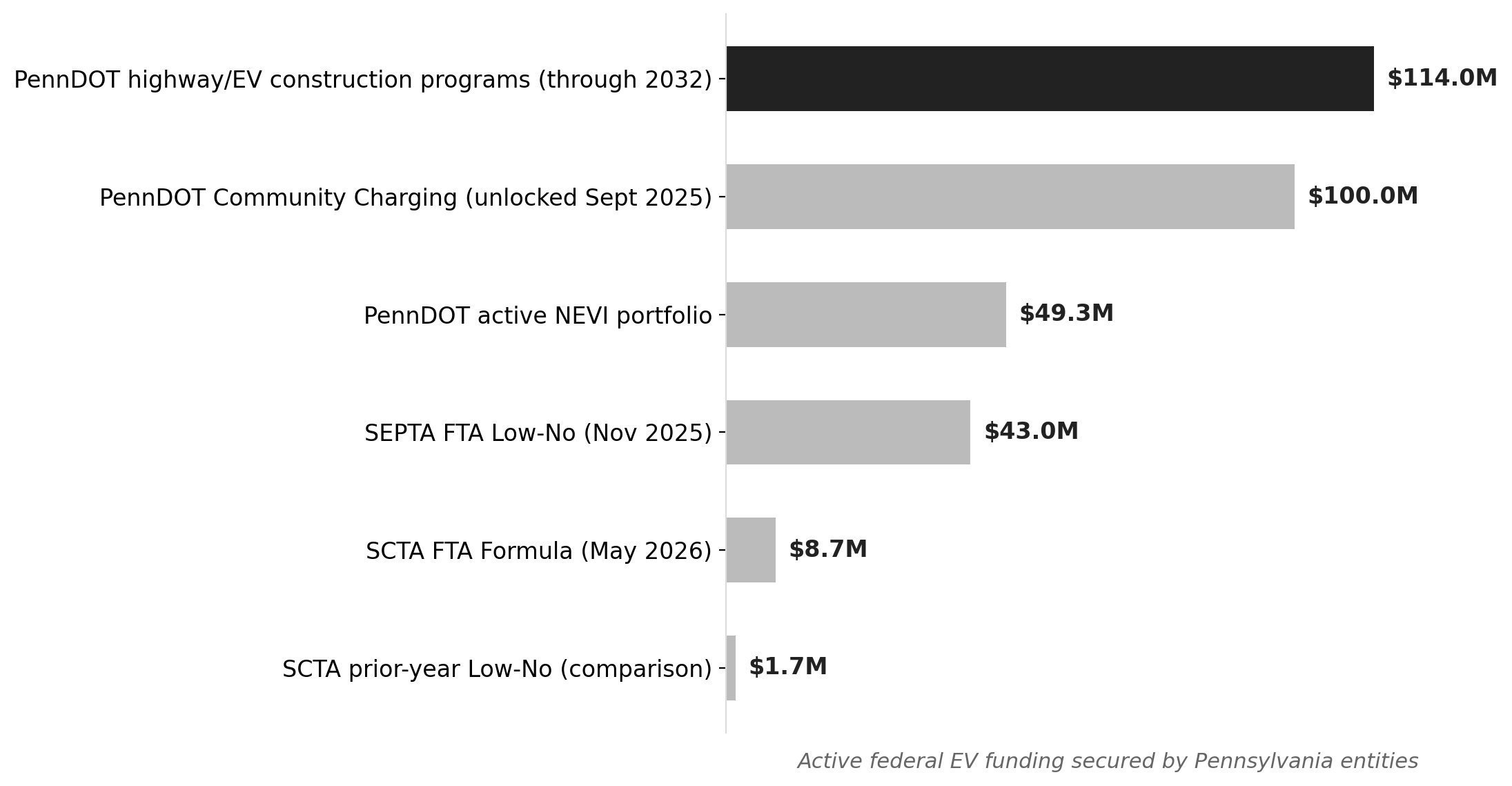
Source: NationGraph.
The 90-day grant spike is anchored by a single FTA Federal Transit Formula allocation to the South Central Transit Authority, the merged Lancaster and Berks County agency, starting May 6, 2026. Formula grants are structurally larger than the competitive Low-No awards SCTA received in prior years, which explains part of the percentage jump. But the jump also reflects how deep Pennsylvania's pipeline now runs. PennDOT currently holds $49.3 million in active NEVI grants running through 2032, alongside $114 million in highway and EV construction programs. The state leads the nation with 92 active NEVI projects across 47 counties, representing $61.9 million in federal investment and more than 35 operational charging stations already built, more than any other state.
Transit fleet electrification is moving on a parallel track. SEPTA received a $43 million FTA Low-No grant in November 2025 and has committed to eliminating diesel buses from its fleet entirely by 2028. That award came out of the FTA's $2 billion national Low-No and Bus Competitive deployment in November 2025, followed by a further $388 million released in February 2026. Both rounds seeded transit agencies across the state, and PennDOT Secretary Mike Carroll has publicly framed the community charging rollout as a direct response to federal obstruction, not a concession to it. According to PennDOT's own accounting, the state's NEVI-funded station count already exceeds every other state in the program.
For Pennsylvanians, the practical effect varies by geography. Drivers in the I-95 corridor already have access to federally funded fast chargers along major routes. The community charging rounds are designed for the places that came second: rural counties in the Central and Western regions, lower-income neighborhoods without reliable charging access, and smaller transit agencies outside Philadelphia and Pittsburgh. The four-round structure means new awards will continue to reach different parts of the state through at least the end of 2026.
The open question is durability. Judge Lin's injunction remains a preliminary order, not a final ruling, and the administration has not abandoned its broader effort to redirect Bipartisan Infrastructure Law spending. Pennsylvania's full build-out certification insulates some of the community charging money by shifting it from the contested highway-corridor framework into a separate FHWA category, but the legal landscape around NEVI is still unsettled nationally. According to the NRDC, the injunction covers all states whose funds were frozen, but enforcement depends on the administration's compliance going forward.
The next concrete signal will come from the Central and Eastern Region community charging rounds, expected this summer. If PennDOT can close those before any further federal action, the $100 million will be largely committed and legally harder to claw back. Whether that window stays open is the thing worth watching.