Eleven Minnesota municipalities have issued lead service line replacement RFPs in the last 30 days, against a monthly average of roughly 1.4 over the past year. That 7.8x spike is not a coincidence of timing. It is a direct product of a hard deadline: cities that fail to certify projects for the Minnesota Public Facilities Authority's 2027 Intended Use Plan by June 5, 2026, lose their place in the only queue that delivers 0%-interest replacement loans. They wait another full year. With lead pipes still serving an estimated 100,000 Minnesotans, that wait has real costs.
The funding architecture is the story here. MPFA administers federal Drinking Water State Revolving Fund dollars as concessional loans, not grants, but the interest rate for lead service line replacement is set by statute at zero percent. That makes the spring application window function like a once-a-year lottery: submit on time and your project gets financed at no carrying cost; miss it and you carry the pipes and the liability for another 12 months. Minnesota's 2026 Drinking Water Project Priority List contains 1,199 projects with an estimated $3.6 billion in costs, far beyond what MPFA can fund in any single cycle. The queue is real and the stakes of missing it are real.
The EPA raised the stakes further in October 2024. The Lead and Copper Rule Improvements set a federal mandate requiring all water systems to complete full lead service line replacement within 10 years, with compliance deadlines running to 2034. Minnesota's own legislature, through HF24 sponsored by Rep. Sydney Jordan, set an even tighter state goal of 2033. For cities still holding years of completed inventory surveys but no signed construction contracts, those dates convert abstract obligations into a procurement clock.
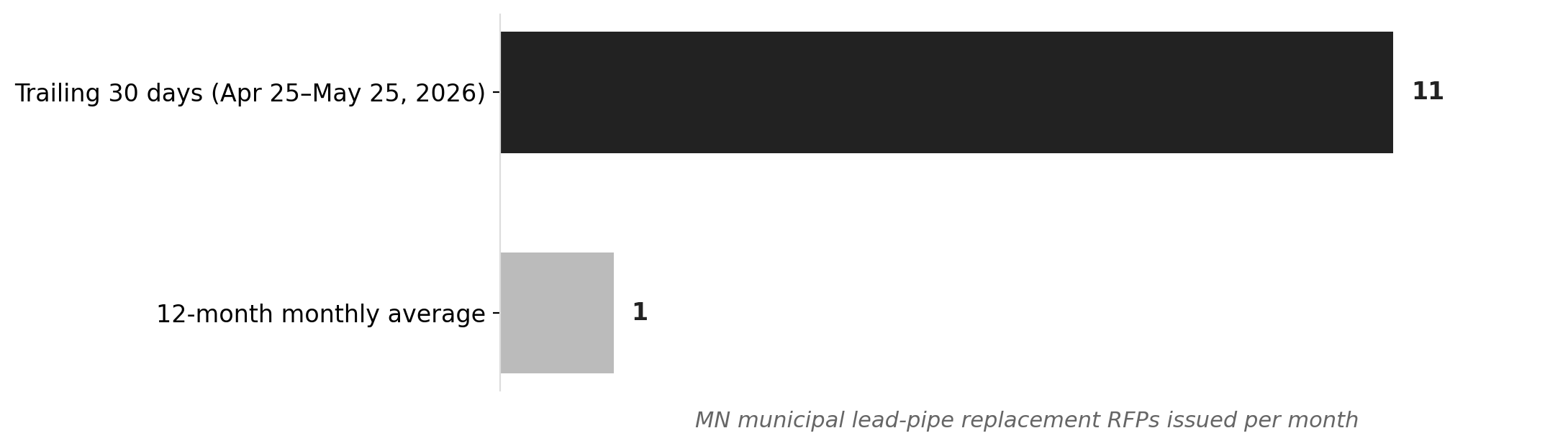
Source: NationGraph.
The current surge is concentrated in small and mid-size systems, which is exactly what MPFA's prioritization formula is designed to produce: it weights financial need and small-system size heavily. Brainerd, a city of roughly 14,000 in Crow Wing County, issued four separate RFPs covering two distinct project zones in this window alone. South St. Paul (pop. 20,000) moved faster still, awarding a contract to Bituminous Roadways, Inc. in early May and breaking ground the week of May 18. Milaca, Foley, and Sauk Rapids, each well under 15,000 residents, have also entered or updated bids in the same compressed period. These are not cities with large public works departments running parallel procurement tracks. The volume of activity is a signal of coordinated deadline pressure, not routine operations.
The federal money behind the state pipeline is substantial. According to the EPA's FY2026 DWSRF LSLR allotments memorandum, Minnesota is receiving approximately $57.8 million specifically earmarked for lead service line replacement this fiscal year, part of a $2.875 billion national DWSRF allocation. MPFA currently holds at least $192 million in active EPA Drinking Water SRF grants across the 2024-2026 vintages. That capital is available, but only to cities that have completed their service line inventories, prepared engineering plans, and submitted applications before the June 5 cutoff.
Minneapolis is a separate track. The state's largest city planned to replace 1,000 lines in 2025 and is operating under a 2025 legislative directive to prioritize lower-income neighborhoods and census tracts with elevated blood-lead levels. Its procurement cycle and funding sources differ from the MPFA loan program serving smaller systems, but the same federal 10-year clock applies.
The construction season in Minnesota runs roughly June through October, which means bids placed in May translate to shovels in the ground this summer. A city that does not have a contract in place by early June is not replacing lines in 2026. The spring RFP window is not just a funding deadline; it is the only realistic construction entry point for another calendar year.
Minnesota is not the only state seeing a surge. Wisconsin logged 16 lead-pipe RFPs in the same 30-day window, suggesting a Midwest-wide seasonal pulse tied to similar revolving-fund structures. But Minnesota's spike is proportionally sharper relative to its baseline, which points to the particular leverage of MPFA's annual IUP cycle and the 0% rate as a concentrated forcing function.
The next signal to watch is June 5 itself. The projects that appear on MPFA's final 2027 Intended Use Plan will show how many of the current RFPs converted into certified applications, and which cities arrived a year too late.