Lyme disease is no longer just a northeastern problem. Over the past decade, the blacklegged tick responsible for spreading the illness has marched steadily into Indiana, establishing populations across the state's fragmented forests and suburban woodlands. The CDC now estimates roughly 476,000 Americans are diagnosed and treated for Lyme disease each year, a figure that has roughly doubled since the early 2000s. Public health officials have struggled to keep pace, relying on labor-intensive methods like manually dragging cloth flags through brush to count ticks, techniques that can only cover small patches of ground.
Now, researchers at Purdue University in West Lafayette, Indiana are trying something considerably more ambitious: robot dogs that roam forests on their own, hunting for ticks.
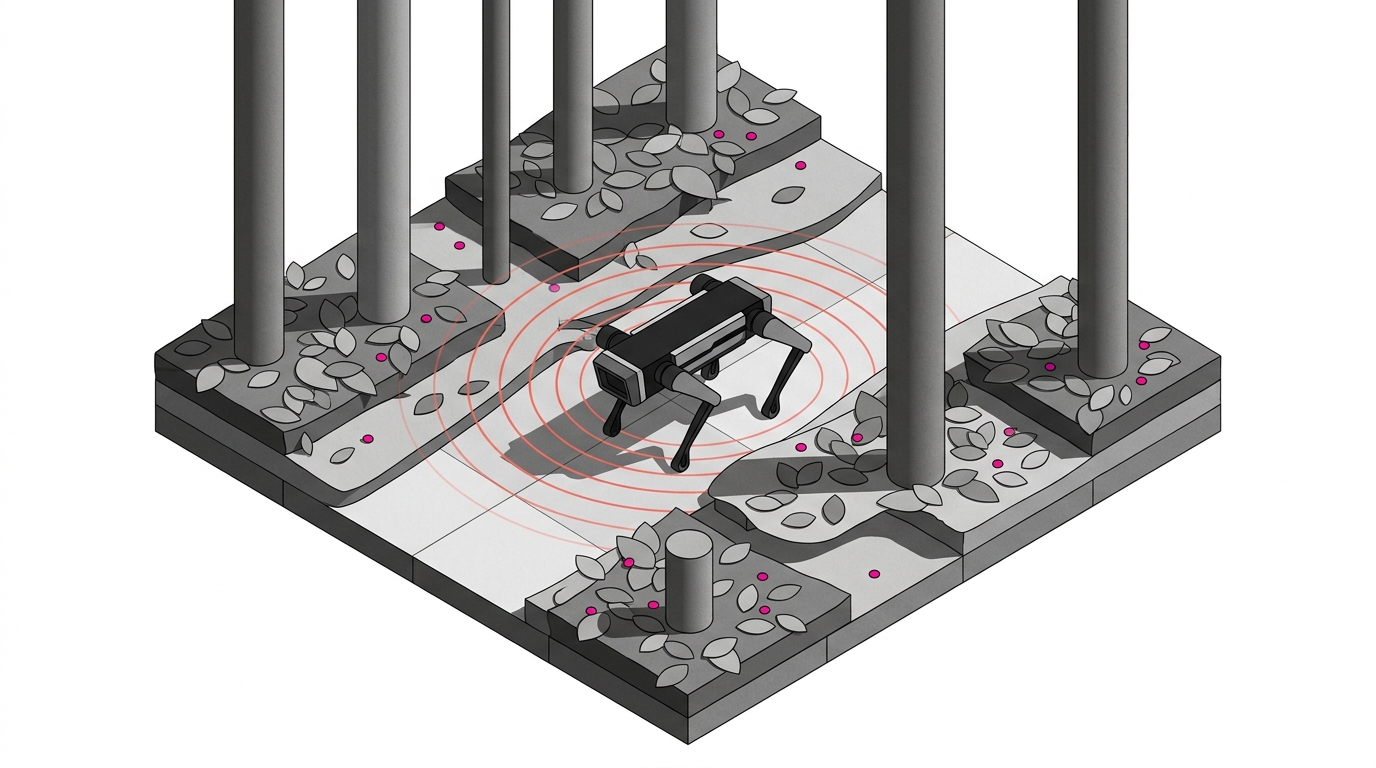
A $415,584 grant from the National Institute of Allergy and Infectious Diseases is funding a two-year project led by Drs. Hill, Murgia, and Kaur to build an autonomous surveillance system that combines millimeter-wave radar, cameras, and neural networks to detect individual ticks concealed beneath leaf litter and vegetation. The same mmWave radar technology used in 5G networks and self-driving cars would be adapted here to pick up ticks, including the tiny nymphal stage responsible for most human infections, in environments where they are almost impossible to spot by eye.
The robotic platform, modeled on quadruped robots similar to Boston Dynamics' Spot, would navigate uneven forest terrain independently, mapping tick hotspots across large areas at a scale no field crew could match. Drones are also being considered as an alternative platform.
Initial testing will use Purdue's Phenocosm, a controlled indoor arena that simulates natural tick habitats over weeks-long study periods, allowing researchers to refine detection algorithms before taking the system into real forests.
Indiana is a fitting place for this research. The state sits squarely in the expanding range of the blacklegged tick, which has spread south and east from established populations in Wisconsin and Michigan. Indiana's mix of agricultural land, fragmented woodlands, and suburban development creates the kind of edge habitat where ticks thrive and encounters with people are most likely. Despite this, Indiana's tick surveillance infrastructure has historically lagged behind northeastern states where Lyme disease has a longer history.
The grant is classified as an R21 exploratory award, NIH's mechanism for early-stage, proof-of-concept research. That means what comes out of the next two years will be a prototype and a foundation, not a deployable system. Field validation and full development would require additional funding, which the research team would need to pursue through follow-on grants. Given ongoing uncertainty around federal research budgets, that next step is far from guaranteed.