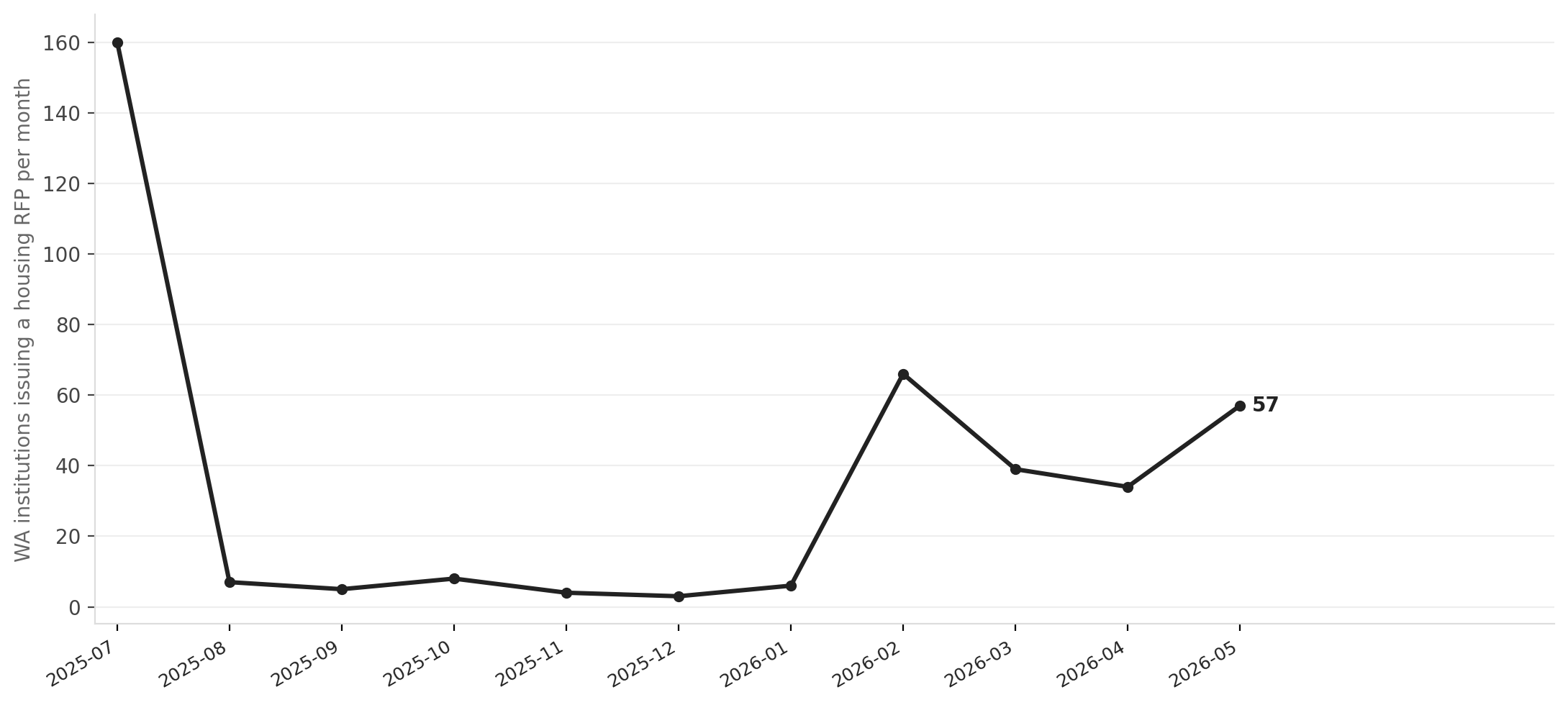
Fifty-nine Washington institutions issued a housing-related procurement request in the last 30 days after going silent for more than a year. In the comparable window before that, the number was effectively zero.
The break in silence traces to a single date. On April 1, 2026, Governor Bob Ferguson signed the supplemental capital budget, injecting $123 million in new Housing Trust Fund appropriations, an 82 percent increase over the current biennial baseline, projected to build or preserve roughly 3,000 units statewide. Within weeks, agencies that had spent months in a funding-uncertainty holding pattern began flooding the procurement pipeline with contractor solicitations, service provider RFPs, and capital repair bids.
The monthly shape of that pipeline tells the story precisely. Housing RFP issuers across Washington collapsed from around 160 institutions in July 2025 to between 3 and 10 per month from August 2025 through January 2026. Then February 2026 hit 66, tracking directly with the introduction and passage of seven housing bills Ferguson signed on March 27. Activity held at 34 to 57 institutions per month through May, a level sustained by the April 1 budget enactment. This is not a gradual recovery. It is a step function.
Source: NationGraph.
The 59 first-timers in this window span the full geography of the state and the full range of housing program types. The Pasco Housing Authority posted a general contractor solicitation for Heritage Boulevard Apartments in Eastern Washington. The city of Lynnwood issued a rental assistance program RFP on the west side of the Cascades. The Taholah tribal community, on the Quinault Indian Reservation in Grays Harbor County, posted RFPs for ductless heat pump installations and home repairs, signaling that the state's tribal housing incentives and block grant programs are activating alongside municipal procurement. The Kelso City Housing Authority posted a flooring rebid. Yakima posted a HUD HOME federal funding solicitation. The breadth suggests this is a statewide unlock, not a Seattle-metro phenomenon.
The urgency behind the spending push has a second dimension that makes the timing harder to separate from politics. The Washington Low Income Housing Alliance has warned that federal cuts under the Trump administration threaten up to $120 million in Washington homelessness and supportive housing program funding, with HUD's Continuum of Care grants reportedly slashed by two-thirds nationally. Active HUD grants in Washington's portfolio total more than $1.1 billion in obligated amounts across tribal housing block grants, Seattle Housing Authority operating funds, and HOME partnerships, but new HUD awards in the last 90 days amount to $192 million in fresh commitments, a figure dwarfed by what the state would lose if federal program cuts proceed at scale. State dollars, in other words, are now the swing variable.
Ferguson signed seven housing bills on March 27 alongside the budget package. The two most structurally significant are SB 6026, which allows residential development in commercial zones and passed the House 69 to 27, and HB 2266, which sets statewide permitting standards for supportive, transitional, and emergency housing. Together with the 2023 middle-housing zoning reform and the 2025 rent stabilization and $600 million Trust Fund package, Washington now has a three-year legislative stack that is, as of this spring, finally producing procurement-level activity. The state's total biennial housing commitment has reached $960 million.
According to Ferguson's April 1 budget announcement, the supplemental capital budget also advances broader infrastructure investments alongside the housing allocation. Rep. Davina Duerr (D-Bothell), who chairs the House local government committee, told The Urbanist in January that many of the permitting reforms "were only implemented this summer, so it's too early to know" whether they are making a difference at the ground level. The RFP surge suggests local agencies are not waiting for that verdict.
The structural backdrop makes the reactivation notable even beyond the dollar figures. Washington's affordability crisis is acute: more than 80 percent of households cannot afford a median single-family home, and construction permits are running at their lowest pace since 2013. The agencies now flooding the procurement pipeline are not acting from optimism about the housing market, they are acting from the arrival of dollars that were uncertain for much of the past year and may not be supplemented by federal sources going forward.
Ferguson signed Executive Order 25-12 in December 2025, creating a task force to design a new cabinet-level Department of Housing, with recommendations due in November 2026 for the 2027 legislative session. That timeline means the next policy layer is still a year away. What's visible right now is what happens immediately after a budget signature reaches agencies that had been standing at the starting line: 59 of them moved at once.