Federal transit grants to Delaware have hit $34.4 million in the last 90 days, nearly eight times the $4.5 million the state received in the same window a year ago. All of it flows through a single agency, DART First State, and almost all of it carries a hard deadline tied to the expiration of the Bipartisan Infrastructure Law.
The IIJA authorized $108 billion for transit through FY2026, but as the Bipartisan Policy Center has explained, its advance appropriations do not continue past September 30, 2026 without new congressional action. When the Federal Transit Administration published its FY2026 full-year formula tables on March 31, 2026, under P.L. 119-75, it effectively fired the starting gun on a national sprint to obligate remaining funds before the fiscal year closes. Delaware, it turns out, was already in the blocks.
Three grants landed in May and June 2026. A $14.75 million Federal Transit Formula tranche arrived in June with a performance window ending September 30, 2026, the IIJA's own close-out date, and a telltale sign that FTA is pushing final-year dollars to agencies it trusts to deploy them quickly. A $9.8 million formula award came in May, running through June 2027. So did an $8.74 million Buses and Bus Facilities/Low-No Emissions grant, DART's sixth in that competitive program series since 2019.
Source: NationGraph.
That sixth Low-No win is worth pausing on. By 2022, DART had already accumulated more than $22 million across five separate Low-No grants and was operating 26 electric buses, a track record that made the agency, in FTA's calculus, a known quantity. At a moment when FTA is trying to move billions of dollars through proven institutional channels before a statutory deadline, a small state agency with a half-decade of clean execution looks like a very good bet.
The math of Delaware's transit structure amplifies all of this. DART is not one operator among many in a fragmented metro system. It is the sole transit agency for the entire state: 246 buses, 54 routes, 2,295 stops, and roughly 32,400 weekday riders. Every dollar of FTA formula funding flows through one institutional channel, which means competitive wins are larger relative to the agency's size and easier to administer than in a city where a dozen operators share the same pot.
What DART is doing with the money reflects deliberate strategy as much as opportunism. WHYY reported in March 2026 that the $14.3 million Bus and Bus Facilities grant will fund a midlife rehabilitation program for 51 buses, roughly 23 percent of DART's fixed-route fleet, extending vehicle life by up to six years and saving an estimated $7.4 million in future costs. DART CEO John Sisson framed the approach plainly: rehabilitate rather than replace, and extend service life rather than chase new procurement cycles. That philosophy also happens to produce a strong cost-per-outcome ratio, exactly the kind of application that scores well on FTA's competitive rubric.
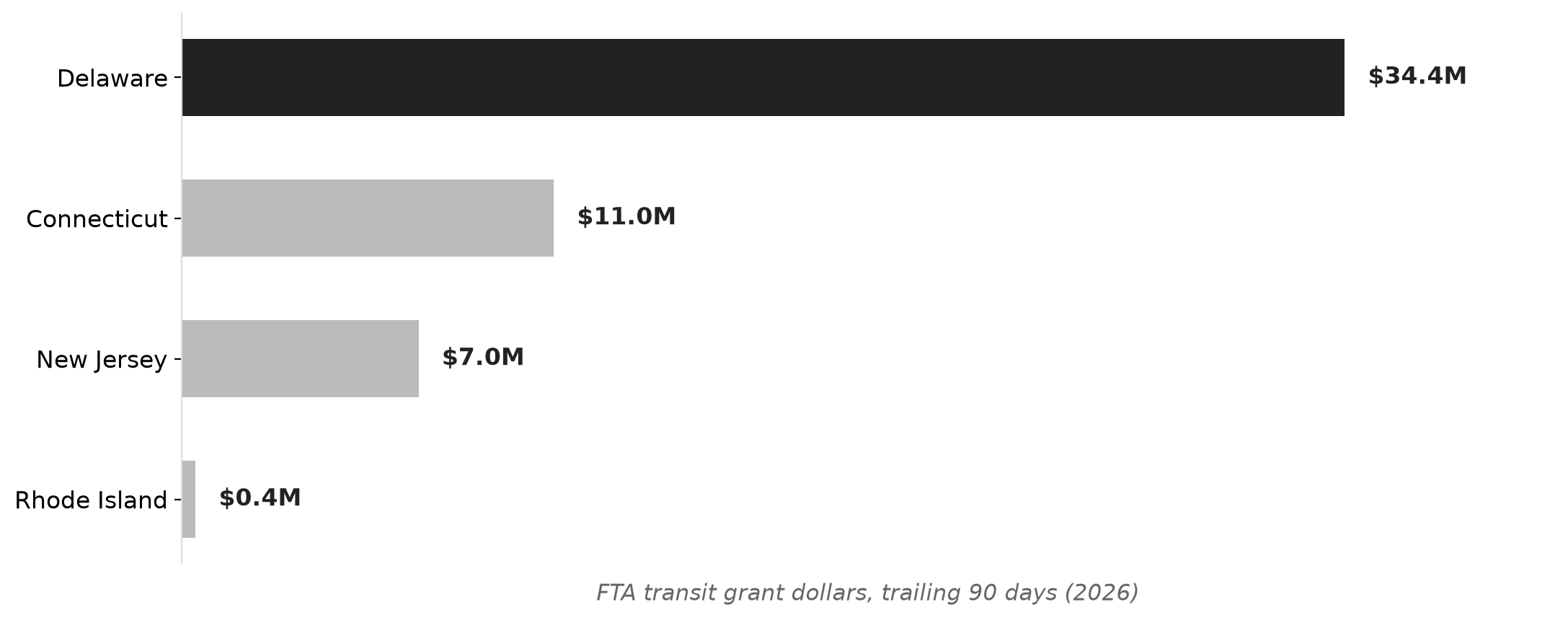
The regional contrast sharpens the picture. Among small Northeast states in the same 90-day window, Delaware's $34 million dwarfs Connecticut's $11 million, New Jersey's $7 million, and Rhode Island's $400,000. Only much larger states with proportionally larger formula shares, Pennsylvania at $249 million and Maryland at $49 million, pulled more. For a state with a population of roughly one million, Delaware's haul is less a product of size than of institutional positioning.
The climate angle is not incidental. Delaware Public Media has reported that transportation accounts for nearly one-third of the state's total carbon emissions. The Low-No program was designed precisely to accelerate fleet electrification in agencies that can demonstrate readiness to deploy, and DART's growing electric fleet gives the state a tangible measure of progress against that emissions share.
The immediate question is whether Delaware can fully obligate the $14.75 million formula grant before September 30. A performance window that ends on the same day as the IIJA's advance appropriations leaves almost no room for administrative delays. If the grant is not fully obligated by then, the money does not automatically roll over.
The larger question sits in Congress. Without reauthorization or a continuing resolution that extends IIJA-style transit funding, the volume of federal dollars available after October 1 drops significantly. FTA has not signaled what a post-IIJA funding landscape looks like in practice, and neither has the current Congress. For DART and the Delawareans who depend on its 54 routes, the sprint happening right now may be the last of its kind for some time.