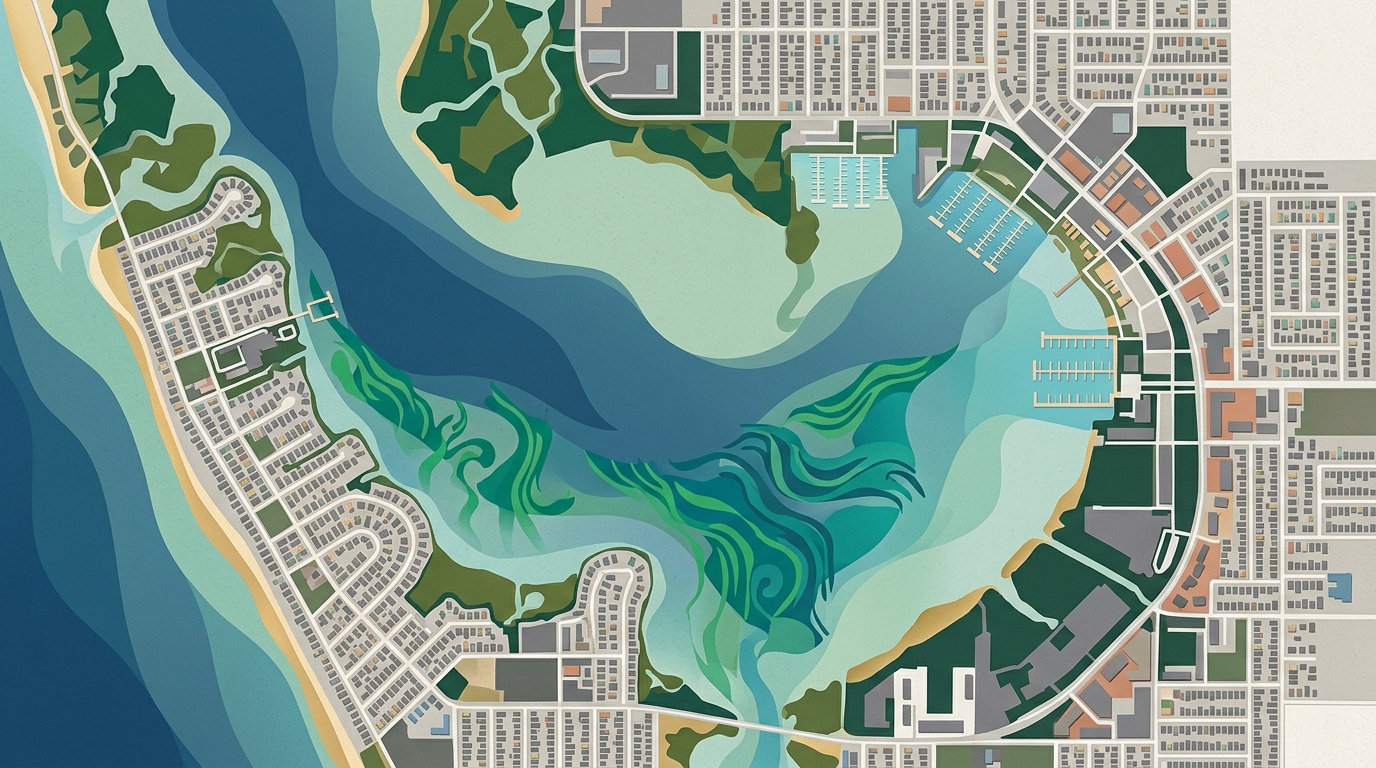
Sarasota Bay, Florida's Gulf Coast estuary that took decades to pull back from the brink of ecological collapse, is getting nearly $910,000 in federal money to push forward a set of habitat restoration and public access projects as the region's rapid growth threatens to undo those gains.
The EPA is awarding the Sarasota Bay National Estuary Program (SBEP) $909,800 through the Bipartisan Infrastructure Law, the same legislation that roughly quadrupled annual funding for the nation's 28 National Estuary Programs compared to pre-2021 levels. The money goes directly to construction and restoration, not planning or permitting — meaning these projects are ready to break ground.
The work spans several sites around the bay. The Fish Preserve, a long-running SBEP initiative that creates protected nursery habitat for juvenile fish, will expand into its fourth phase. GT Bray Park will receive habitat restoration work. Crews will also deploy more of the specially designed artificial reefs that SBEP has used for years to supplement the bay's underwater ecosystem. Two additional projects — improvements to Dr. Martin Luther King Jr. Memorial Park and design work on a seawall at Longboat Key Bayfront Park — round out the grant.
The MLK Jr. Memorial Park project carries particular significance. The park sits near Newtown, Sarasota's historically Black community, which has had limited access to waterfront amenities. The project aims to open up a tributary to Sarasota Bay, treat urban stormwater before it reaches the bay, and improve tidal creek habitat. SBEP will also run school field trips and develop environmental curriculum tied to the restoration sites.
Sarasota Bay's recovery over the past three decades is one of the EPA's most cited estuary success stories. When SBEP was founded in 1989, the bay had been hammered by dredge-and-fill development, sewage discharge, and pollution. Seagrass — the foundation of the bay's food web — had declined sharply. Coordinated restoration work eventually pushed seagrass coverage above historical baselines by the 2010s.
But the bay is under new pressure. Sarasota County's population has surged past 450,000, up from about 380,000 in 2010, driving more impervious surfaces and stormwater runoff into the water. Severe red tide blooms in 2018 and 2021 killed hundreds of tons of marine life and hammered the area's tourism-dependent economy. Rising water temperatures and sea levels are stressing the intertidal habitats that line the bay's shores — which is why the grant specifically funds work that allows those communities to migrate to higher ground within project boundaries.
Similar federal investments are playing out at estuaries up and down the East Coast: the Narragansett Bay program in Rhode Island, for example, recently received funding for up to eight new restoration projects through the same infrastructure law.
With the funding now awarded, SBEP and its local partners will move into construction on the shovel-ready sites while design and permitting work begins on the Longboat Key seawall project.