Highly pathogenic avian influenza remains one of the most serious threats to American poultry farms, and researchers at Indiana University are now working on a technology-based defense: ultraviolet light systems designed to kill the virus before it ever reaches a chicken.
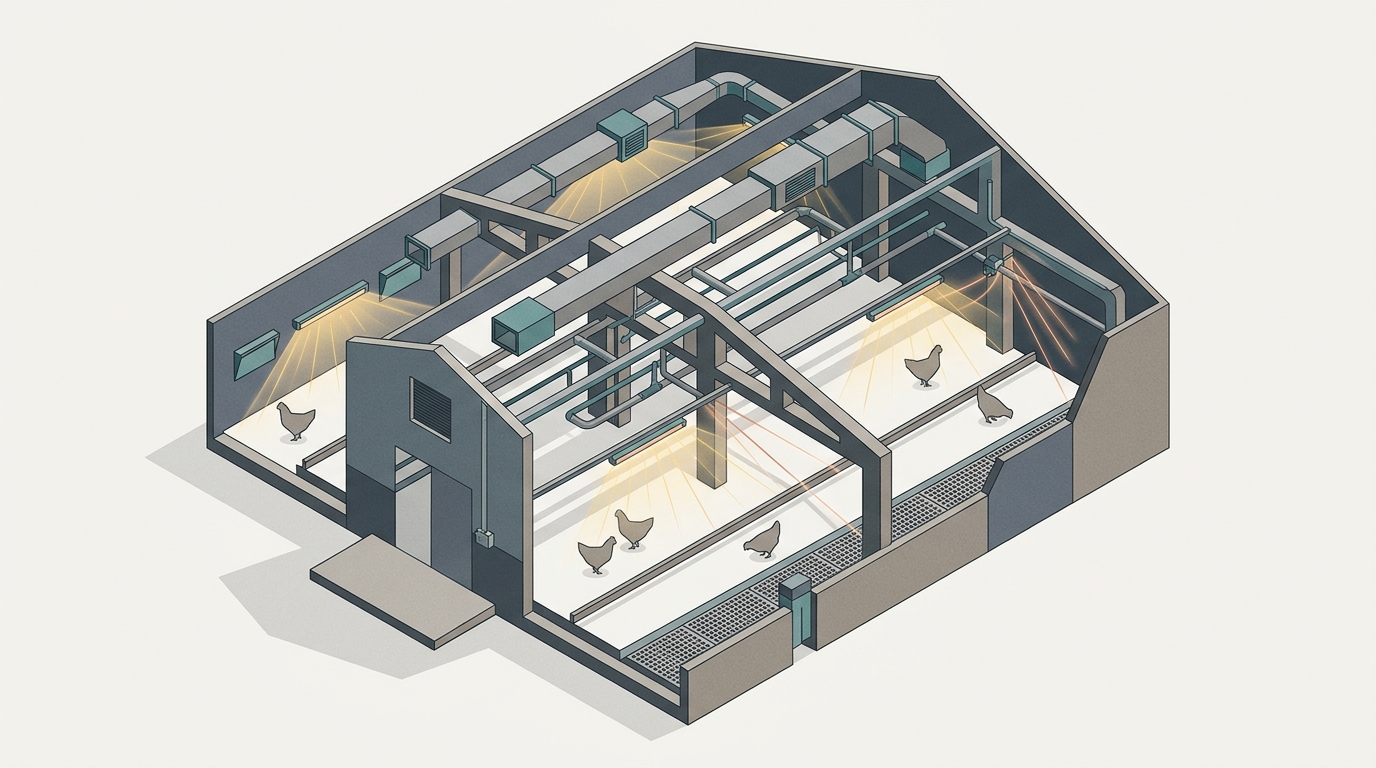
A $399,828 federal grant is funding the research, which focuses on ultraviolet-C (UVC) light as a way to disinfect the three main pathways through which avian flu enters commercial farms: contaminated air moving through ventilation systems, infected water sources, and virus-laden surfaces. Taken together, those routes represent how most outbreaks begin, often traced back to contact with wild birds or their droppings.
Indiana is a logical place for this work. The state has roughly 37 million egg-laying hens and a poultry sector worth about $1.8 billion annually, making it one of the most exposed states in the country to a major HPAI outbreak.
The research team spans three universities. Indiana University is leading the project, with Professor Karl Linden of the University of Colorado contributing expertise in UVC disinfection, and Professor Kaisen Lin of Michigan State University focusing specifically on how airborne viruses behave and how effectively UV radiation can neutralize them under the humid, dusty conditions typical of real poultry facilities.
The team will test multiple UV light technologies across different wavelengths and measure how much exposure is needed to inactivate 99% and 99.99% of avian influenza virus in water, air, and on surfaces. They will also use artificial intelligence to model where and how these systems should be deployed on working farms to get the best results.
The goal is practical: by the time the project wraps up, researchers plan to publish validated protocols and training materials that farm operators and agricultural extension agents can put to use without needing specialized scientific knowledge. If the technology proves out, it could offer commercial egg operations a relatively low-cost layer of biosecurity on top of existing practices.
Results from lab and bench-scale experiments are expected to inform field testing at Indiana egg-laying facilities in later phases of the project.