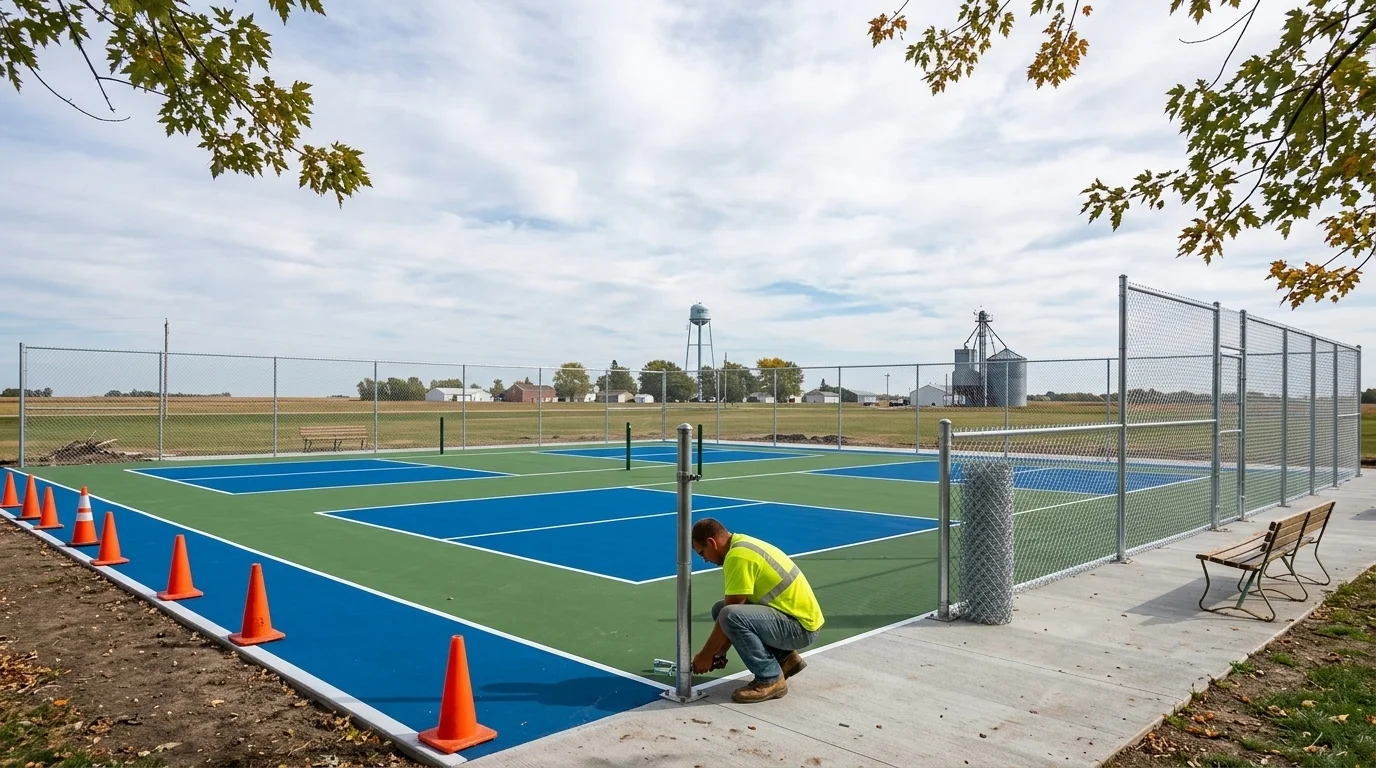
Eight Minnesota cities have issued pickleball facility RFPs in the last 30 days, more than three times the monthly average of roughly 2.5 over the prior year, and the timing is not a coincidence. The surge maps precisely onto a pair of bureaucratic deadlines that have turned a long-building sport trend into a compressed construction race.
The mechanics are specific. The Minnesota DNR's Outdoor Recreation Grant Program, which passes federal Land and Water Conservation Fund dollars down to local governments through a competitive matching process, set a March 31, 2026 application deadline for its current cycle. That deadline produced the biggest single month in at least 18 months: 10 pickleball-related RFPs in March 2026, as cities rushed to scope and price projects before filing. Then the DNR's own timeline takes over. According to the MN DNR Outdoor Recreation Grant Program, preliminary award announcements come in summer 2026 and the earliest allowable project start date is fall 2026. Cities receiving award signals this summer now have a narrow window to complete procurement before the construction clock runs out. The current August spike, 8 RFPs in 30 days, is the procurement echo of the spring application wave.
The grant program's scoring criteria matter here too. The DNR's competitive grants are now governed by the 2026-2030 State Comprehensive Outdoor Recreation Plan, the five-year policy document the National Park Service requires Minnesota to maintain as a condition of LWCF eligibility. Pickleball courts, as ADA-accessible, multi-generational outdoor facilities, score well against the criteria that SCORP sets. Cities building courts are not just chasing a sport fad; they are answering a rubric.
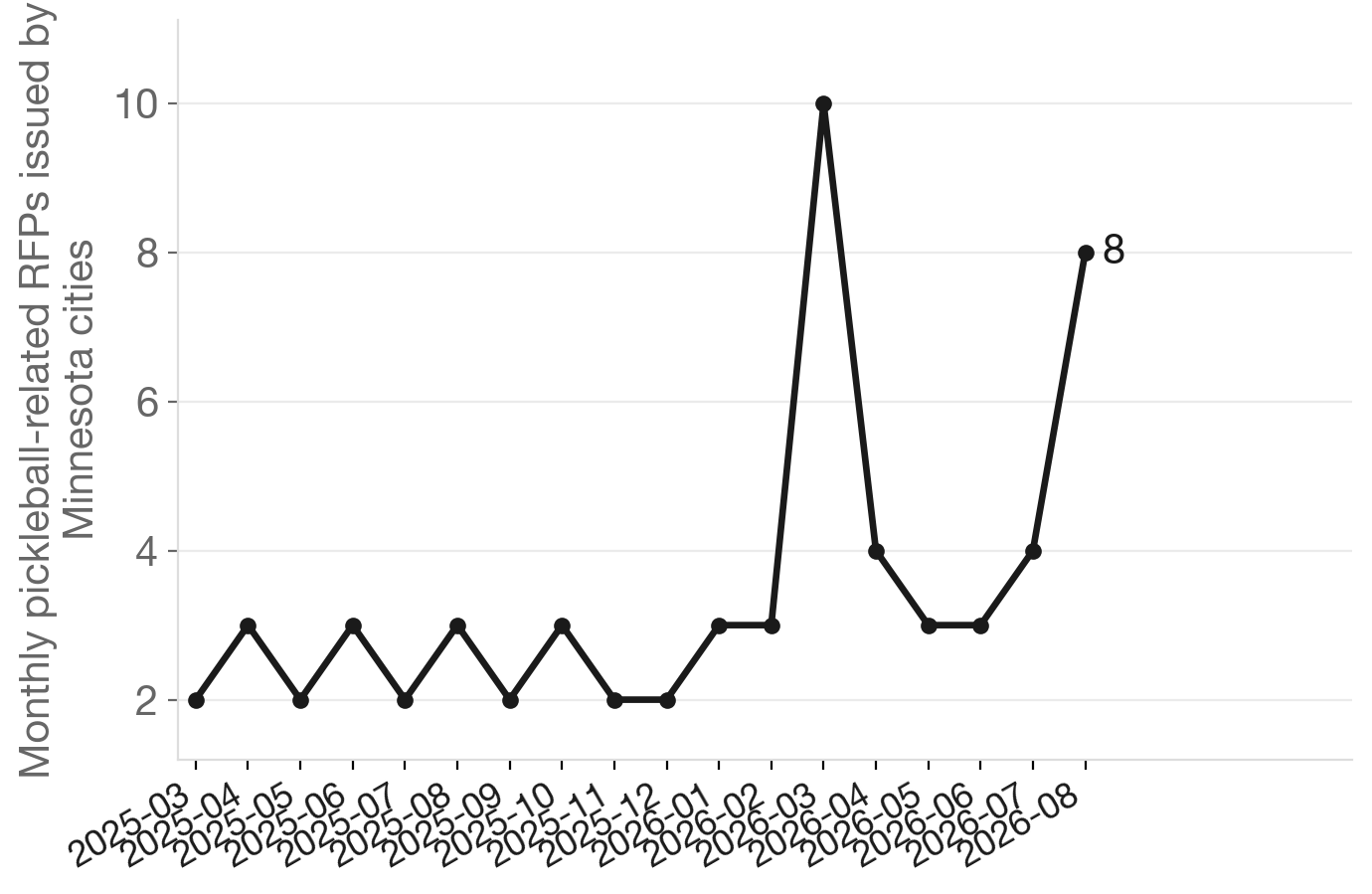
Source: NationGraph.
The geographic spread of cities now issuing RFPs tells the same story as the timing: this is statewide, not concentrated in the Twin Cities metro. Mankato, Wadena, Proctor, Virginia, St. Cloud, Big Lake, Apple Valley, Monticello, and Fairmont span more than eight counties, from the Iron Range to the southwest prairie. Fairmont is the clearest example of the full pipeline. The city first placed a pickleball court project on its council agenda in April 2026, shortly after the grant application window closed. By its August 24, 2026 council meeting, it had approved Task Order 8 with engineering firm Bolton & Menk for design and bidding services. Application to RFP in roughly four months, exactly the timeline the DNR's award-to-construction schedule would predict.
On the demand side, community groups are the engine pushing city halls to compete. In Austin, a local pickleball association proposed an $380,000, eight-court complex for Rotary Centennial Park, taking the case directly to the city council and demonstrating how organized sport communities are turning facility aspirations into capital budget line items. Cities that might have deferred the question for another budget cycle found themselves holding a community proposal, a grant opportunity, and a scoring rubric that favored exactly this kind of project, all in the same quarter.
Funding is also being layered. USA Pickleball's Play It Forward grant program, with applications that closed in late April 2026, offers a non-governmental funding source that cities are stacking on top of DNR and LWCF dollars. That stacking lowers the local match burden and makes marginal projects viable, which partly explains why smaller outstate cities like Wadena and Proctor are in the same construction wave as larger ones.
Minnesota's grant infrastructure is unusually well-suited to producing these periodic surges. The state runs multiple parallel competitive programs, including DNR Outdoor Recreation, Natural and Scenic Areas, Local Trail Connections, and the LWCF pass-through, all synchronized to the five-year SCORP cycle. Cities that miss a grant window do not get a second chance for years. That structure concentrates spending into waves rather than spreading it smoothly, and the current wave happens to coincide with pickleball reaching the point where demand data is credible and politically legible. Minnesota Pickleball, the state's sanctioning organization, has operated since 2014 and now serves thousands of registered players, giving city councils something to point to when approving capital outlays.
The 2026 Minnesota State Pickleball Tournament, a National Tier-1 event running in Maple Grove August 27-30, lands in the middle of the procurement window, reinforcing the political case for investment at the exact moment park boards are signing engineering contracts.
The next signal to watch is fall 2026 contract awards. Cities that clear procurement in the next six to eight weeks will break ground before winter; those that miss the window face a full-year delay and may need to reapply in the next DNR grant cycle. If the current wave of RFPs converts to awarded construction contracts at a normal rate, Minnesota will add a meaningful share of its outdoor pickleball infrastructure in a single construction season, a build-out that organically would have taken several years.