Federal solar grants to California totaled $8.9 million in the trailing 90 days, down from $103.9 million in the same window a year earlier, a 91% collapse that reflects not a budget cycle but a deliberate policy reversal at the federal level.
The numbers inside that $8.9 million make the point plainly. Only six federal awards matching solar-related keywords reached California this summer, and none is a dedicated solar-energy program. The two largest are a $4 million highway planning grant to Caltrans and a $3.5 million transit formula grant to the City of Los Angeles. The prior-year window, by contrast, included a $33.9 million NOAA cooperative institute award to UC San Diego, $30 million in Strategic Growth Council resilience grants with solar components, and $9.2 million in DOE renewable energy grants to tribal nations. That window now looks like the tail end of an era.
Three distinct federal instruments have been dismantled in sequence, and the One Big Beautiful Bill Act (H.R. 1), signed by President Trump on July 4, 2025, is the legislative instrument linking them.
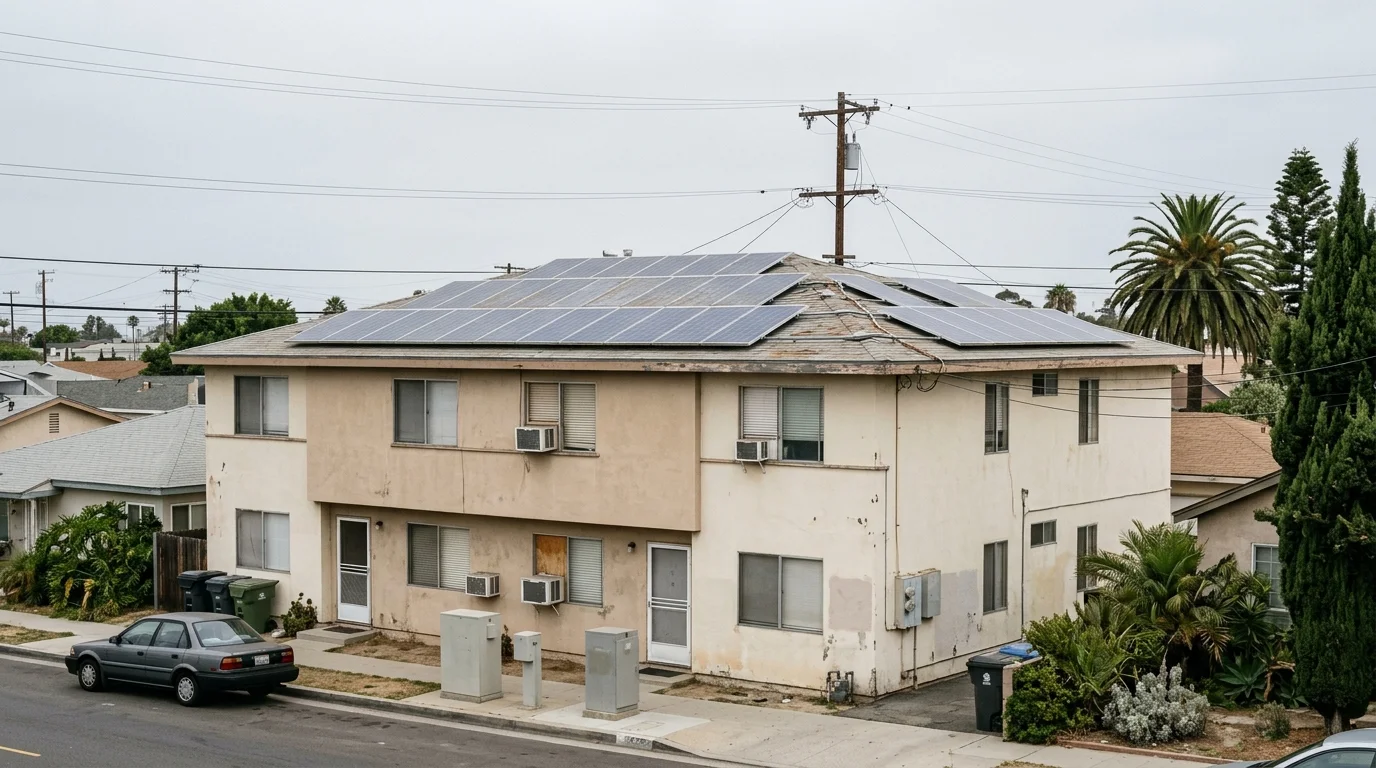
The first is the EPA's Solar for All program, a $7 billion direct grant initiative funded through the Greenhouse Gas Reduction Fund under IRA Section 60103, designed to bring residential and community solar to low-income and disadvantaged households. California was awarded approximately $250 million across three state agencies: $210.4 million to the California Public Utilities Commission, $30.2 million to the California Energy Commission, and $9.2 million to the Employment Development Department. EPA Administrator Lee Zeldin formally terminated the program on August 7, 2025, citing the OBBBA's repeal of the underlying statutory authority, and initiated clawback proceedings on already-obligated grants. The CPUC had been running informational webinars on its Solar for All program as recently as June 2025, soliciting proposals from community organizations, before the program was cut entirely.
The second instrument is the Section 25D residential clean energy tax credit, a separate homeowner-facing benefit that provided a 30% credit for the purchase and installation of rooftop solar systems. The OBBBA eliminated it effective December 31, 2025, with no phase-down. This credit was not a grant to state agencies; it was a direct subsidy to individual homeowners making a capital investment. Its abrupt termination is a distinct policy action from the Solar for All cancellation, aimed at a different set of actors through a different mechanism. As analysts at the National Law Review note, the speed of the cut, no transition period, was unusual even by the standards of credit phase-outs.
The third instrument, the Section 48E and 45Y commercial clean electricity tax credits, targeted developers and investors in utility-scale solar. Under the OBBBA, these credits are being accelerated toward phase-out for projects beginning construction after July 4, 2026, and placed in service after December 31, 2027. That clock is now running.
All three programs were solar-supporting. All three operated through entirely different actors, state agencies, private homeowners, and commercial developers, respectively. And all three are now being wound down through the same legislation, reinforced by Executive Order 14315, signed July 7, 2025, which directed every federal agency to end support for solar and other green technologies.
The collapse is not California-specific in origin, but California is disproportionately exposed. The state is the largest residential solar market in the country, requires solar on all new homes, and received one of the largest Solar for All allocations of any state. Quarterly grant data confirms the trajectory: California touched roughly $945 million in federal grants with solar components in Q1 2025, driven by the EPA's Clean Ports and GGRF disbursement wave. By Q4 2025 and through Q3 2026, new federal commitments have fallen to near zero. DOE solar grants have dried up nationally in the same window, only $2.2 million to Maryland and $2 million to Minnesota registered any DOE solar awards in the trailing 90 days, confirming this is a federal withdrawal, not a California budget quirk.
The litigation picture complicates any near-term resolution. More than 20 state attorneys general sued EPA over the Solar for All termination, arguing that the OBBBA only rescinded unobligated funds and could not void already-binding grant agreements. A federal judge ruled in June 2026 that those suits must proceed in the Court of Federal Claims rather than district court, a significant procedural setback for states that slows any prospect of reinstatement. California's CPUC and CEC remain in legal limbo, having spent the first half of 2025 designing programs and issuing solicitations against grants that are now subject to clawback.
For Californians who were in line to receive Solar for All benefits, renters in disadvantaged communities, lower-income homeowners who needed grant support rather than a tax credit to afford solar, the courthouse is now the only venue where the program still exists. The next signal to watch is the Court of Federal Claims docket: if courts rule that EPA's clawback of already-obligated GGRF funds was unlawful, some portion of California's $250 million could be reinstated. If not, the programs those dollars were designed to fund will not be rebuilt through federal channels in the current administration.