Federal transit grants newly obligated to the District of Columbia hit $352.7 million in the trailing 90 days ending September 7, 2026, a 75% increase over the $201.7 million obligated in the same window a year earlier. Nearly all of it landed in 17 days.
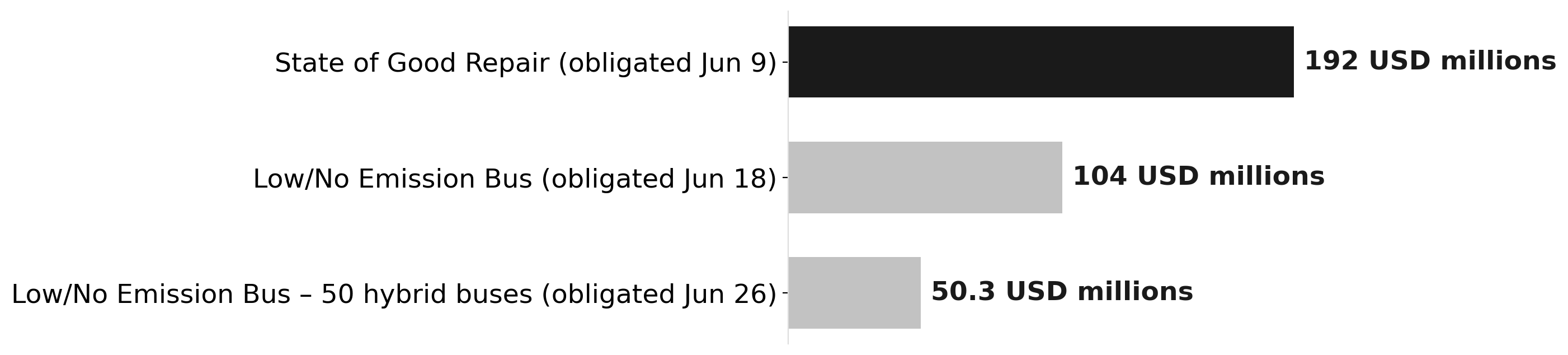
Between June 9 and June 26, 2026, the Washington Metropolitan Area Transit Authority received three separate federal grants totaling $346.3 million: a $192 million State of Good Repair formula grant, a $104 million Low/No Emission Bus competitive award, and a $50.3 million Low/No Emission Bus grant for 50 new diesel-electric hybrid buses. Outside that window, monthly federal transit obligations to DC had mostly run between $1 million and $15 million for the prior year. The spike was not gradual accumulation. It was a logjam breaking.
The reason traces back to February 3, 2026, when President Trump signed the Consolidated Appropriations Act of 2026 (P.L. 119-75). The law provided full-year FY2026 spending authority for Federal Transit Administration programs after months of continuing resolutions had held agencies in a holding pattern, unable to finalize grant awards or obligate capital funds at scale. FTA posted its FY2026 full-year apportionment tables on March 31, 2026, the administrative trigger that allowed transit agencies nationwide to begin drawing down funds. WMATA, with three major grants in various stages of award, drew all of them within the same three-week window once the apportionment tables cleared.
Source: NationGraph.
The three grants come from legally distinct programs and should not be read as a single policy decision. The $192 million State of Good Repair grant flows from Section 5337 of the IIJA, a formula program apportioned annually based on fixed guideway and motorbus metrics, WMATA's share of a $4.74 billion national FY2026 pool targeting capital maintenance of rail and bus infrastructure. The two Low/No Emission Bus grants are competitive discretionary awards, selected through a Notice of Funding Opportunity process, and represent FY2025 competitive cycles that were themselves delayed by the continuing-resolution environment. WMATA's press release on the $50.3 million award describes the funds as supporting bus fleet modernization. The $104 million competitive award was announced separately by Delegate Eleanor Holmes Norton. What the February appropriations act did was not create these grants, it unlocked the calendar that allowed all three to close simultaneously.
WMATA's capacity to absorb tranches of this size reflects its unusual position in American transit finance. Unlike any other U.S. transit agency, WMATA receives a dedicated annual federal appropriation under the Passenger Rail Investment and Improvement Act, currently authorized at $150 million per year and matched by DC, Maryland, and Virginia. The District of Columbia separately contributes $178.5 million annually through a Capital Funding Agreement. That layered structure means WMATA carries an active federal grant portfolio, now $1.22 billion across 68 concurrent grants, that requires ongoing administrative capacity to manage. For agencies without that infrastructure, a $346 million month would be operationally impossible. For WMATA, it was a backlog clearing.
The prior-year comparison window was itself not a baseline. Between July and September 2025, WMATA received $153.5 million in PRIIA-backed capital grants, which elevated the year-ago figure. The 75% year-over-year increase understates the underlying June 2026 concentration: on a month-by-month basis, June 2026 represents roughly 25 times the typical monthly federal transit obligation to DC over the preceding year.
Institutionally, WMATA enters this capital cycle with unusual competitive standing. The American Public Transportation Association named WMATA its Transit Agency of the Year in 2025, citing record ridership growth and a redesigned bus network. Competitive grant programs weight agency performance and readiness, factors that likely reinforced WMATA's position in the Low/No Emission Bus award cycle.
The forward question is whether this concentration repeats. Congress is already moving on what comes after the IIJA framework: the BUILD America 250 Act, a surface transportation reauthorization bill, was introduced in the House on May 19, 2026, and marked up three days later. A new authorization would reset formula apportionments and competitive grant pools, but transit agencies are watching the legislative calendar carefully. Remaining IIJA-backed funds that have not yet been obligated carry implicit deadline pressure, and the pattern of concentrated June drawdowns suggests agencies will time their grant closings around the next moment Washington clears a funding logjam, whenever that comes.