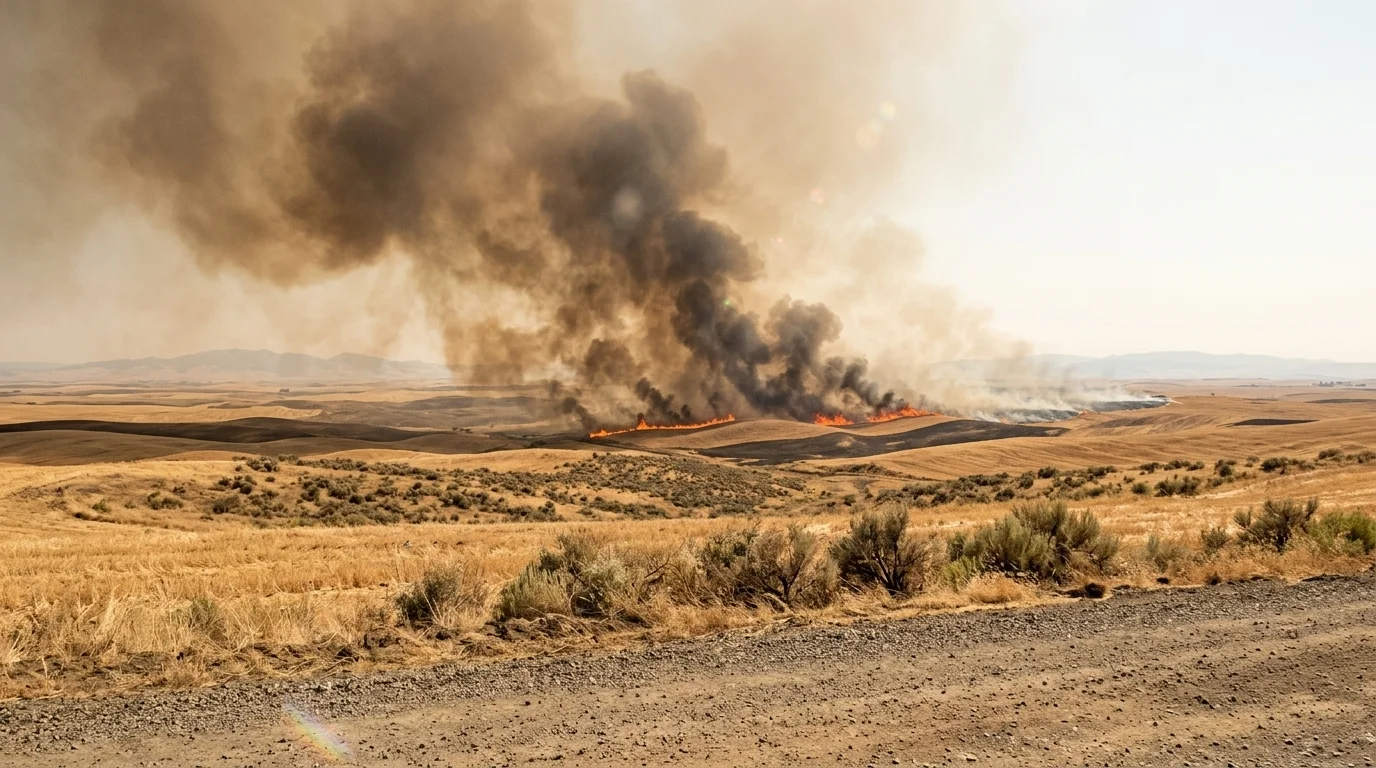
Washington has issued seven wildfire-related procurement solicitations in the last 30 days, roughly 2.5 times the monthly average over the past year, and the number understates the urgency. With more than 1,000 fires burning across 425,000 acres, a statewide emergency declaration, and a federal disaster declaration unlocking FEMA coordination for six Eastern Washington counties and three Tribal nations, local governments are now racing to open contracts for work the fire season began demanding months ago.
The procurement surge is a lagging signal. The fires themselves are not new: Washington's Department of Ecology declared a drought emergency in early April, snowpack came in below normal, and a record heat wave arrived in late July. What changed in early August was political and administrative. Governor Bob Ferguson declared a statewide wildfire emergency on August 1, citing record drought, extreme heat, and high winds. Three days later, the Trump administration approved a federal emergency declaration covering Chelan, Ferry, Okanogan, Spokane, Stevens, and Yakima counties. Together those two actions activated FEMA coordination and EMAC mutual aid, the administrative triggers that turn a disaster into a procurement event.
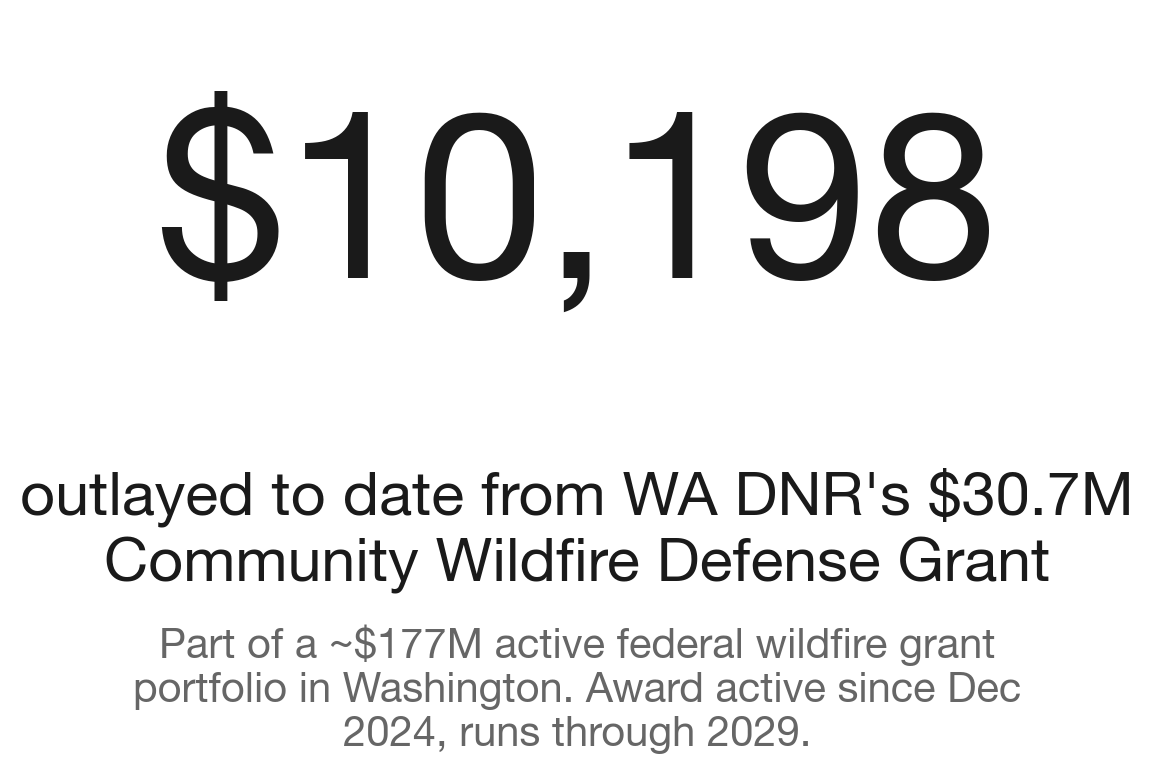
The money was already there. The Washington State Legislature doubled the 2026 firefighting budget to $120 million, twice the prior year. The active federal wildfire-related grant portfolio across the state runs to approximately $177 million, spread across USDA, EPA, DOE, and DOI programs. The single largest wildfire-specific award is a $30.7 million USDA Community Wildfire Defense Grant issued to the Washington Department of Natural Resources in December 2024, funded through the Infrastructure Investment and Jobs Act and running through 2029. Total outlays against that grant: $10,198.
Source: NationGraph.
That figure is not a rounding error. It reflects how long the gap between authorization and deployment can run in normal times, and how dramatically an active disaster compresses the timeline. With fires near Spokane destroying hundreds of structures and the Little Giant Fire near Lake Wenatchee exceeding 38,500 acres at zero percent containment as of August 2, the pressure on agencies to start drawing down that pipeline is no longer abstract. Commissioner of Public Lands Dave Upthegrove put it plainly: "This year has already been one of our busiest wildfire years on record, and we just started August."
The contracting activity now showing up in public procurement databases reflects both the emergency response and the longer-horizon resilience work. The most substantive new solicitation is a Climate-Driven Wildfire Risk Assessment and Community Resilience Plan RFQ from the City of Camas in Clark County, which has been issued and updated three times since July as the city works to operationalize the climate element of its Comprehensive Plan. Camas sits west of the Cascades, a reminder that the crisis is no longer confined to the dry rain-shadow country of Eastern Washington. The Washington State Department of Ecology has issued air quality alerts for seven western counties, including King and Pierce, as smoke from Eastern Washington fires streams over the mountains.
The geographic spread matters for how procurement flows. Eastern Washington's six federally designated emergency counties are where the fire damage is most acute and where FEMA reimbursement mechanisms are now active. But western cities and counties, facing smoke emergencies and long-term exposure risk, are also beginning to formalize their resilience planning, which requires separate contracting vehicles. The result is a procurement landscape that is simultaneously reactive in the east and prospective in the west.
For residents, the immediate signal is that the government machinery is now moving in a way it wasn't in July. Emergency declarations reduce administrative friction, shorten procurement timelines, and allow jurisdictions to access mutual aid without the normal authorization delays. The $30.7 million USDA grant, nearly untouched after eight months, is the clearest measure of how much runway remains. Washington is not short of funding; it is short of signed contracts and deployed personnel, and the current RFP surge is the first visible step toward closing that distance.
The next signal to watch is how quickly Eastern Washington's six designated counties move from emergency declarations to actual contract awards. FEMA coordination is now authorized, but reimbursement claims require documentation, and documentation requires contractors on the ground. Oregon, facing comparable fire conditions, produced only two wildfire-related solicitations in the same 30-day window, suggesting Washington's procurement response is moving faster than the regional baseline. Whether the $30.7 million USDA grant sees meaningful outlays before the 2026 fire season peaks will be a concrete test of whether the administrative machinery has actually shifted.