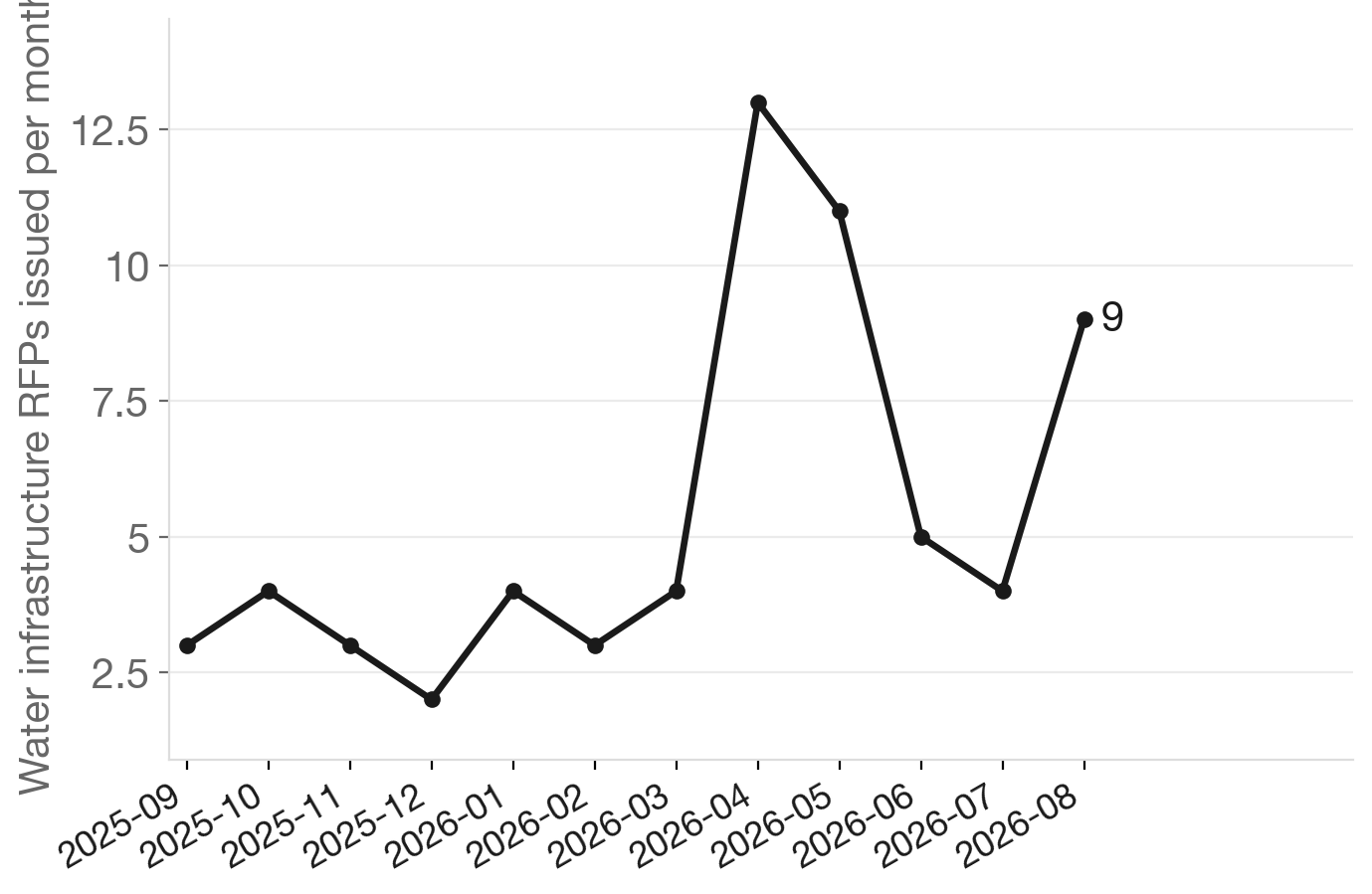
Minnesota issued nine water infrastructure RFPs in the last 30 days, more than double its 12-month monthly average of roughly 3.9, and the timing is not a coincidence. Within 48 hours in mid-May, two distinct funding streams arrived at the same administrative door: the state Legislature passed a $1.24B capital investment bill on May 18, and the EPA announced $57.77M in federal lead service line replacement funds for Minnesota on May 20. Both flow through the Minnesota Public Facilities Authority. The result is the most concentrated procurement surge the state has seen in years.
The two mechanisms are legally separate and should not be confused. The federal money is the final annual tranche of the Infrastructure Investment and Jobs Act's $15 billion, five-year Drinking Water State Revolving Fund lead pipe program, which EPA distributed nationally on May 20, 2026 as $2.875 billion across all states. Minnesota's $57.77M share arrives as below-market loans and principal forgiveness grants to local water systems, with 49 percent required to go to disadvantaged communities. The state money is a different instrument entirely: HF 719, a general obligation bond bill, the first even-year bonding bill Minnesota has passed since 2018. The Legislature had failed to pass bonding bills in four of the last five even-year sessions. When it cleared the chamber 122-11 in the House and 60-7 in the Senate, it directed the largest single share of its $1.24B to water, with roughly $137M flowing to MPFA loan and grant programs, an additional $345M in direct city earmarks for water and wastewater projects, and $15M specifically for lead service line replacement.
The reason both streams hit at once is structural. Minnesota channels virtually all state and federal water money through MPFA, which coordinates annual Intended Use Plans with the MPCA and MDH. Cities that secured spots on the MPFA Project Priority List by the January 2026 submission deadline for the 2027 IUP cycle are now positioned to move to procurement the moment authorization arrives. When two authorizations landed within 48 hours, every municipality on that list got a simultaneous green light.
Source: NationGraph.
The RFP data reflects exactly that dynamic. Issuers in the current 30-day window span the full range the bonding bill was designed to reach: metro anchors like the University of Minnesota, the Metropolitan Airports Commission, and the City of Bloomington alongside smaller communities like the City of Belview and Redwood County. The bonding bill explicitly combined MPFA statewide programs with individual city earmarks, and the procurement activity mirrors that structure. Minnesota's 30-day count is also 3 to 9 times higher than any neighboring state in the same window: Wisconsin issued one RFP, Iowa three, South Dakota three, North Dakota two. This is not a regional uptick driven by seasonal construction cycles. It is specific to Minnesota.
The urgency behind the surge is real. FY2026 is the final year of the IIJA lead-pipe program. After this round, the Environmental Policy Innovation Center has noted, federal funding for lead service line replacement enters a "constrained" period with no comparable successor program enacted. For municipalities that have been waiting on the MPFA priority list, procuring now is not just opportunistic, it is the last chance to access federal dollars at this scale for lead pipe work. The Freshwater Society has observed that advocates had pushed for $250M in state lead-pipe funding through an earlier bill; HF 719 delivered $15M, meaning the federal DWSRF allocation is carrying the bulk of the lead replacement burden.
The scale of what remains to be done puts the current procurement window in context. Minnesota's 20-year drinking water and wastewater infrastructure need exceeds $16.7B. The EPA's active water grant portfolio for the state shows $554M obligated but only $93.7M outlayed across 72 active grants, meaning the vast majority of committed federal money is still seeking implementation and contractor procurement. The bonding bill and the IIJA tranche together represent a meaningful down payment, but the gap between obligation and outlay also signals that the procurement pipeline must keep moving to convert authorizations into built infrastructure before deadlines pass.
The next signal to watch is how quickly MPFA closes financing agreements with the municipalities now issuing RFPs, and whether the 2027 Intended Use Plan cycle, already open for submissions, produces another round of prioritized projects before the federal lead-pipe program fully winds down. Cities that miss this window will be competing for a substantially smaller pool of federal dollars in the years ahead.