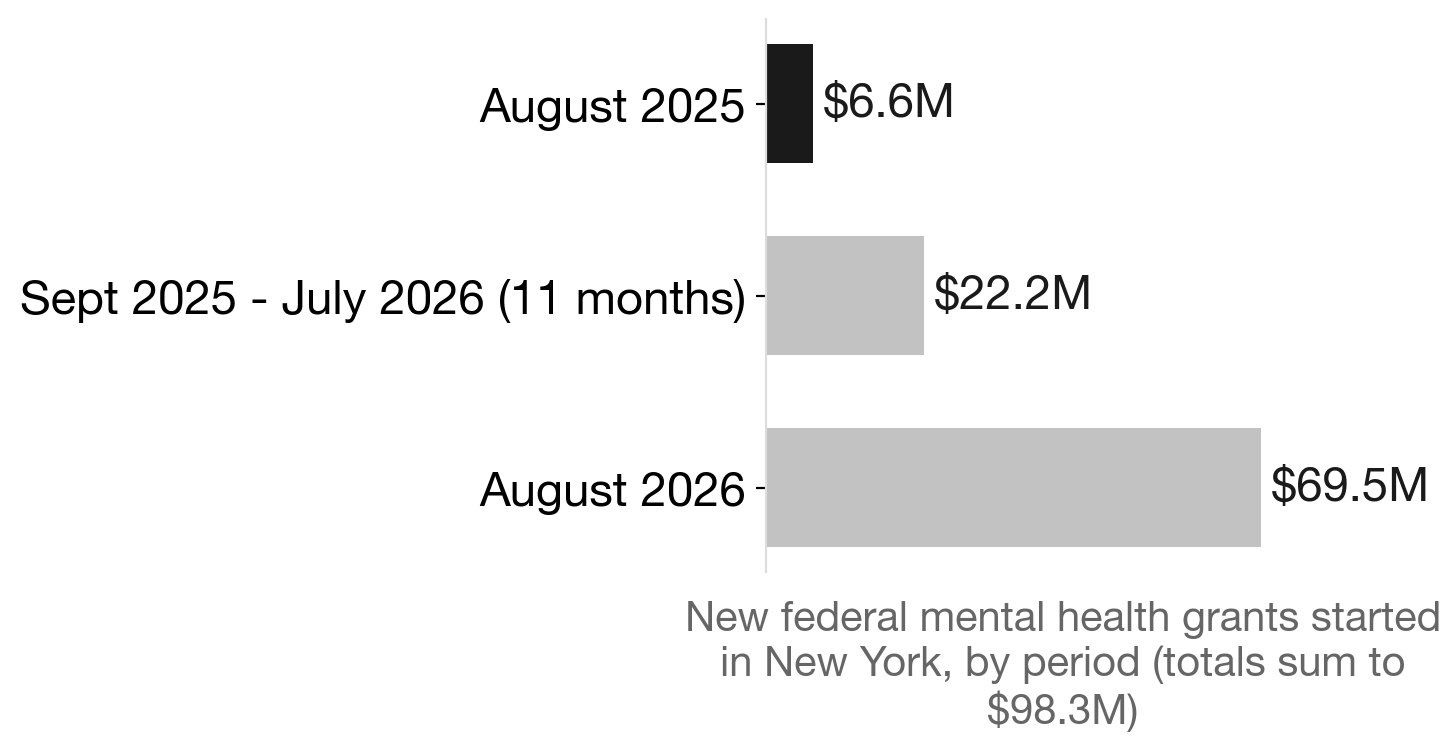
Federal mental health grants newly started in New York over the past 90 days total $98.3 million, a 149% jump above the $39.5 million awarded in the same window a year ago. Almost none of that money went to service providers or housing nonprofits, the kinds of awardees that dominated last year's numbers. This is a research-institution surge, concentrated in August 2026 and concentrated in a handful of Manhattan zip codes.
The August spike alone tells the story. Of the $98.3 million, $69.5 million arrived in August, compared to $6.6 million in August 2025. That ten-fold monthly jump is not a policy victory. It is the collision of two independent forces that happened to resolve in the same fiscal window.
The first is structural. NIH retired its long-standing Continuous Submission pathway for competing renewals, with a hard cutoff of August 10, 2026. That program had allowed certain senior investigators to submit grant renewals on a rolling basis rather than adhering to standard application cycles. Its retirement compressed a large cohort of renewals into a single deadline, generating an artificial concentration of awards in this window that will not recur in the same form. The NIH grant cycle mechanics behind this change had been flagged by research administrators for months, but the downstream dollar effect is visible now.
Source: NationGraph.
The second force is a rebound from deliberate disruption. The National Institute of Mental Health lost 128 grants between February and April 2025, more than any other NIH institute, as part of the broader DOGE-driven termination wave that cut roughly $1.8 billion in NIH awards. Many of those terminations targeted DEI-adjacent research and minority health studies at exactly the kinds of elite urban medical centers that define New York's research infrastructure. Federal courts subsequently ordered reinstatement of many awards. By April 2026, the Trump administration had conceded on its push to cap NIH indirect costs, and NIMH announced it would fund non-competing continuation awards at 100% of negotiated levels, up from the 85% cap imposed during the 2025 continuing resolution. The backlog cleared.
The result is visible in who is receiving money. Mount Sinai leads with $24.7 million across 26 grants, followed by NYU at $17.9 million, Weill Cornell at $15.4 million, and Columbia at $15.1 million. Albert Einstein College of Medicine and Albany Medical College account for most of the remainder. These institutions were disproportionately exposed to the 2025 terminations, meaning they had the largest suppressed backlogs. New York ranks second nationally in 90-day mental health grant volume, behind California's $102.7 million and well ahead of Massachusetts at $40.6 million and Texas at $39.5 million.
The contrast with last year's awardee mix is sharp. In the same window in 2025, the City of New York and HUD-funded housing nonprofits led the list. That was a service-delivery picture. The current surge is a basic and translational research picture, driven by institutions with active NIH portfolios and the grant-writing capacity to absorb a compressed renewal cycle.
State policy has kept New York institutions well-positioned to compete. Governor Hochul's $1 billion multi-year mental health plan created sustained clinical demand that translational researchers can point to in grant applications. The FY2026 Enacted Budget committed more than $196 million to mental health infrastructure, and a January 2026 announcement added $43 million specifically for psychiatric emergency and inpatient services. Federal reviewers looking for research-to-practice pathways find them in New York in ways they might not in states without comparable clinical infrastructure.
For people living in New York, the practical implications of this surge will take years to materialize. Federal research grants fund principal investigators, postdoctoral fellows, and clinical trial infrastructure. They do not directly fund treatment slots or crisis beds. The translation from a Mount Sinai neuroscience grant to a changed clinical protocol typically runs five to ten years. What the surge does signal is that the research pipeline feeding New York's mental health system has been restocked after a year of depletion.
The more immediate question is what happens next fiscal year. The Continuous Submission compression is a one-time effect. NIMH's restored funding posture is real, but the rebound-plus-deadline combination that produced August 2026's numbers will not reassemble itself automatically. Research administrators at New York's medical centers are already adjusting application calendars to the new NIH deadline structure. Whether the 2027 window sustains anything close to $98 million will depend on how many of these newly reinstated and newly renewed grants survive to their next competing renewal, and whether Congress holds NIMH's budget at levels that support the current funding strategy.