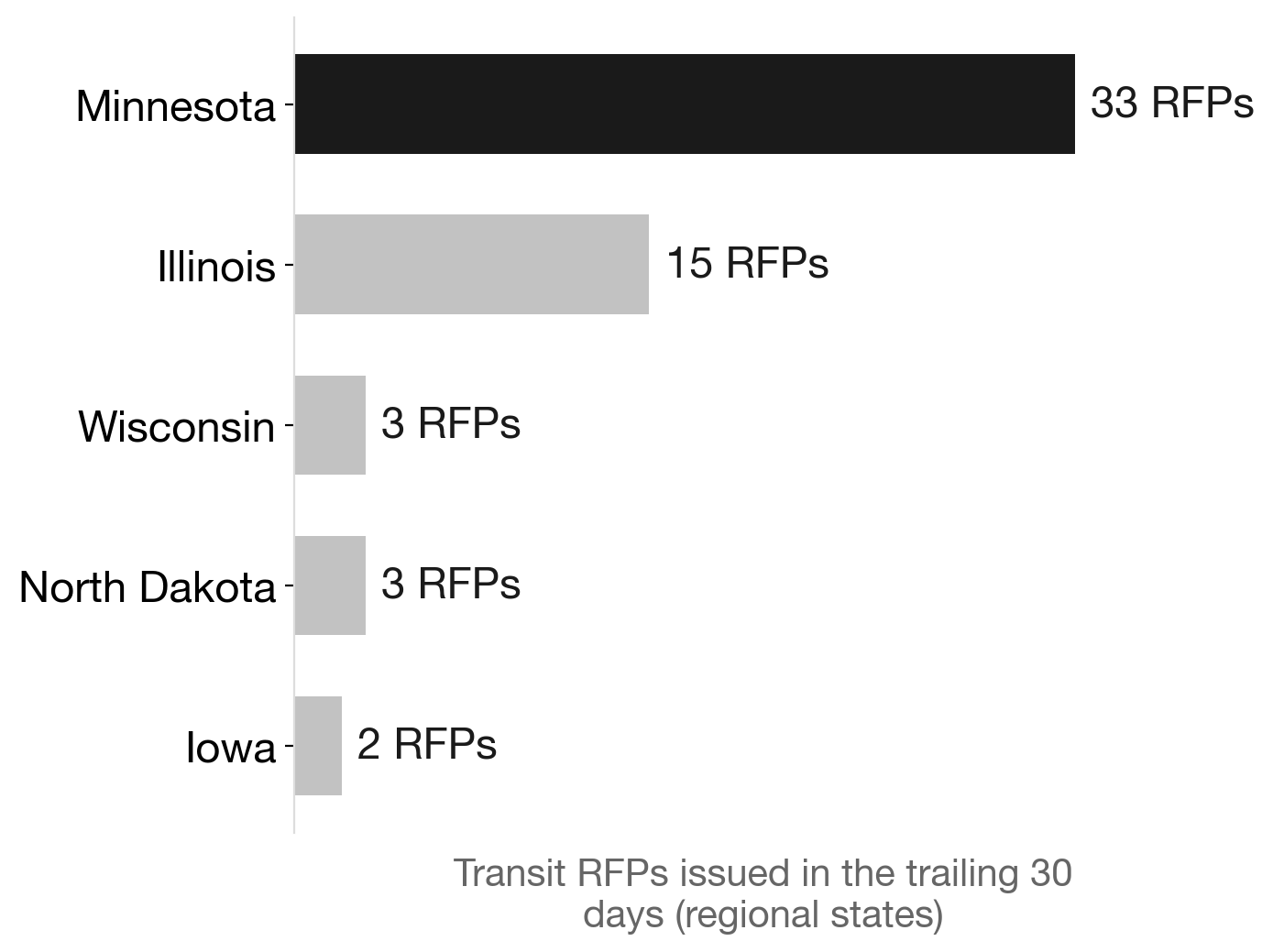
Minnesota logged 33 transit RFPs in the last 30 days, against a 12-month monthly average of 13.7, a 2.4x surge that dwarfs every neighboring state. Illinois, the next closest, managed 15. Wisconsin and North Dakota logged 3 each. Iowa logged 2. The volume is not an accident.
On August 4, the Hennepin County Board voted to commit $2.254 billion to the Blue Line Extension, the 13.4-mile light rail expansion to Brooklyn Park. That vote was the mandatory local-partner prerequisite for the Metropolitan Council to submit a Full Funding Grant Agreement application to the Federal Transit Administration for $752 million in New Starts money. The application is expected before year-end 2026. The procurement surge is what "construction-ready" looks like in the weeks after that kind of commitment gets made.
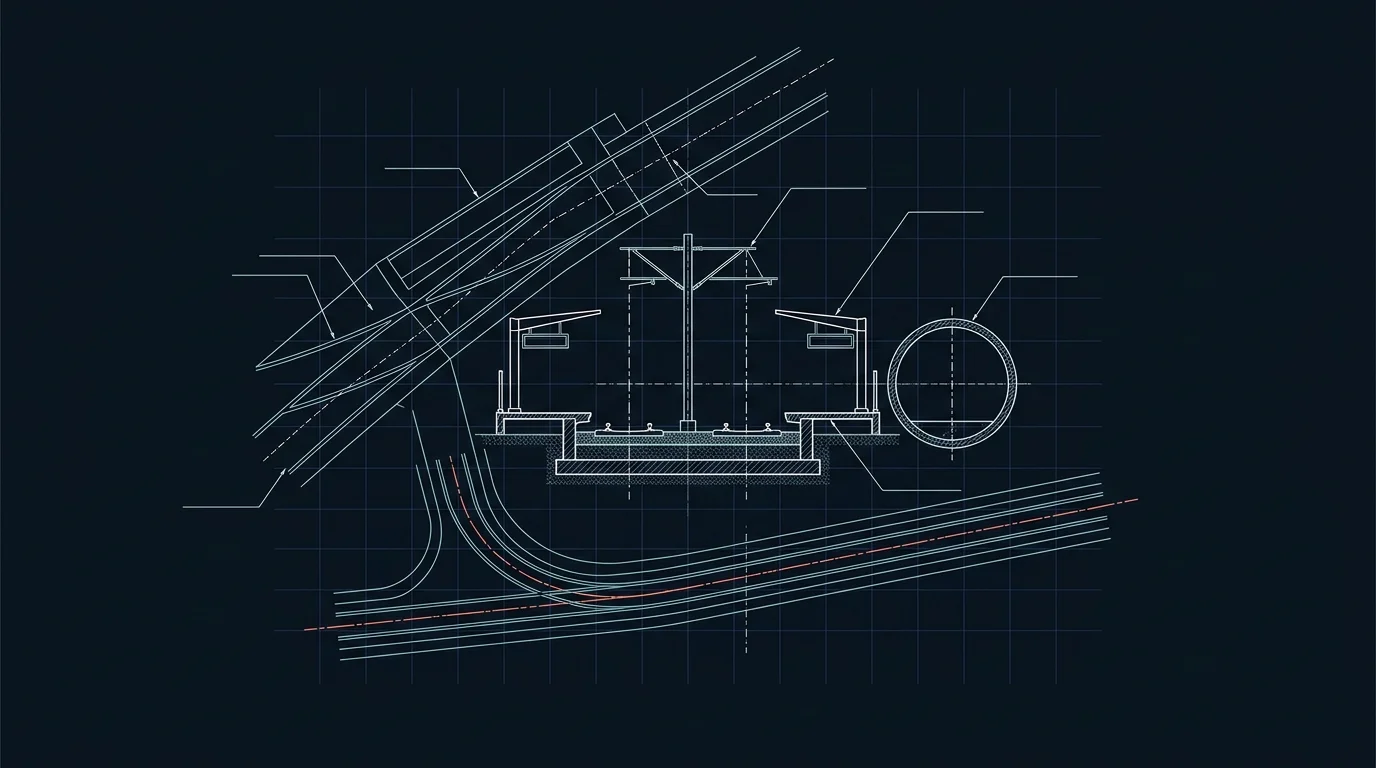
The Met Council is responsible for 26 of the 33 RFPs, or 79% of the state's total. The remaining seven come from the Minnesota Valley Transit Authority, Burnsville, Sherburne County, MnDOT, and the Washington County Sheriff's Office. The Met Council's list spans the full pre-construction stack: Franklin Avenue Station renovation design, St. Paul Operations and Maintenance Facility modifications for light rail vehicle overhaul, Northstar platform removals, Regional Mobility Hub pilot construction, Transit Control Center console upgrades, stray-current rail engineering, and push-button annunciator systems. None of these are standalone curiosities. Together, they constitute the physical and technical infrastructure a transit authority needs in place before it can break ground on a major corridor.
Source: NationGraph.
The Blue Line Extension is one half of the pressure. The other is the Green Line Extension, the 14.5-mile Southwest LRT to Eden Prairie that was over 90% complete as of January 2026 and is targeting a 2027 opening. A project in final systems construction and operational testing generates its own procurement wave: staffing contracts, systems integration services, and operational readiness work that has to happen on a fixed schedule regardless of what the Blue Line is doing. The Met Council is running both timelines simultaneously.
The federal backdrop makes the timing more acute. Whether the Republican-controlled federal government will maintain its commitment to a project of this scale remains an open question, as the Star Tribune reported earlier this year. The Blue Line Extension's total budget has grown to $3.58 billion, up from $3.2 billion at municipal consent in 2024 and more than double the pre-redesign estimate of $1.5 billion. That cost escalation drew immediate criticism from House Transportation Chair Rep. Jon Koznick, who argued it should prompt a reconsideration in favor of bus rapid transit. The 2025 Legislature mandated a technical BRT study; the Met Council's analysis found BRT would cost less but attract fewer riders. The political pressure has not gone away, which makes demonstrating procurement readiness before year-end a strategic necessity, not just an administrative one.
The active federal grant footprint supporting this work is substantial: a $929 million FTA Capital Investment Grant running through 2032, a $161 million formula grant, a $130 million Congressionally-directed spending award through 2031, and a $65 million Buses and Low/No Emissions grant through 2030. The FTA's FY2026 Low or No Emission Grant Program offers approximately $589 million in competitive grants nationally, adding further incentive for the bus fleet modernization RFPs in the current batch.
The political backdrop at the state level is adversarial in a different way. The 2025 Legislature cut $61 million from Metro Transit system operations in the 2026-27 biennium, forcing the Met Council to transfer $93 million in regional sales tax revenue to cover bus rapid transit operations. That funding restructuring itself requires new service-contracting RFPs, layering administrative procurement on top of capital procurement in the same 30-day window.
For residents of the Twin Cities metro, the immediate consequence is a construction and service contracting market that is unusually active. Vendors, engineering firms, and transit service providers are responding to solicitations that span every functional layer of a regional rail system. The Blue Line Extension completed 90% design in May 2026 and is targeting 100% design by fall 2026, with formal construction procurement solicitation beginning this year. When that solicitation launches, it will be the largest single procurement action in this cycle.
The signal to watch is the FTA application itself. If the Met Council files its Full Funding Grant Agreement before year-end, the $752 million federal commitment either gets confirmed or it doesn't. That decision will determine whether the current procurement surge resolves into a construction start in 2027 or stalls into a politically complicated renegotiation. The county has made its $2.254 billion bet. The federal answer is what comes next.