Five Washington municipalities and utilities that had issued no water infrastructure RFPs in more than a year have each posted one in the last 30 days, and the timing is not a coincidence. November 30, 2026 is Washington State's final application deadline for Drinking Water State Revolving Fund construction loans under the Bipartisan Infrastructure Law, and after that date the funding landscape changes substantially.
The five late-entrants span the state's geography and project types: the City of Stevenson (pop. 1,621, Skamania County) is seeking on-call engineering services; the City of Shoreline (pop. 61,353, King County) is soliciting design work for a flood reduction project; Snohomish County PUD No. 1 in Monroe is pursuing a water main replacement; Clallam County PUD 1 is moving on East Bluff water infrastructure upgrades; and the Port of Moses Lake in Grant County has posted an RFP for a farm irrigation installation. The diversity of project types across small rural systems and mid-sized suburban utilities alike signals that the deadline pressure is now reaching institutions that had been sitting on the sideline through most of the BIL wave.
The urgency comes from a hard government calendar. Washington DOH's Drinking Water State Revolving Fund has run with roughly $120 million available in its current construction loan cycle, supported by the approximately $143.8 million EPA obligated to the state's DWSRF starting in July 2025. DOH has publicly flagged this as the final application cycle with BIL supplemental funding and warned applicants directly: construction cycles from November 2027 onward will be highly competitive, with the number of projects funded per year falling from 35 to 50 to fewer than 20, and maximum per-project awards shrinking accordingly. Applicants must also have an approved Water System Plan on file by November 30, a procedural requirement that is itself a barrier for systems that delayed.
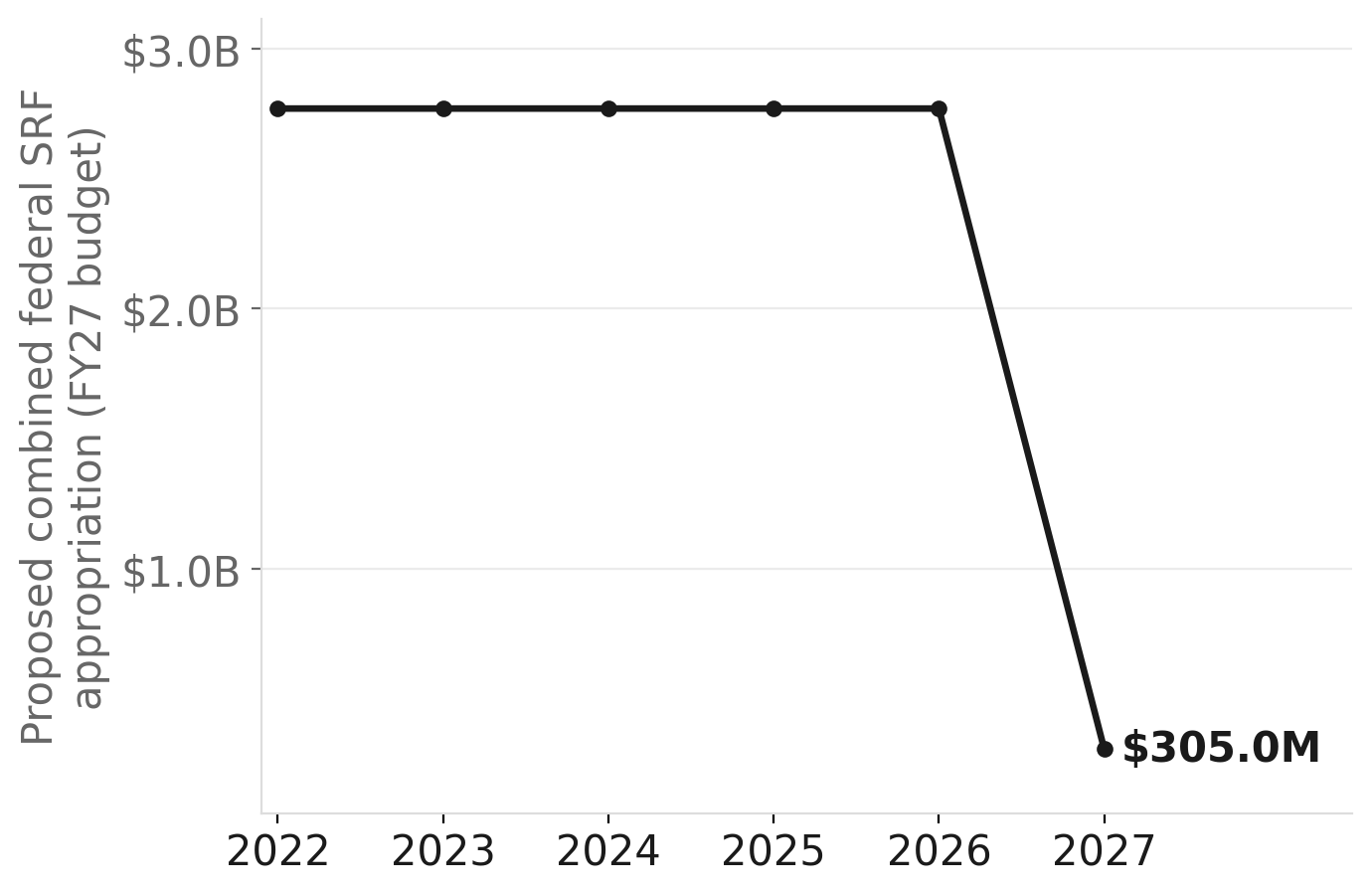
Source: NationGraph.
The broader federal picture explains why that cliff is real, not hypothetical. The IIJA's supplemental water authorization expired nationally on September 30, 2026, and the Trump administration's FY27 budget proposes cutting the combined Clean Water and Drinking Water State Revolving Funds from $2.7 billion to $305 million, roughly an 89% reduction. The National League of Cities and municipal water utilities have been pressing Congress to reauthorize at IIJA levels, but no legislation has cleared. Analysts estimate total federal water infrastructure funding could fall approximately 60% between FY2026 and FY2027 absent congressional action.
It is worth being precise about the two programs involved. The Drinking Water SRF, administered through Washington DOH, funds drinking water system improvements, treatment upgrades, distribution pipe replacement, lead service line removal, PFAS treatment. The Clean Water SRF, administered separately through Washington Ecology, funds wastewater treatment, stormwater management, and nonpoint source pollution control. Both were dramatically capitalized by the BIL, with EPA obligating a combined $217.9 million to Washington under both programs (July 2025 through 2030). They are parallel in structure but serve different purposes, and some of the five new RFPs, Shoreline's flood reduction project in particular, may ultimately draw on Clean Water SRF or FEMA channels rather than the DWSRF. The November 30 DWSRF deadline is the proximate catalyst for most of these RFPs, but local governments are often positioning for whichever funding door opens first.
The monthly RFP time series for Washington underscores how late this surge is arriving. Water infrastructure procurement activity in the state peaked at roughly 14 institutions per month in February 2026, then tapered to 4 to 6 per month through summer as most systems that had moved quickly already filed their qualifying engineering work. These five represent a final cohort: communities that either lacked internal capacity to move faster, depended on procurement cycles that ran long, or simply miscalculated how tight the deadline would become. For a system like Stevenson, with a population under 2,000, assembling an engineering qualification package is a significant administrative lift without dedicated staff.
For residents in these communities, the practical question is whether their local water system gets into this cycle or waits out what cities and utilities are calling a funding cliff. Projects that qualify in 2026 access low-interest construction loans with potential principal forgiveness for disadvantaged communities, a financing structure that effectively lowers the cost of a water main replacement or treatment upgrade by millions of dollars compared to municipal bonds alone. Projects that miss November 30 compete in a much smaller pool, likely in 2028 or later.
The immediate signal to watch is whether these five institutions can complete their engineering pre-qualification processes in time to submit full applications by the deadline. RFPs posted in October leave a narrow window. DOH's priority list for the 2026 cycle will be a public document; if these systems appear on it, that confirms they made it in. If they don't, they join the queue for a post-BIL funding environment that, at current budget proposals, looks far less generous.