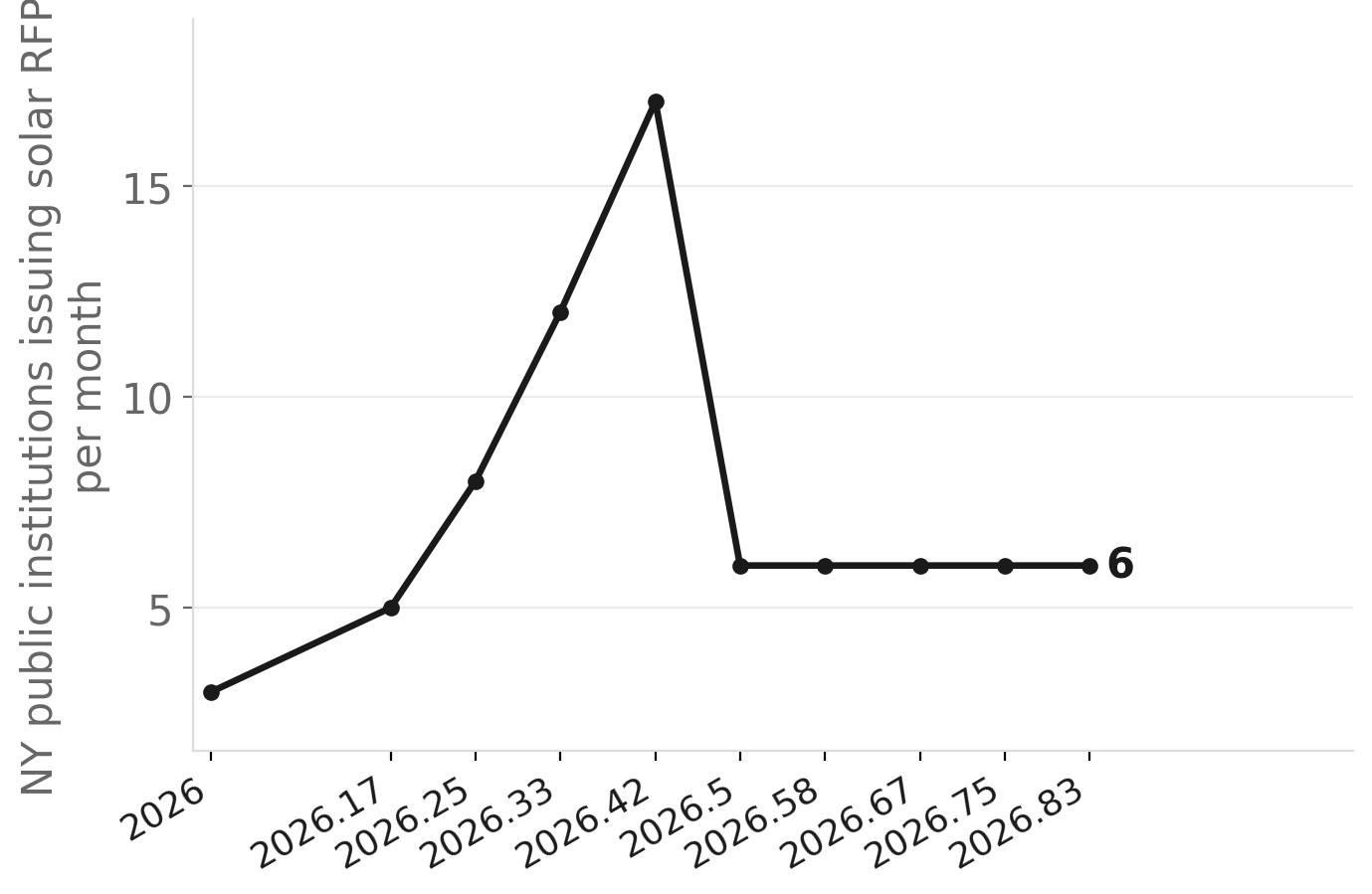
Six New York public institutions issued their first solar procurement bids in over a year during October 2026, a cohort that spans a state power authority, a SUNY campus, a Long Island township of nearly half a million residents, and a Rockland County municipality. A year ago, that same 30-day window produced zero such bids.
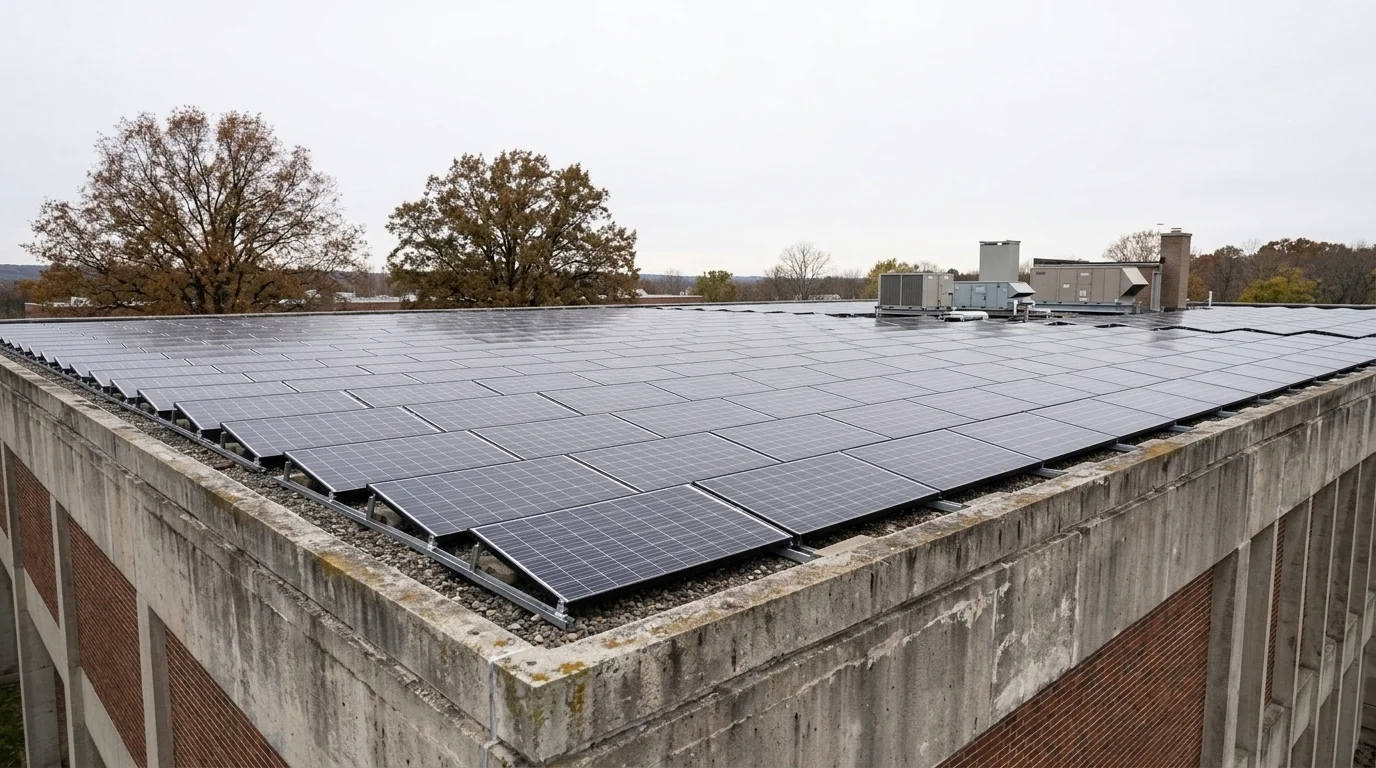
The institutions are not connected by a single program or a single funding source. The New York Power Authority issued two new solar bids: an engineered solar PV installation at an Albany landfill site and a pathway lighting project at ECHDC, with the EPC contract due November 17. NYPA had no solar RFPs in procurement databases before January 2026 and now holds 12 active solar procurements. The Town of Brookhaven, Suffolk County's largest municipality, posted an RFP for construction of a solar facility at its Aquatic Center, due October 26. SUNY Brockport issued a solar field campus utilities extension bid due October 28. Orangetown, in Rockland County, procured a solar-powered traffic beacon. NYSERDA, meanwhile, formally published the contracted results of its 2025 land-based renewables solicitation, closing a cycle that had been in motion for more than a year.
What connects them is timing, not paperwork. The NYSERDA 2025 solicitation (RESRFP25-1), issued September 26, 2025, resulted in executed contracts for 13 solar, wind, and hydroelectric projects totaling 719 megawatts, with results formally published in October 2026. When NYSERDA closes a competitive solicitation round, it does two things downstream: it validates updated project economics for the rest of the market, and it signals that a new solicitation cycle is beginning. NYSERDA's 2026 solicitation (RESRFP26-1), issued April 24, 2026, completed evaluation in August, with conditional award notifications expected by September. Institutions that had been watching the market now had fresh price signals to work with.
Source: NationGraph.
A second force is more blunt: the federal Investment Tax Credit cliff passed in July 2026. Projects that did not demonstrate commencement of construction before that date lose ITC eligibility unless they are operational by end of 2027. Institutions procuring in October are doing so in a post-cliff environment. They cannot rely on federal tax equity to anchor project financing the way developers could a year ago. That leaves state incentive structures as the primary backstop, and those structures are themselves under pressure. The Public Service Commission clawed back $271 million in previously approved NY-Sun distributed solar funding, compressing the near-term incentive window for exactly the kind of distributed-scale institutional projects Brookhaven and SUNY Brockport are pursuing. Waiting is not obviously safer than acting.
It is worth being precise about what these three funding mechanisms are, because they are distinct. NYSERDA's RES solicitations contract Renewable Energy Certificates from large-scale developers to meet the CLCPA's 70%-by-2030 mandate, they set market signals but do not directly fund municipal projects. NY-Sun is a separate state incentive program, funded through utility surcharges, that pays per installed watt for distributed solar; it is the program most relevant to Brookhaven or SUNY Brockport, and it is the one facing the PSC clawback. The federal ITC was a tax credit available to project owners or their financing partners; for October procurements, that window has closed.
New York's 2026 Enacted Budget amended the CLCPA, adjusting greenhouse gas accounting timelines, but left the 70%-by-2030 renewable electricity target and the 10 GW distributed solar goal intact. The regulatory pressure on public-sector actors did not ease. Meanwhile, the NY Senate passed the ASAP Act (S.6570A) in April 2026, which would raise the distributed solar target from 6 GW to 20 GW by 2035 and mandate interconnection reforms, but the bill remained in Assembly committee as of this writing. A companion bill, S.8696, would require SUNY institutions to install solar canopies on 75% of suitable parking by 2040. SUNY Brockport's October RFP may be a precursor to that mandate, or simply a campus utility decision made in a favorable procurement window. Either way, the direction is the same.
The geographic spread of the October cohort is itself meaningful. These are not six institutions in one county responding to a single local program. They are spread across Suffolk County, Rockland County, Monroe County, and the Capital Region, a second wave distributed across the state, not a cluster. New York's monthly solar RFP activity peaked at 17 institutions in May 2026 and contracted sharply through summer. October's return to that baseline, led by institutions with documented prior-year gaps, suggests the procurement cycle is reasserting itself after a seasonal and regulatory pause.
The next signal to watch is NYSERDA's pending contract announcements from RESRFP26-1. When those awards are published, a third downstream wave of institutional procurement could follow in early 2027, assuming the NY-Sun incentive structure stabilizes and the ASAP Act clears the Assembly.