Federal school safety funding flowing into Maryland hit $14.2 million in the last 90 days, a 1,622 percent increase over the same window a year ago. The number looks like a windfall. It is, in a narrow sense, but the fuller story is that Maryland is collecting money from a program that Washington cancelled with considerable fanfare, then rebuilt on different terms and quietly relaunched.
The original program, the Bipartisan Safer Communities Act school mental health initiative, distributed roughly $1 billion to 260 recipients across 49 states under the Biden administration. On April 29, 2025, the Trump Education Department terminated those awards, telling recipients the grants violated civil rights law and did not advance administration priorities. Schools that had hired counselors, enrolled graduate students in training pipelines, and built out services lost funding overnight. Sixteen Democratic-led states, including Maryland, sued in June 2025 after the cancellations caused layoffs and eliminated student scholarships.
By the fall, the administration had relaunched the program under a different name and a narrower mandate. Education Week reported the recompeted awards would focus specifically on school psychologists, cutting out the broader counselor and social worker workforce the Biden-era grants had supported. The legal authority, the School Safety National Activities statute, stayed the same. The priorities shifted.
Source: NationGraph.
Maryland landed eight grants from that new cohort, all dated January 1, 2026, all running through December 31 of the same year. That single-year structure is itself a departure: Biden-era awards ran multiple years, giving recipients time to build durable programs. The new awards are one-year FY2026 contracts.
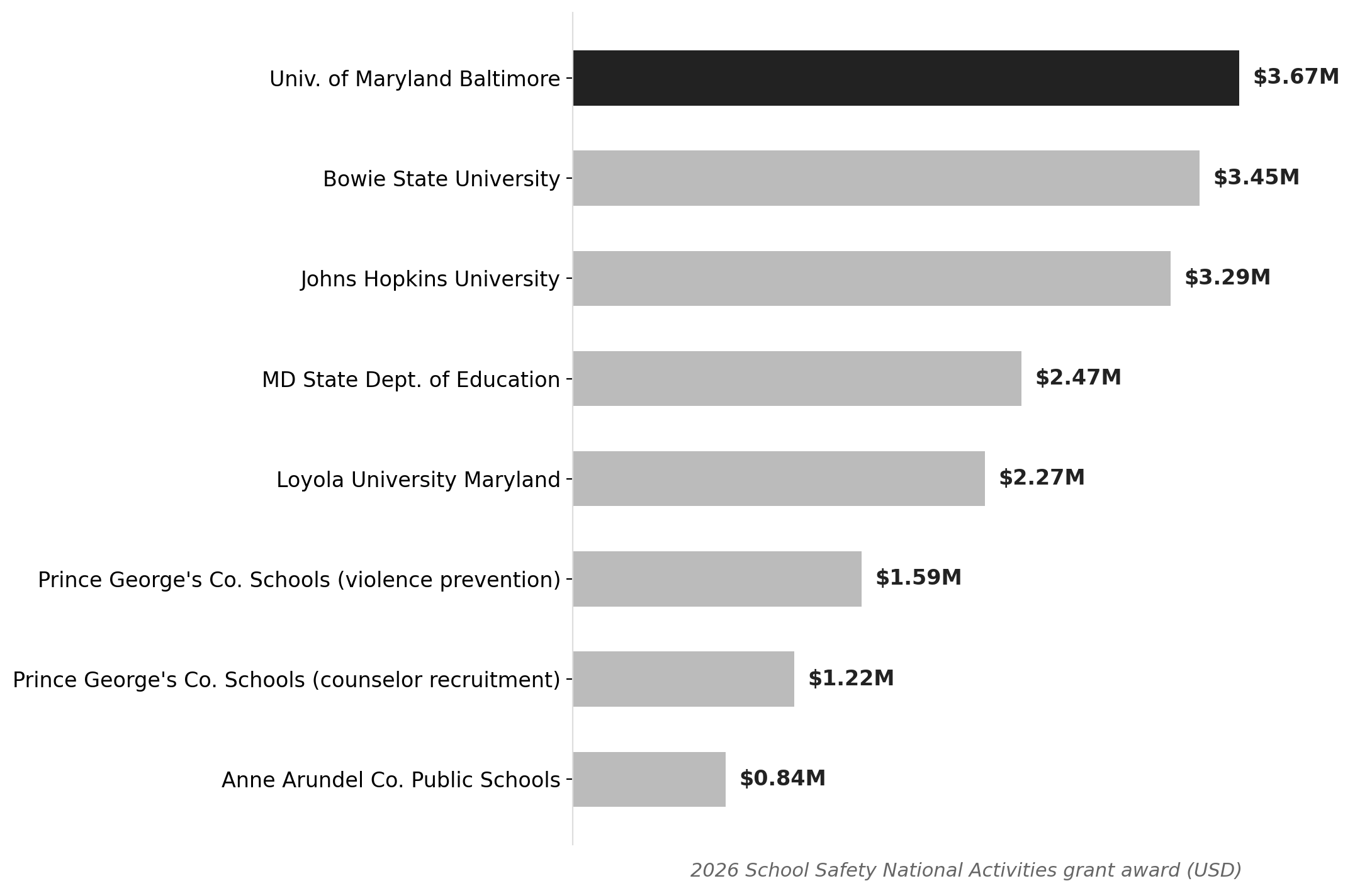
The recipients tell the story of who survived the recompete. The University of Maryland Baltimore received $3.67 million for school-based mental health services. Bowie State University, a historically Black university in Prince George's County, took $3.45 million for its Ujima school counseling program. Johns Hopkins University received $3.29 million for a counselor training initiative called RESET. The Maryland State Department of Education landed $2.47 million for a school psychologist program it calls SMART, and Loyola University Maryland received $2.27 million.
Prince George's County Public Schools appears twice in the cohort, once for a violence prevention program and once for counselor recruitment, collecting a combined $2.81 million. Prince George's is one of the largest majority-Black school districts in the country and one of the higher-need jurisdictions in the state, which suggests the recompeted program is still reaching districts with significant resource gaps, even as its workforce focus has narrowed.
The concentration of university recipients is the clearest structural signal in Maryland's awards. Three research universities, one HBCU, and one Jesuit institution account for most of the $18.8 million total. These are institutions with federal grants offices, existing school mental health infrastructure, and the capacity to turn around a competitive application in a compressed recompete window. School districts, which drove much of the original BSCA spending, are underrepresented in the new cohort.
Nationally, Maryland ranks 19th in the 2026 SSNA cohort by total award value, behind California at $184 million, Texas at $93 million, and Georgia at $85 million. For a mid-Atlantic state, eight awards is a notably deep showing. The combination of Johns Hopkins, the University of Maryland system, and Bowie State, all with established mental health research programs, gave Maryland an unusually strong applicant pool for a competition that explicitly rewarded existing infrastructure.
The one-year award structure creates the most immediate question for recipients. Programs that hire staff, enroll graduate students in training fellowships, or build school-district partnerships on a 12-month federal commitment face the same underlying fragility that made the April 2025 cancellations so disruptive. A program that trains school psychologists under a one-year grant has to make hiring and enrollment decisions before it knows whether year two exists.
The Education Department and HHS announced an additional grant competition under the same statutory authority in late May and June 2026. Whether Maryland's current recipients can roll their programs into that competition, or whether the next recompete reshuffles the cohort again, will determine whether the $18.8 million now moving through Baltimore, College Park, and Bowie produces lasting capacity or a second cycle of disruption.
The next signal to watch is whether Congress locks in multi-year appropriations for the SSNA program in the FY2027 budget process. Without that, the cycle of cancellation and recompete can repeat, and the universities and districts that competed for this cohort will be doing it again.