Federal housing grant commitments newly starting in West Virginia over the last 90 days total roughly $8.3 million, down 61% from $21.3 million in the same window a year ago. That number looks like a crisis. It is not quite that, yet. But the machinery that would prevent it from becoming one is sitting in a congressional conference committee with its future unresolved.
The immediate drop is largely mechanical. The prior-year comparison window was crowded with one-time events: a $4.7 million Department of Energy Weatherization Assistance grant that started in July 2025, and a cluster of multi-year Section 8 Housing Choice Voucher renewals from housing authorities in Charleston, Huntington, Raleigh County, Mingo County, and Parkersburg that generated lump-sum start-date commitments totaling more than $13 million. Charleston's Housing Authority alone logged $8.4 million in HCV renewals in June 2025, following $4.1 million in March and $4.0 million in January of that year. Those are multi-year contract resets, they do not recur every quarter. The current 90-day window catches the routine monthly disbursement phase of those same contracts, not new ones. Add a $13.8 million CDBG State Program grant that West Virginia's Division of Economic Development received in October 2024, the state's largest single discretionary housing award in recent years, and the prior-year baseline was simply unusually large.
None of that makes the current window look healthy on its own terms. Nearly every dollar of new commitment in the trailing 90 days is entitlement maintenance: incremental HCV payments, CoC renewals, and HOPWA disbursements. There is no new production money, no new weatherization award, and no CDBG state grant yet, though one is close. West Virginia's Division of Economic Development received 20 CDBG applications in Program Year 2025 requesting $28.2 million in total, against an expected award of roughly $13 to $14 million. Those awards are still pending, meaning a significant new round of community development dollars is imminent but has not yet generated grant start dates. When it does, the trailing 90-day figure will look considerably less alarming.
Source: NationGraph.
The harder problem is not the current window. It is what the pipeline looks like from here.
West Virginia's draft PY2026 Annual Action Plan, published for public comment this year, assumes a $3.4 million HOME Investment Partnerships Program award and a $2.8 million Housing Trust Fund allocation for affordable housing production. Both figures are contingent on federal appropriations that have not been settled. The Trump administration's FY2026 budget proposed eliminating HOME entirely, a $1.25 billion cut nationally, and zeroing out CDBG, a $3.3 billion program. The House THUD appropriations bill, approved by committee on July 17, 2025, would follow through on eliminating HOME. The Senate's competing bill retains HOME funding, and the two chambers have not yet reconciled their versions into law.
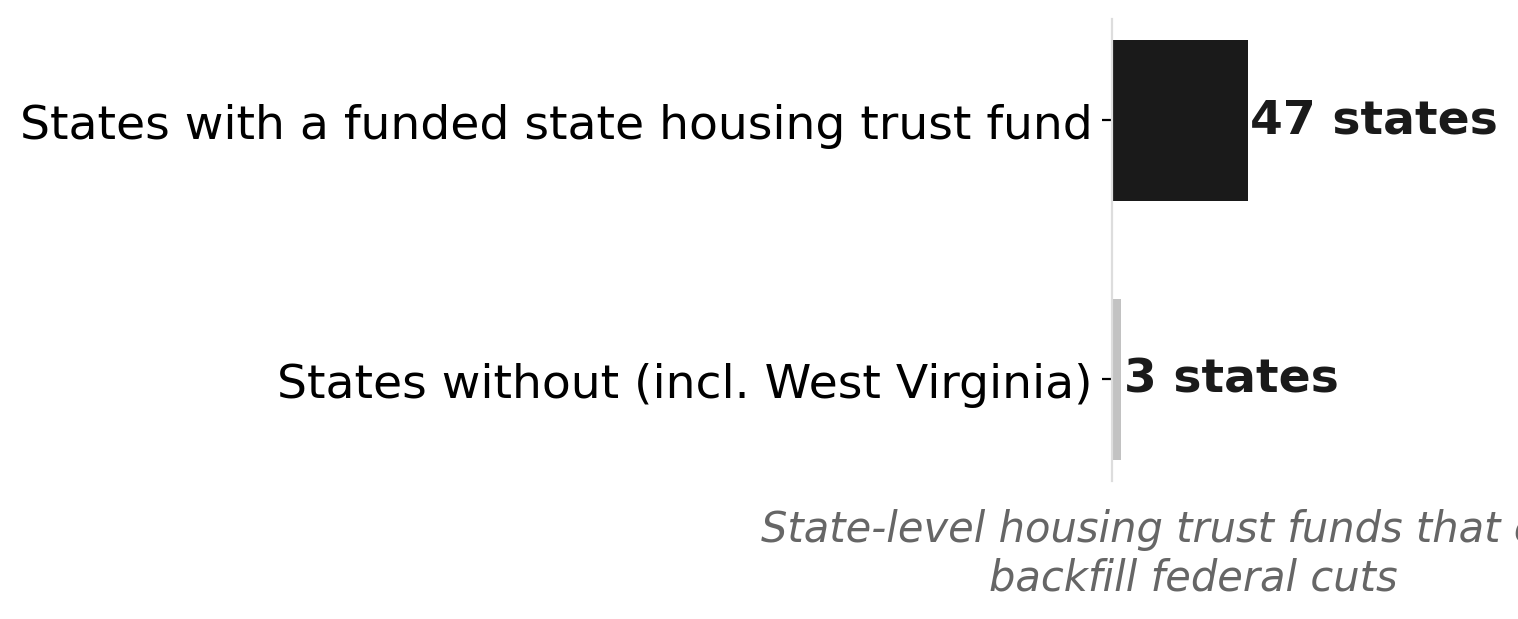
For most states, that standoff is a budget uncertainty. For West Virginia, it is closer to an existential question about affordable housing production. The state has no significant state housing bond program and no independent affordable housing fund to speak of. Its 2025–2029 Consolidated Plan identifies deteriorating housing stock as the top community development priority statewide, and the programs it relies on to address that, CDBG for rehabilitation and infrastructure, HOME for new affordable units and homeownership, are precisely the ones Congress is debating whether to fund at all. Housing advocates describe the proposed cuts as a historic 44% reduction to HUD's core community development toolkit. A state with a robust bond authority or a dedicated housing trust fund could absorb a HOME elimination by shifting capital. West Virginia cannot do that at meaningful scale.
HUD Secretary Scott Turner did provide some administrative relief to West Virginia grantees following the February 2025 flooding under disaster declaration DR-4861-WV, granting flexibility on spending timelines and eligible uses for CDBG, HOME, CoC, ESG, and HOPWA recipients. That flexibility matters for grantees managing existing awards, but it added no new housing production dollars to the state's pipeline.
The next signal to watch is the CDBG PY2025 award announcement from the West Virginia Division of Economic Development. When those grants are made, the trailing 90-day commitment total will recover and the headline decline will shrink. The more durable question, whether the HOME and CDBG programs that drive new housing production in the state survive the current appropriations cycle intact, will be answered in the Senate-House conference negotiations still ahead. West Virginia administrators are writing plans that assume those programs exist. They are writing them against a congressional calendar that has not yet confirmed that assumption.