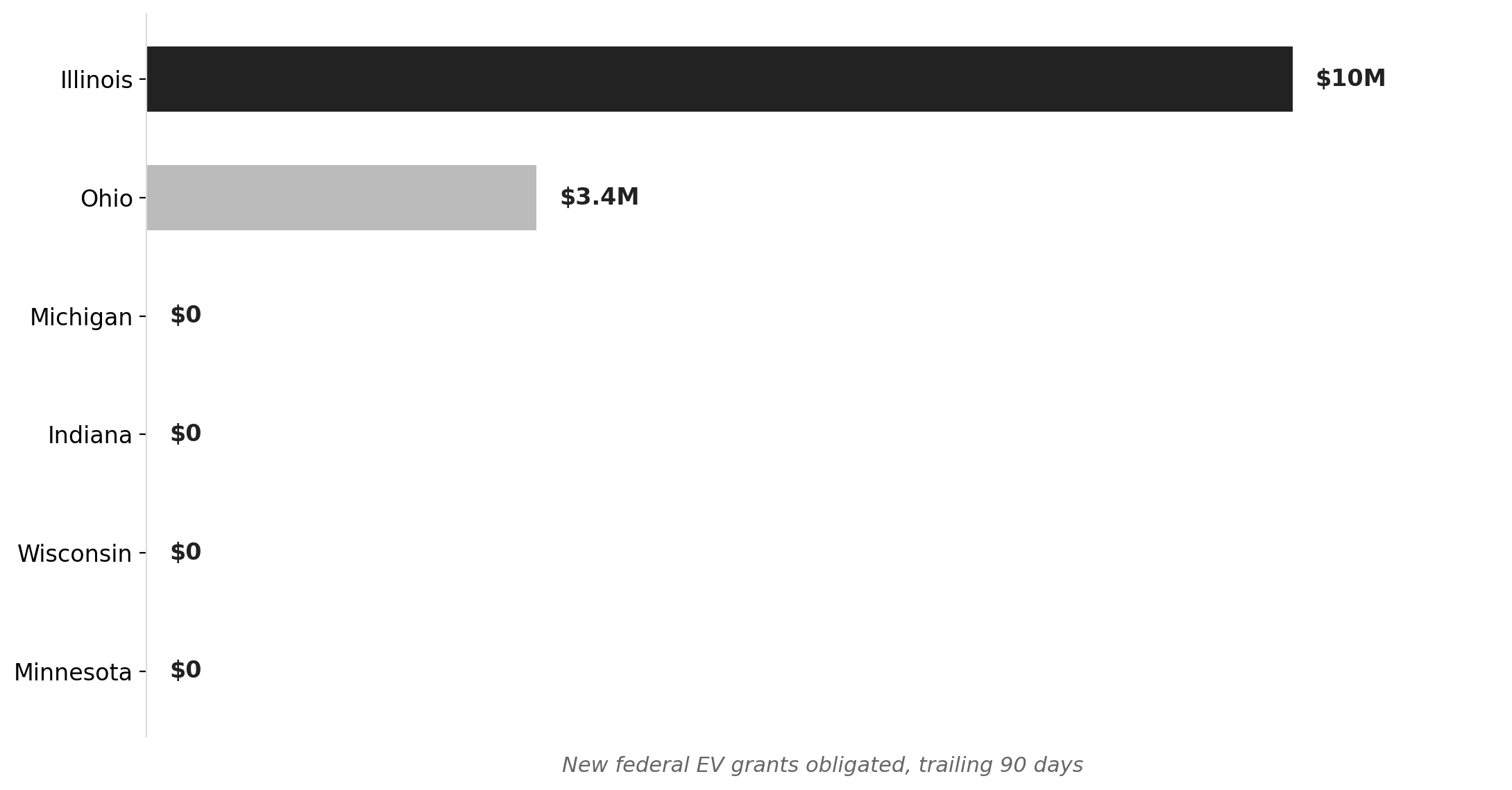
Federal electric vehicle grants to Illinois have hit $10 million in the past 90 days, a 130% jump over the same window last year, and the entire increase flows through a single award to a downstate bus agency most riders outside the Quad Cities have never heard of.
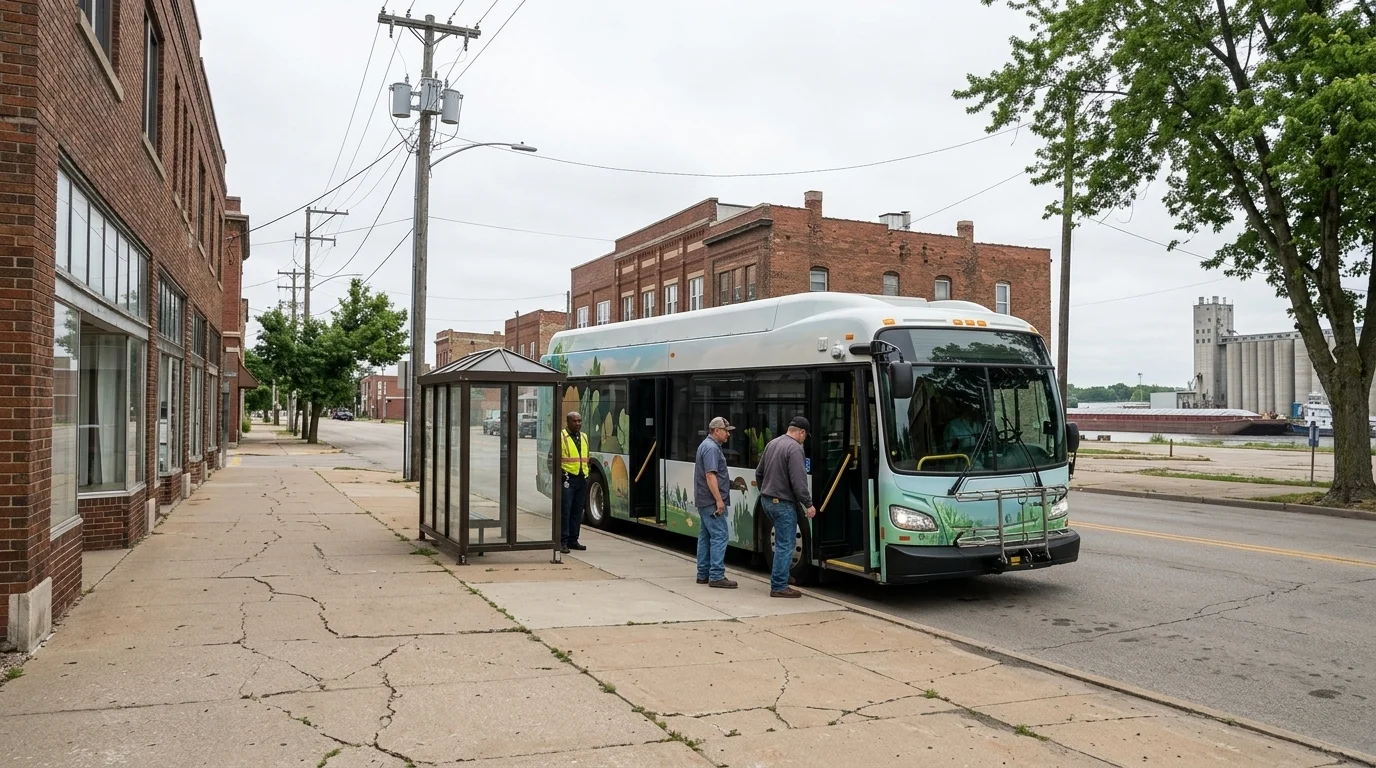
The grant went to Rock Island County Metropolitan Mass Transit District, known as MetroLINK, obligated July 21, 2026 under the FTA's Low or No Emission program. It follows an $8 million DOT award MetroLINK received in September 2024 for a zero-emission battery-electric ferry on the Mississippi River. The agency has been building its electric fleet since 2018, and at this point it has become one of the most consistent federal EV grantees in the Midwest, serving a manufacturing-heavy, lower-income region on the Iowa border. As Senators Duckworth and Durbin announced, the new $10M is part of a broader $254 million package for Illinois transit districts, signaling that the state's downstate operators are well-positioned in the competitive grant queue.
The proximate trigger for this wave is the FTA's November 2025 announcement of roughly $2 billion in FY2025 Low-No and Buses and Bus Facilities awards across 165 projects in 45 states. Illinois agencies that applied in that cycle are now receiving their awards. MetroLINK's $10M is one of those grants landing, and it won't be the last. The FTA published a new $610 million notice of funding opportunity for FY2026 on July 27, 2026, with applications due September 21, meaning Illinois transit agencies are already in position to layer another round on top of current awards before the year is out.
Source: NationGraph.
What makes this moment structurally unusual is what's happening on the other side of the federal ledger. The Trump DOT suspended Illinois's NEVI highway-charging plan on February 6, 2025, freezing new federal obligations for the EV charging infrastructure network that was supposed to line the state's interstate corridors. No new NEVI dollars are flowing. That decision has effectively narrowed the channel through which federal EV money reaches Illinois to transit and bus programs, concentrating momentum in exactly the agencies now receiving FTA competitive grants. MetroLINK is not the accidental beneficiary of a changing federal landscape; it applied for and won a grant that was designed before the political winds shifted and is now one of the few federal EV funding pipelines still open.
Zoom out and the scale of Illinois's active EV grant portfolio becomes striking. Across EPA, DOT, and DOE programs, Illinois institutions currently hold more than $743 million in active federal EV-related grants, most of them funded through the Inflation Reduction Act and running through 2028 to 2030. The largest single commitment is a $430 million EPA Climate Pollution Reduction Grant to the Illinois EPA, awarded October 2024. Only $96,854 of that has been outlayed so far, the funds are obligated but barely disbursed, meaning the bulk of the state's IRA-era EV money is still sitting in the pipeline, waiting to move. Illinois is also the only Midwest state to receive a new EV grant start in the 90-day window; Michigan, Indiana, Wisconsin, and Minnesota show zero new grant obligations in the same period.
The state is not relying entirely on federal momentum. Governor Pritzker's IEPA reopened the state EV consumer rebate program on August 1, 2026, with $14 million appropriated for rebates of up to $4,000 per vehicle, a direct response to the expiration of federal consumer EV tax credits on September 30, 2025. The Environmental Defense Fund noted in February 2026 that the state's 2026 legislative session includes a package of EV bills framing Illinois as intending to lead on clean transportation even as federal consumer incentives disappear. Pritzker's stated goal remains 1 million EVs registered in Illinois by 2030, backed by the Climate and Equitable Jobs Act and the Reimagining Energy and Vehicles Act.
For riders in the Quad Cities, the practical result of all this is a bus fleet that is getting quieter and cheaper to operate. For state policymakers, the open question is whether the FTA competitive grant channel stays open long enough to absorb the next application cycle. The September 21 deadline for FY2026 Low-No grants is the next concrete signal to watch: if Illinois agencies submit strong applications and the FTA awards on a similar timeline to FY2025, another tranche of grants could land in early 2027. Whether the NEVI suspension remains in place by then, and whether the broader IRA funding architecture survives the next budget reconciliation, will determine how much of the $743 million pipeline actually reaches the street.