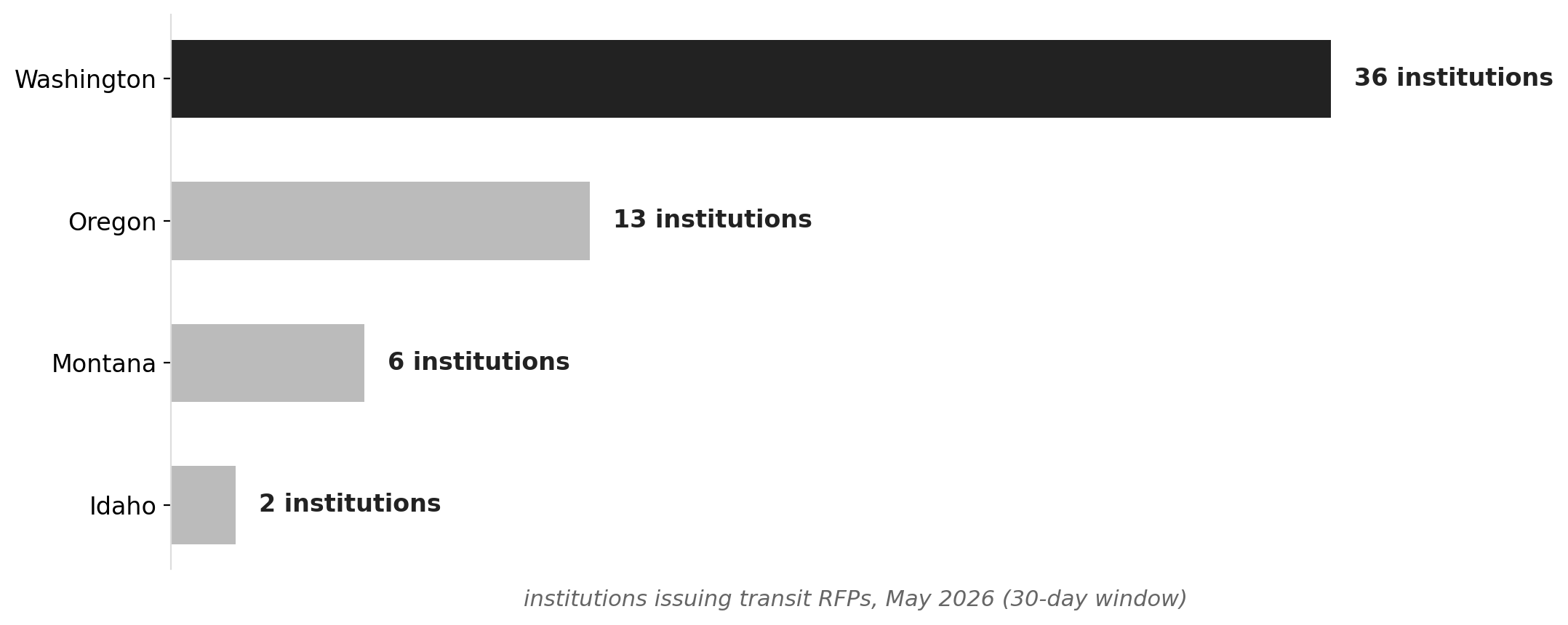
Thirty-six Washington institutions issued transit RFPs in May 2026, the highest single-month count in at least 18 months and a sharp reversal from the October–December 2025 window, when just one to three institutions per month posted new contracts. The burst spans the full state geography and every layer of the transit stack: Bellevue opened six transit-oriented development solicitations, Sound Transit posted PA modernization and distributed antenna system contracts, Kitsap Transit sought construction management for inductive EV charger installation, and Spokane Transit Authority opened unit-price stop improvement bids. Washington's May total dwarfs neighboring states in the same 30-day window: Oregon logged 13 institutions, Montana 6, Idaho 2.
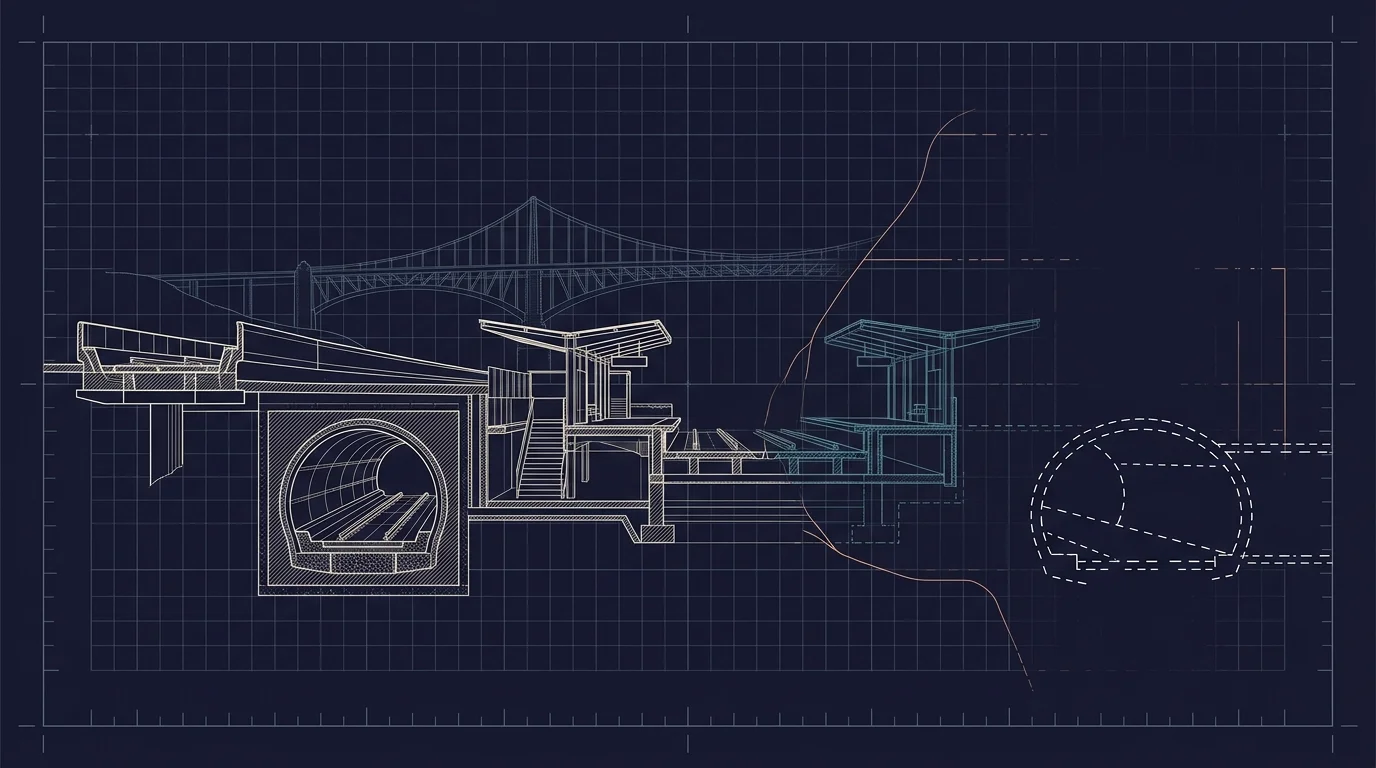
The trigger is specific and datable. Sound Transit's 2 Line fully opened on March 28, 2026, completing the East Link Extension across the I-90 floating bridge and connecting Seattle to Bellevue and Redmond for the first time. The opening closed the last gap in a rail corridor that has been under construction, in one form or another, for nearly two decades. For cities along the line, that date was not just an operational milestone, it was a legal and contractual threshold. Station-area development rights that municipalities had been holding, pending actual train service, became exercisable the moment the trains ran.
Bellevue's six May RFPs illustrate the mechanism directly. The solicitations target the Wilburton, Kelly, and 130th Street station areas, all within the BelRed corridor that the city has been planning around East Link for years. Land disposition and construction procurement could not rationally begin until the transit investment was proven. Now it is.
Source: NationGraph.
Two pieces of 2026 state legislation removed additional friction. SB 6309, signed in spring 2026 by Governor Bob Ferguson, grants Sound Transit expedited authority to exceed local development regulations when building transit infrastructure, directly accelerating the TOD pipeline Bellevue is now running. The supplemental transportation budget, SB 6005, signed by Ferguson in April, continued Climate Commitment Act funding for youth transit passes and tribal transit grants and directed new operating funds to regional transit agencies, giving institutions across the state both the authority and the resources to move.
Federal urgency is amplifying the pace. Washington's active federal transit grant portfolio exceeds $1.5 billion. Sound Transit holds a $1.17 billion DOT Capital Investment Grant active through 2029. King County Metro carries more than $220 million in active DOT grants, including a $46.8 million State of Good Repair grant expiring in June 2026, a hard deadline that turns every week of procurement delay into potential lost reimbursement. The Trump Administration's H.R. 1 has shifted more than $500 million in costs onto Washington's state budget, creating pressure to obligate federal transit dollars already in hand before the fiscal environment tightens further.
The paradox embedded in this procurement wave is hard to ignore. Washington's transit buildout is entering its most productive contracting season in years at the precise moment its flagship agency is staring down a structural deficit. Sound Transit faces a projected $34.5 billion funding shortfall through 2046, and the 2026 legislature made it worse: provisions tied to the millionaires' tax bill repealed sales tax authority that had been expected to unlock roughly $2 billion in long-term Sound Transit revenue. The agency that just completed the world's first light rail service on a floating bridge is simultaneously managing its largest financial crisis since voters approved the ST3 expansion package in 2016.
For residents along the 2 Line corridor, the near-term effect of the procurement surge is concrete: accelerated construction activity around Bellevue stations, expanded transit amenities statewide, and genuine momentum behind transit-oriented housing projects that have existed only as renderings. Sound Transit projects 50,000 daily riders on the 2 Line by 2030, a figure that depends on the surrounding development density actually materializing.
The longer-term signal to watch is how Sound Transit navigates the $34.5 billion gap. The agency has not yet disclosed which projects from the ST3 package will be deferred, restructured, or cut. Decisions on that question will determine whether the current procurement burst represents a turning point in Washington's regional transit buildout, or the high-water mark before a long correction. A formal Sound Transit board action on the funding shortfall is expected later in 2026.