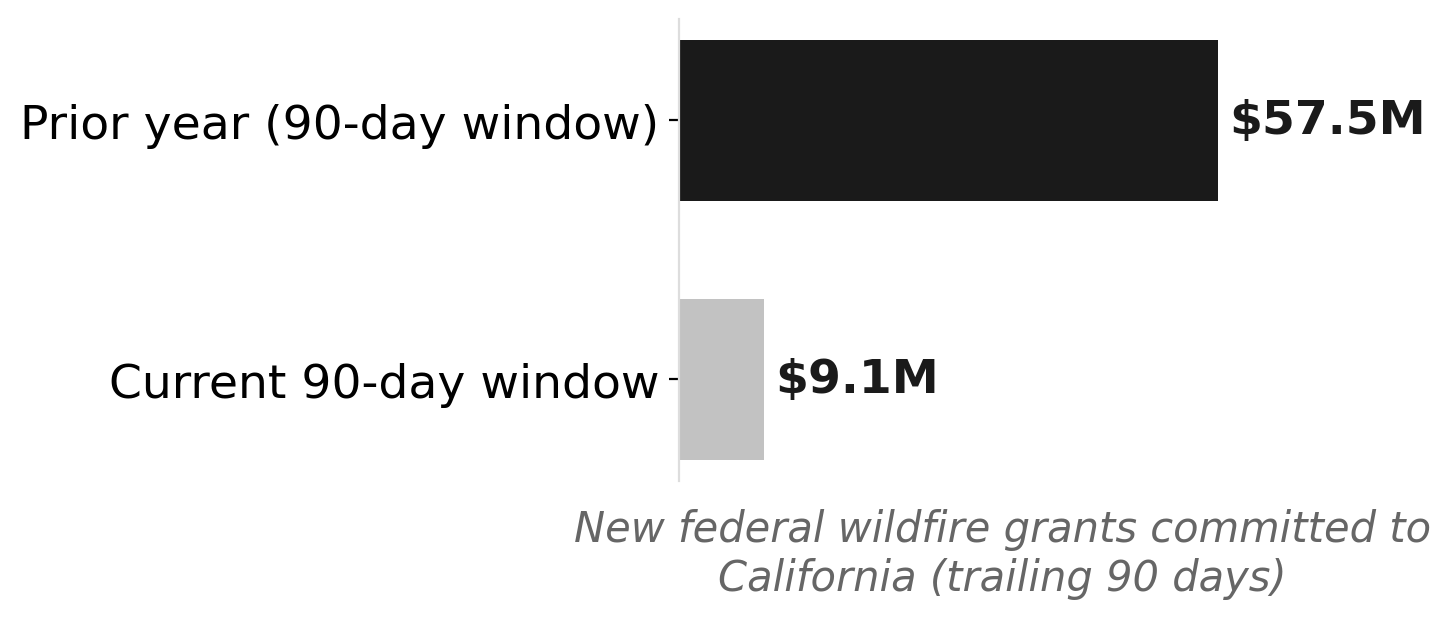
Federal wildfire prevention grants newly committed to California have fallen to $9.1 million in the past 90 days, down 84% from $57.5 million in the same window a year ago. The drop comes not because California's fire risk has eased, it comes eight months after the Palisades and Eaton fires caused tens of billions in damages across Los Angeles, but because the federal programs Congress built to fund exactly this kind of prevention work are being dismantled.
The why is specific. Two distinct federal programs drove last year's baseline, and both are effectively gone. The USDA Forest Service's State, Private, and Tribal Forestry account, a $283 million discretionary program that channeled State Fire Capacity grants, Volunteer Fire Assistance, and related funding through state forestry agencies, was proposed at zero dollars in the Trump FY2026 budget and again in the FY2027 request. Separately, the Community Wildfire Defense Grant program, a competitive grant initiative funded by the Bipartisan Infrastructure Law that directed money to communities and tribes for fuels reduction in wildland-urban interface zones, awarded its final round nationally in September 2025, exhausting its five-year, $1 billion IIJA authorization. These are two different mechanisms serving different recipient classes, but the result in California's grant pipeline is the same: the tap has closed.
USDA Forest Service Chief Tom Schultz made the stakes plain in Senate testimony this past June, telling members that states should prepare to receive zero discretionary dollars from the State, Private, and Tribal Forestry program in FY2026. DOGE had already begun pausing awards under these programs in January and February 2025, stopping new commitments months before any formal budget action. The effect in California was immediate and concrete: the prior-year window was defined by a concentrated batch of large operational awards, a $7 million CWDG grant to Truckee Fire Protection District, $7 million to Mariposa County Resource Conservation District, $6 million to Trinity County RCD, and roughly a dozen similar fuels-reduction commitments landing in a single October-November 2024 cycle. The largest wildfire-specific operational grant committed to California in the current 90-day window is $400,000, to the Idyllwild Fire Protection District under the USDA Wildfire Crisis Strategy Landscapes program. Most of the $9.1 million total consists of NSF and HHS university research awards that mention wildfire incidentally.
Source: NationGraph.
The collapse is not a California-specific story. Nevada fell from $117 million in new wildfire grants during the prior window to $2.2 million now. Oregon dropped from $34 million to $3.9 million. The uniformity across western states points to a nationwide program shutdown, not any shift in how individual states or communities are applying. As the Center for Western Priorities has documented, the proposed elimination of the SPTF account would cut $76 million in State Fire Capacity grants alone, funding that flows directly to CAL FIRE, state forestry agencies, and local fire departments for prevention and preparedness work that federal land managers do not perform.
California still carries roughly $444 million in active, currently running wildfire-related federal grants, led by the California Department of Forestry and Fire Protection at $167 million, with additional active awards from HHS, USDA, and Interior. That portfolio represents years of previously committed money still being drawn down on multi-year projects. The problem is the pipeline feeding future commitments, not the reservoir of money already under contract.
Senator Alex Padilla, co-chair of the bipartisan Senate Wildfire Caucus, has introduced more than ten wildfire-related bills since the LA fires, including provisions in the Senate Fix Our Forests Act, and pressed Schultz directly on the administration's failure to finalize state fire assistance funding ahead of its own August 15 deadline. Senate Appropriations Committee Chair Susan Collins has noted that Congress holds the power of the purse, signaling potential resistance at the appropriations level. But no enacted FY2026 spending bill has restored the SPTF account, and the FY2027 Trump budget proposal, released in April 2026, again proposed to eliminate it entirely and transfer all wildfire management to a new U.S. Wildland Fire Service housed at the Department of Interior.
California has partially responded with its own CAL FIRE grant programs and state appropriations, and fire-safe councils across the state are pursuing whatever federal research and mitigation dollars remain available. But state programs are operating at a different scale. The $1 billion that the Bipartisan Infrastructure Law dedicated to community wildfire defense over five years, a program that put tens of millions into California communities for fuels reduction, home hardening, and evacuation planning, has no direct state-level analog at that magnitude.
The next signal to watch is the Senate appropriations process. If Congress passes a full-year FY2027 spending bill that restores any portion of the SPTF account or creates a new vehicle for state fire assistance, the grant pipeline could reopen. If it does not, or if the government runs on another continuing resolution, the current near-zero pace of new federal wildfire prevention commitments in California is likely to hold through another full fire season.